Why Article 50 is no big deal for the pound

The government has confirmed that Article 50 will be triggered on Wednesday 29th March, just before Theresa May's self-imposed deadline of the end of Q1. This means that we will leave the EU, with or without a trade deal, at the end of March 2019. The pound fell to session lows in the hour after the news, but the question now is, how much further can GBP fall, and is all of the "bad" Brexit news priced in?
Knee-jerk reaction to Article 50?
In fairness, we think that today's dip in the pound is just a knee-jerk reaction to the Article 50 news, and part of sterling's decline is also due to the recovery in the dollar and US Treasury yields, 10-year yields are back above 2.5%. But it is worth watching how the pound performs in the next day or two, if GBPUSD can find support ahead of 1.2350 – a key short-term support level- and recoup today's losses then it would be a bullish signal for GBP for this reason: the pound is failing to react to "bad news". Last week the pound actually rallied although the Scottish leader said she will hold a second independence referendum, this is significant as markets that don't fall on what is perceived as bad news can often rally in the aftermath.
GBP benefitting from a less hawkish Fed
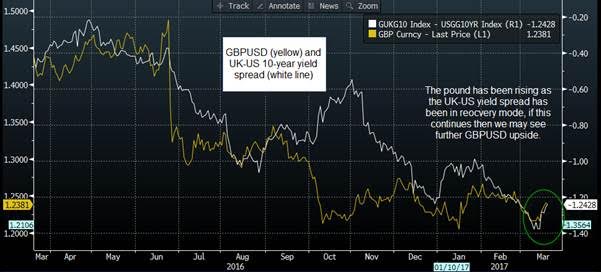
The other reason to be positive on the pound is the recovery in the UK-US yield spread, which had fallen to a record low at one point last week. This spread has narrowed by 13 basis points since last week's BOE meeting. This may not sound like a lot, but in the bond market this move is a big deal, and, if it continues to recover, could trigger a further recovery in GBP/USD, see figure 1 below. Overall, both of these factors suggest that the bad news could be priced in for the pound. The stock market is also worth watching, the FTSE 250, which is sensitive to Brexit risks, has also picked up off the lows on Monday, suggesting that the Article 50 news is only a minor blip for UK asset prices.
Other risks for the pound
This does not mean that the pound is not without risks, it is just that the Brexit negotiations, at least in the short-term, is not one of them. There are a couple of risks for sterling that are worth noting; firstly, retail sales data on Thursday. UK inflation is expected to rise to 2.2% on Tuesday, if rising prices is hurting the consumer, then we could see GBP take a knock.
Optimistic for a constructive EU negotiating partner
The second risk to sterling is the EU negotiating team's response to Article 50, which we should know by end of April at the latest. This will be crucial to set the tone for exit negotiations and trade deals with the currency bloc. The optimist in me says that the EU won't want to play hardball, not at this stage, and instead will want to kick off negotiations in a pleasant manner. However, this is based purely on my own gut feeling and not fact. If I'm correct then the pound could rally, if instead the EU decides to delay talking about a trade deal, or sounds aggressive in its approach to Brexit negotiations then we could see sterling nose-dive. While we don't expect Brexit to be trouble-free, perhaps it won't be as bad as some, including us, feared last year?
FX risks elsewhere could protect sterling
It is also worth noting that there are risks for other currencies this week too, including the first French Presidential debate tonight, if Far Right candidate Le Pen puts in a strong performance then this could knock the euro. The dollar could also suffer this week from political risk. The US FBI director is scheduled to testify to the US Congress on the extent of Russia's involvement with the US election; if there is any link that Trump colluded with the Russians to weaken Hillary Clinton's campaign then his political position will become tenuous and could knock the dollar. This is worth watching later on Monday.
At this stage, we still believe that the pound could continue its recovery and any dip in sterling could be met with buying interest. 1.2740 – the 200-day moving average could be on the cards in the medium-term.
Author
Kathleen Brooks
XTB UK
Kathleen has nearly 15 years’ experience working with some of the leading retail trading and investment companies in the City of London.