What's next for GBP/USD? A look at the second half of 2024

We're already halfway through 2024, and the volatility of GBP/USD has been unusually low. What can we expect in the second half of the year? Now is the perfect time to explore the GBP/USD outlook for H2 2024.
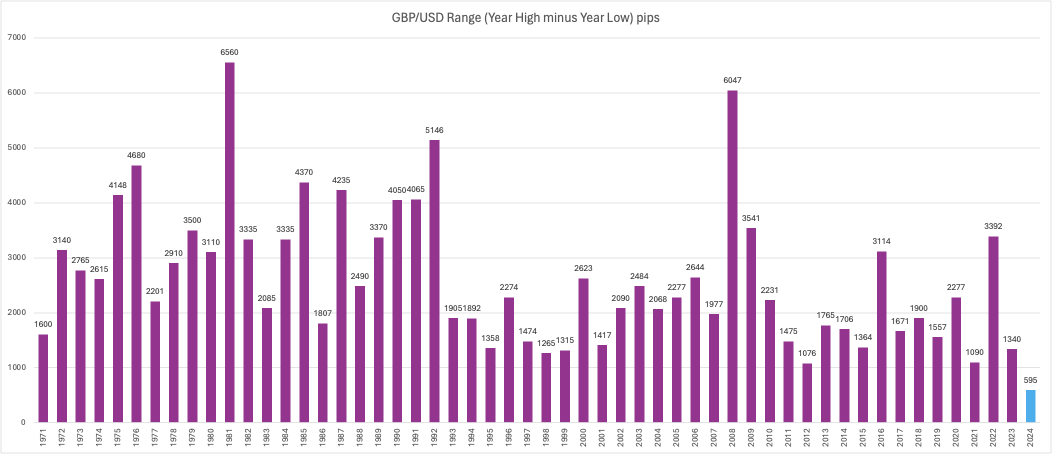
Source: Tradingview
Let's review the historical fluctuation range of GBP/USD from 1971 to 2023. Typically, the difference between the annual high and low (the range) averages about 1600 pips. The range has reached a maximum of 6560 pips and a minimum of 1076 pips. As of May 10, 2024, the year-to-date fluctuation is only 595 pips, indicating potential for further movement.
If this trend continues, there could be an additional movement of 400 to 1000 pips either up or down, depending on whether the yearly high or low has been established. For instance, if 1.23 represents the lowest point this year, the GBP might rise to around 1.33. Alternatively, if 1.29 is the peak for the year, a drop of 1000 pips could bring the low to about 1.19. if minus 1600 pips from the year-to-date high, the GBP/USD could even test 1.13 support. The chart below illustrates these scenarios.
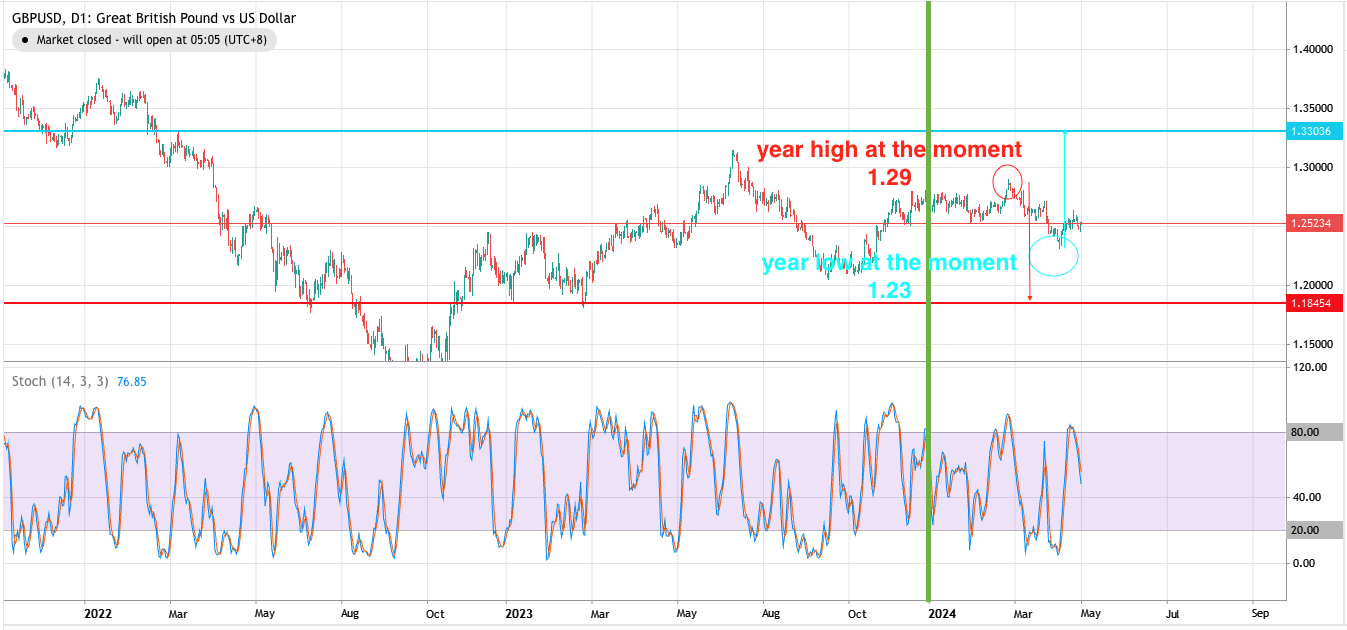
Source: deriv MT5
Now, we need to determine whether GBP/USD will trend upwards or downwards in the H2 of 2024.
Last Thursday, the Bank of England (BoE) announced that its Monetary Policy Committee (MPC) voted 7-2 to maintain the interest rate at 5.25%, a 16-year high. Deputy Governor Dave Ramsden and Swati Dhingra argued that an immediate rate cut is necessary due to the delayed effects of monetary policy and the potential for inflation to decrease more than expected. The BoE indicated that future rate decisions will be guided by forthcoming data and their implications for persistent inflation. Currently, strong wage growth and service price inflation, both hovering around 6%, present risks of pushing inflation above the target of 2%.
Before the announcement, investors were speculating whether the BoE would align with the European Central Bank’s planned rate cuts in June or opt for a delay similar to that of the U.S. Federal Reserve. Markets had almost fully priced in a modest BoE rate cut for August. Additional cuts expected later in the year could potentially reduce the bank rate to 4.75%, with further cuts anticipated in 2025.
As a result, the interest rate differential between the UK and the US is expected to widen, especially since the Federal Reserve tends to delay rate cuts. This will likely exert downward pressure on GBP/USD.
Low unemployment rates and high job vacancies in 2022 and 2023 indicated a tight labour market, with most people who wanted to work being employed. This made recruitment more challenging than usual. The situation was exacerbated by an increase in the number of economically inactive people since the start of the pandemic and following Brexit.
The strikes in the UK have not only impacted productivity but also prolonged the easing of inflation.
More than a quarter of UK homeowners with fixed-rate mortgages are facing a sharp increase in their monthly payments before the end of 2024. This is likely to affect consumer demand in the second half of the year. In fact, retail sales across the UK fell by 1.5% in May as the cost of living crunch hampered demand, according to the British Retail Consortium (BRC).
One in five counties in the UK is likely to declare bankruptcy within the next 15 months. This situation will not only lead to reduced government spending but also necessitate tax increases, further diminishing consumer spending.
The UK will hold a general election in the second half of 2024. According to recent YouGov polls, the popularity of the Conservative Party continues to slide. This political uncertainty is likely to weaken GBP/USD until the election results become clear.
Unless the Federal Reserve implements a significant reduction in interest rates—which seems unlikely given the current data and information—the UK is poised for a slower economic recovery compared to the US. Coupled with lower interest rates, this situation is likely to push GBP/USD towards a lower target.
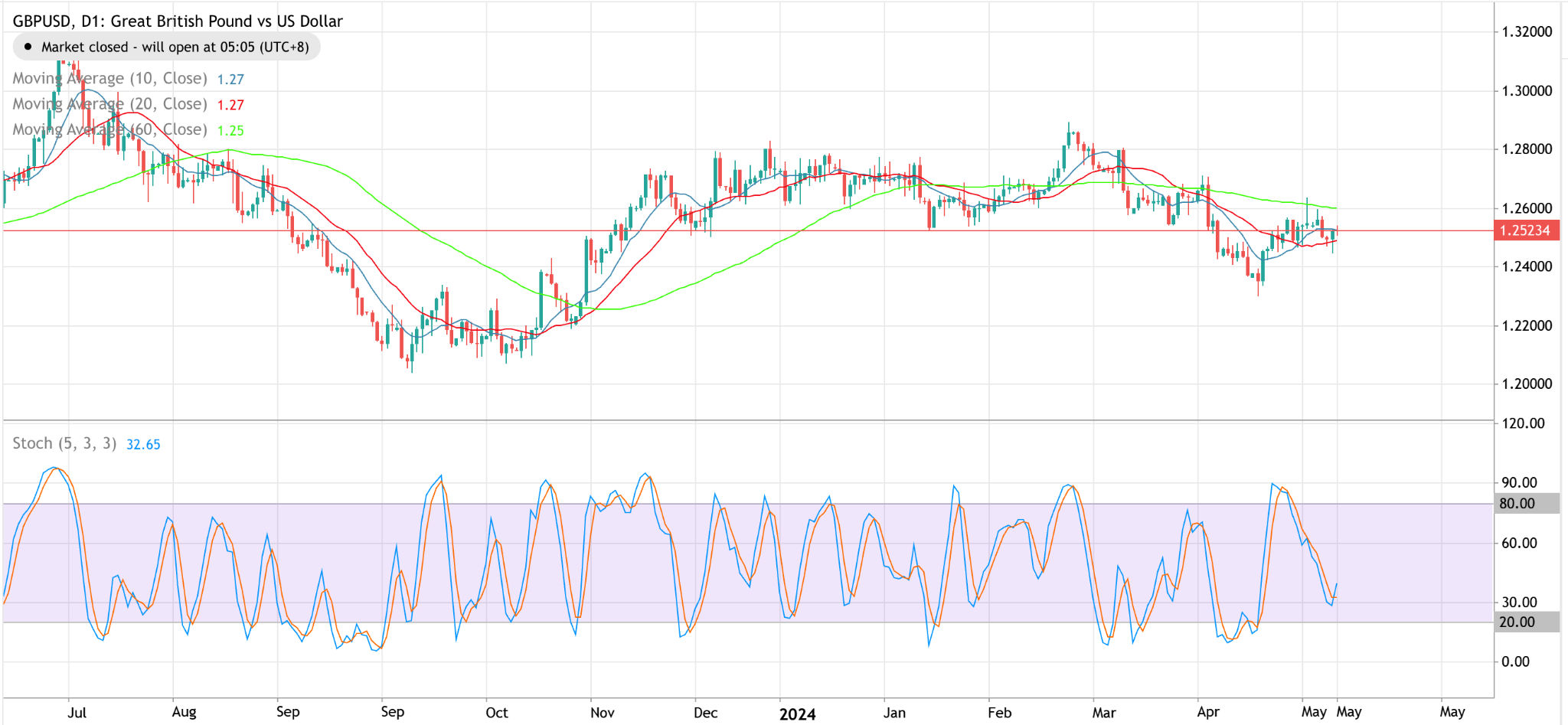
Technical analysis in short term
Source: deriv MT5
In the short term, the GBP/USD pair has encountered resistance at the 60-day moving average and found support at the 20-day moving average. Recently, there has been a shift in the price trend of GBP/USD from primarily staying above the 60-day moving average in the second half of 2023 to currently trending below it. Additionally, the stochastic indicators have not yet turned negative, suggesting that there is no immediate downside risk and the currency pair continues to experience range-bound movement.
Conclusion
The UK economy faces several challenges that might weaken the GBP compared to the USD. High employment and job vacancies have tightened the labour market, with added pressures from Brexit and the pandemic. Strikes are further reducing productivity. Additionally, over a quarter of UK homeowners will see higher mortgage payments by late 2024, likely lowering consumer spending, as already seen in recent declines in retail sales. Financial issues are worsening, with one in five UK counties at risk of bankruptcy soon, possibly leading to government spending cuts and higher taxes. Political uncertainty from the upcoming 2024 general election could further destabilise the economy. Moreover, the Bank of England is expected to cut interest rates before the US Federal Reserve, likely increasing the interest rate gap and causing funds to shift from the GBP to the USD.
Author
Prakash Bhudia
Deriv
Prakash Bhudia, HOD – Product & Growth at Deriv, provides strategic leadership across crucial trading functions, including operations, risk management, and main marketing channels.