What would a Republican sweep mean for Gold and Treasury yields?
The United States (US) midterm elections, scheduled for November 3, could trigger a major repricing of the US Dollar (USD), Treasury yields, and Gold, but the outcome is not predetermined. With all 435 House seats and 35 Senate seats up for grabs, the vote will serve as a referendum on Donald Trump's presidency, and prediction markets currently price in a roughly 60% chance of a Democratic sweep, about 30% for a divided Congress, and have almost priced out a Republican sweep. Because Congress shapes taxes, spending, government borrowing, and scrutiny of Federal Reserve (Fed) appointments, the result could push long-term yields, and Gold along with them, decisively in either direction. The key Gold levels to watch sit around $4,000 on the downside and $4,500 on the upside.

What the midterms can (and cannot) change
The US midterm elections take place on November 3. With all 435 House seats and 35 Senate seats up for grabs, the US midterms will serve as a referendum on Donald Trump's presidency, with control of Congress, the cost of living, and the ongoing Iran war dominating voters' concerns. Republicans currently hold narrow majorities in both chambers. Democrats need to gain seats in both chambers to secure control of Congress.
Why does this matter to financial markets? Because Congress has a major role in shaping taxes, spending, healthcare policy, government borrowing, and the legislative agenda. A change in congressional control could make it harder for the White House to pass new legislation. It could also increase scrutiny of the administration's policies and appointments.
But traders need to understand one important distinction: a midterm election changes the balance of political power, not the presidency itself. Even if Democrats gain control of Congress, existing policies would not automatically disappear. A divided government could limit new legislation while leaving the administration with considerable influence over trade, sanctions, and foreign policy.
That means the market reaction may depend less on who wins and more on what investors believe the result means for economic growth, inflation, government debt and the Federal Reserve. The election result alone won't tell us how financial markets would react — what matters is how markets are pricing the three possible outcomes.
Scenario one: The Democratic sweep, the market's base case
Currently, prediction-market pricing gives a Democratic sweep a probability of approximately 60%, although these odds can change before election day. At first glance, investors might expect this outcome to weaken the US Dollar because it would constrain Trump's legislative agenda. A Democratic-controlled Congress could restrain additional tax cuts and spending without necessarily reversing the administration's existing policies. A Democratic Senate could also increase scrutiny of Fed appointments, potentially limiting the administration's influence over the central bank and easing concerns about its independence.
If markets interpret the outcome as a more restrained fiscal path, Treasury yields could face some downward pressure. That could support Gold by reducing the opportunity cost of holding a non-yielding asset. However, one important factor remains. If the administration responds by relying more heavily on tariffs, sanctions, or other executive measures, uncertainty could remain elevated. Depending on the reaction across major currencies and bond markets, the USD could still strengthen against some peers. So don't automatically buy Gold just because Democrats win. Watch the US Dollar and Treasury yields after the result.
Scenario two: Democratic House, Republican Senate
Prediction-market pricing puts the probability of Democrats winning the House while Republicans retain the Senate at roughly 30%. This would create divided government and make major legislative changes more difficult. The White House could face greater congressional scrutiny, but Congress would not automatically reverse its existing policies. This scenario could broadly be neutral for the USD and US Treasury markets.
For Gold, that suggests the election result alone may not generate a sustained trend. Instead, traders may return their attention to the Federal Reserve, inflation, energy prices, government debt, and geopolitical developments. In other words, political headlines could create short-term volatility, but the broader macroeconomic backdrop would still determine whether Gold can establish a lasting move.
With a divided Congress, the election may deliver less of a clear fiscal signal. A Republican sweep, by contrast, could change expectations for spending, borrowing and inflation.
Scenario three: The Republican sweep, the biggest repricing risk
This outcome could produce the biggest market repricing, as markets have largely priced it out. A Republican sweep could give the administration greater room to pursue its legislative agenda, including additional fiscal stimulus. If investors anticipate stronger growth, higher government borrowing or more inflationary pressure, they could demand higher yields on longer-dated US Treasuries. That could support the USD if markets interpret the yield rise as a sign of stronger growth or tighter monetary policy. For Gold, this could create a significant headwind.
Are higher yields confidence, or fiscal concern?
Another factor could matter more than the election headline itself: the cost of financing US government debt. When Treasury yields rise, the government pays more to borrow as it issues new debt or refinances maturing obligations. Higher yields can also feed through to borrowing costs across the wider economy, including mortgage rates.
A month before the vote, the US average 30-year fixed mortgage rate climbed to 7.49%, its highest level since November 2023, according to data from the Mortgage Bankers Association. The rise came as Treasury yields increased amid inflation concerns, geopolitical uncertainty, and the government's substantial financing needs.
Why should Gold traders care? Because higher long-term borrowing costs can tighten financial conditions across the economy. More expensive mortgages can weigh on housing demand. Higher financing costs can also pressure businesses and government budgets. If investors believe a Republican sweep will lead to more borrowing and fiscal stimulus, long-term yields could rise further. Initially, that could support the US Dollar and pressure Gold.
But a second possibility exists: If yields rise because investors grow increasingly concerned about government debt, fiscal sustainability, or the credibility of US economic policy, the USD may not strengthen as expected. Gold could benefit if investors turn to it as a store of value or a hedge against broader financial uncertainty.
This is the central question traders should ask: Are higher yields reflecting confidence in the US economy or growing concern about the US fiscal outlook? The answer could determine whether Gold falls or proves unexpectedly resilient.
Gold's technical picture: The burden of proof is on the bulls
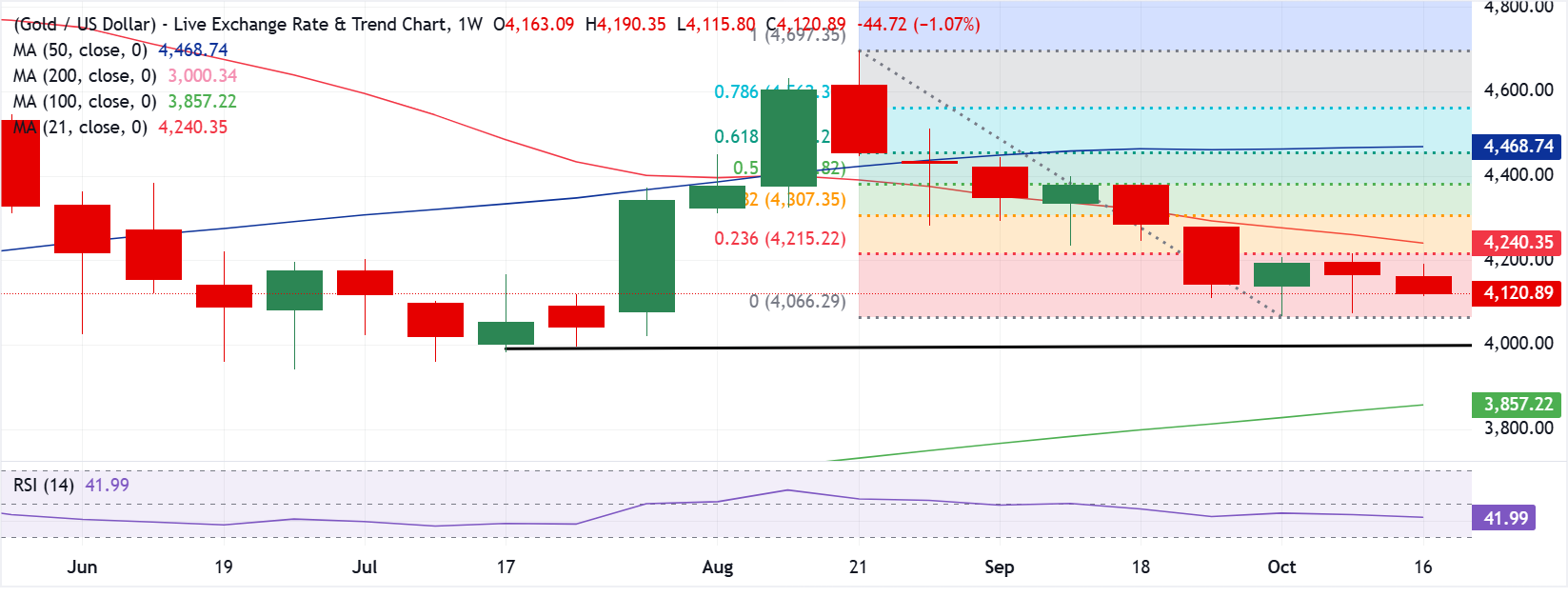
Gold's weekly chart shows that the medium-term recovery remains unconfirmed. The Relative Strength Index (RSI) is below the neutral 50 level. This suggests momentum remains weak, though the market is not necessarily oversold. More importantly, Gold is trading below two major weekly moving averages. This alignment puts the burden of proof on the bulls.
The first major support is at the psychological $4,000 area. A hotly contested election, a Republican sweep that lifts expectations for fiscal expansion, or a stronger USD could add pressure, but the bearish scenario would need confirmation from price action. A break below $4,000 would be a more significant deterioration in the technical picture. Traders would then target the 100-week Simple Moving Average (SMA) near $3,850, followed by $3,800.
On the other hand, in a Democratic sweep, investors would expect more fiscal restraint, lower long-term yields and reduced uncertainty around the Fed's independence. Then, the yellow metal could attempt a recovery. Gold first needs to reclaim the $4,215-$4,250 area. That's the confluence zone of the 23.6% Fibonacci retracement of the decline from $4,700 and the 21-week SMA. Above that, the next hurdle is the $4,400 zone, where the 50% Fibonacci resistance and the psychological level intersect. A sustained move above the resistance zone would improve the recovery case and open the door to the $4,460 region, where the 61.8% Fibonacci hurdle and 50-week Simple Moving Average align. The next resistance comes in at $4,500.
Recapturing those levels would provide stronger evidence that the recovery is gaining traction.
If the election produces political gridlock and neither party can materially change the fiscal outlook, Gold could remain range-bound between $3,850 and $4,400. Investors could then refocus on inflation, the Fed's policy path, energy prices and economic growth.
Beyond the ballot: three risks for Gold traders
The chart gives us the key levels: $4,000 and $3,850 below, and $4,400 and $4,460 above. However, Gold traders must watch three risks.
- First, the Federal Reserve. If inflation stays elevated and policymakers signal further tightening, Gold could struggle even if election-related uncertainty increases.
- Second, geopolitical developments. A possible escalation involving Iran is an upside risk for the US Dollar. Depending on the nature of the shock, Gold could also attract safe-haven demand.
- Third, the US debt ceiling. Difficult negotiations in 2027 could create volatility in short-dated Treasury bills and broader financial markets.
These risks show why it is dangerous to assume that one election result will dictate Gold's direction for months. Markets respond to the full policy and economic consequences, not just the political headline.
The bottom line
The US midterm elections could trigger a major repricing of the US Dollar, Treasury yields, and Gold, but the outcome is not predetermined. A Republican sweep could raise fiscal-expansion concerns and pressure Gold if yields and the US Dollar rise. Democratic gains could limit new legislation and support Gold if yields ease. A divided Congress could leave markets focused on the Federal Reserve and the wider economic outlook.
Technically, watch $4,000 and $3,850 on the downside, and $4,400 and $4,460 on the upside. Don't trade the election headline. Trade the confirmed reaction.
(This article was created with the help of an Artificial Intelligence tool and reviewed by an editor. Know more.)
Author

Dhwani Mehta
FXStreet
Residing in Mumbai (India), Dhwani is a Senior Analyst and Manager of the Asian session at FXStreet. She has over 10 years of experience in analyzing and covering the global financial markets, with specialization in Forex and commodities markets.

















