What will influence the value of Gold in 2023?

Whether or not to invest in Gold depends on your financial goals, risk tolerance, and trading strategy. However, many professionals recommend dedicating a part of your portfolio to Gold, as it can be a good investment given that it’s a tangible asset that retains its value over time. Additionally, it can serve as a hedge against inflation and is a safe haven in times of economic or political uncertainty.
There are different ways to invest in Gold: you can buy physical or digital Gold, you can buy shares of Gold miners, you can also use ETF to be exposed to Gold or trade Gold over the short-term with financial derivatives like those offered by the regulated broker, ActivTrades: CFD or Contract For Difference.
If you’re thinking about adding Gold to your portfolio, let’s have a look at what can influence the price of Gold in 2023.
A price analysis of Gold
Like most commodities, the price of an ounce of Gold reached a new high during the first quarter of 2022 with the war between Russia and Ukraine. However, prices of Gold traded downward from April until November, when it reached a yearly low of approximately $1,617, bringing the price of Gold close to its April 2020 levels. Since then, prices have gained around 10% and investors are wondering whether or not the yellow metal could reach the $2,000 level next year.
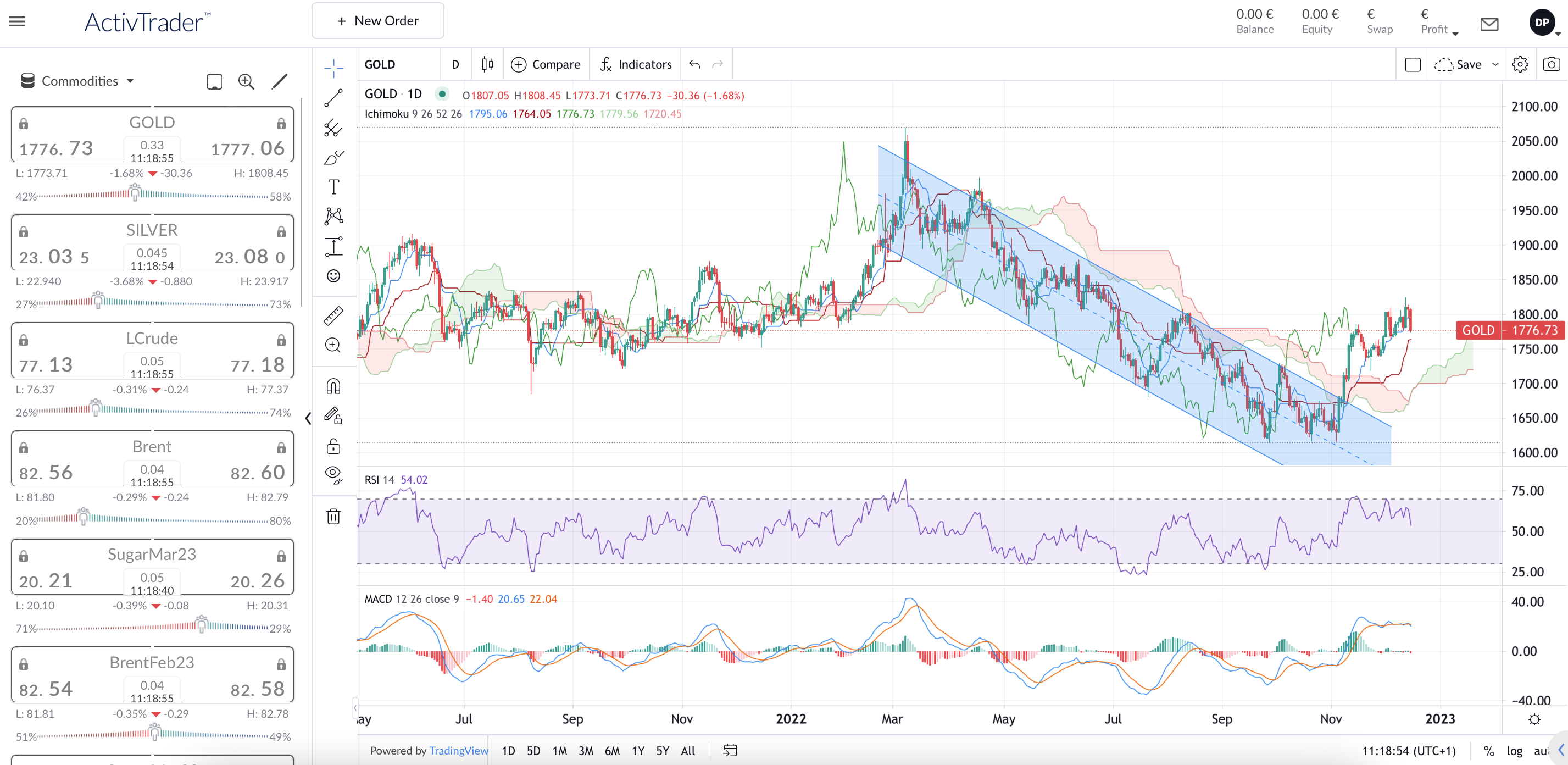
Daily Gold Chart - Source: ActivTrades’ online trading platform (ActivTrader)
A reminder of what makes the price of Gold move up and down
A wide range of factors may have an effect on the price of Gold, such as supply and demand, interest rates, the value of the American Dollar, sanitary conditions, especially regarding the COVID-19 in regions like China, and political as well as geopolitical happenings, like the war in Russia.
Supply and demand are two of the primary forces that are responsible for determining the price of Gold. Because Gold is a finite resource, its price has a tendency to rise in response to increased demand for it. For instance, if there is an increase in demand for Gold jewellery or investments backed by Gold, the price may rise to accommodate this need. On the other hand, the price of Gold may decline if there is an increase in the supply of Gold, or if there is a reduction in the demand for it.
Interest rates are another significant variable that may have an effect on the price of Gold. The opportunity cost of keeping Gold falls when interest rates are low, so Gold becomes a more appealing investment option during these times. As a direct consequence of this, there is a possibility that the demand for Gold would grow, hence driving up its price. On the other hand, when interest rates are high, the opportunity cost of keeping Gold rises. This means that Gold becomes less appealing as an investment when interest rates are high, especially as other safe investments are available and offering a yield, like US government bonds. This might result in a decline in the demand for Gold, which would then lead to a decrease in its price.
In addition, the price of Gold may be influenced by political events. For instance, if there is political instability or uncertainty in a large Gold-producing area, this may cause investors to seek safe havens for their money, or it could disrupt Gold production, which in turn may cause the price of Gold to increase. In a similar vein, if a nation that has a sizable amount of Gold reserves declares that it intends to sell a sizable percentage of that Gold, the amount of Gold that is available on the market may grow, which may result in a decline in the price of Gold - and vice-versa.
Higher inflation and uncertainty about global growth prospects could support Gold prices (or weight on it)
In times when there is a lot of uncertainty about the path that economic growth will take, or when there is a lot of volatility in the financial markets, Gold is often thought of as a safe haven asset. In the case of higher inflation, it is also frequently considered the investment vehicle of choice - and inflation has reached unseen levels in decades in many countries in 2022!
Nevertheless, Gold has performed poorly while inflation was reaching record levels. Why? Because it all depends on the monetary policy that is in place in relation to the inflation level.
The Federal Reserve intervened many times during the year 2022 in an effort to offset the considerable increase in inflation levels. Because of this, the Federal Reserve has significantly raised interest rates, which has the effect of making government bonds (which are also an asset that is considered a safe haven) more appealing than Gold.
This is due to the fact that bonds give returns, but Gold does not offer any. When investors look for investments that are less risky, they turn away from Gold and into bonds, which then weighs on the price of Gold.
Gold prices are supported by a weakening US Dollar
Because of the Federal Reserve's recent aggressive monetary policy tightening cycle, the value of the US Dollar has strongly increased in 2022. This is because higher interest rates are attractive to international investors who are searching for better investment possibilities. The returns on investments in dollars go up in tandem with the rate of inflation (when interest rates rise).
In addition to this, investments in USD generate more profits in comparison to investments in nations that have interest rates that are lower. Because they bring in a greater number of investors, those investors purchase a greater quantity of USD in order to make their investments, which drives up demand and, as a result, supports the value of the greenback.
However, the strength of the US Dollar puts downward pressure on the price of Gold, as both assets have a negative correlation, which means that their values often move in the opposite direction of one another. As the value of the dollar increases, the price of Gold tends to decrease since it becomes more costly for individuals holding other currencies to buy Gold, and the opposite is true when the dollar value decreases.
Recently, the USD lost ground, which has supported the price of Gold. After increasing by over 28% towards record levels in September 2022, the value of the Dollar Index dropped by around 8% in the last quarter of 2022 so far.
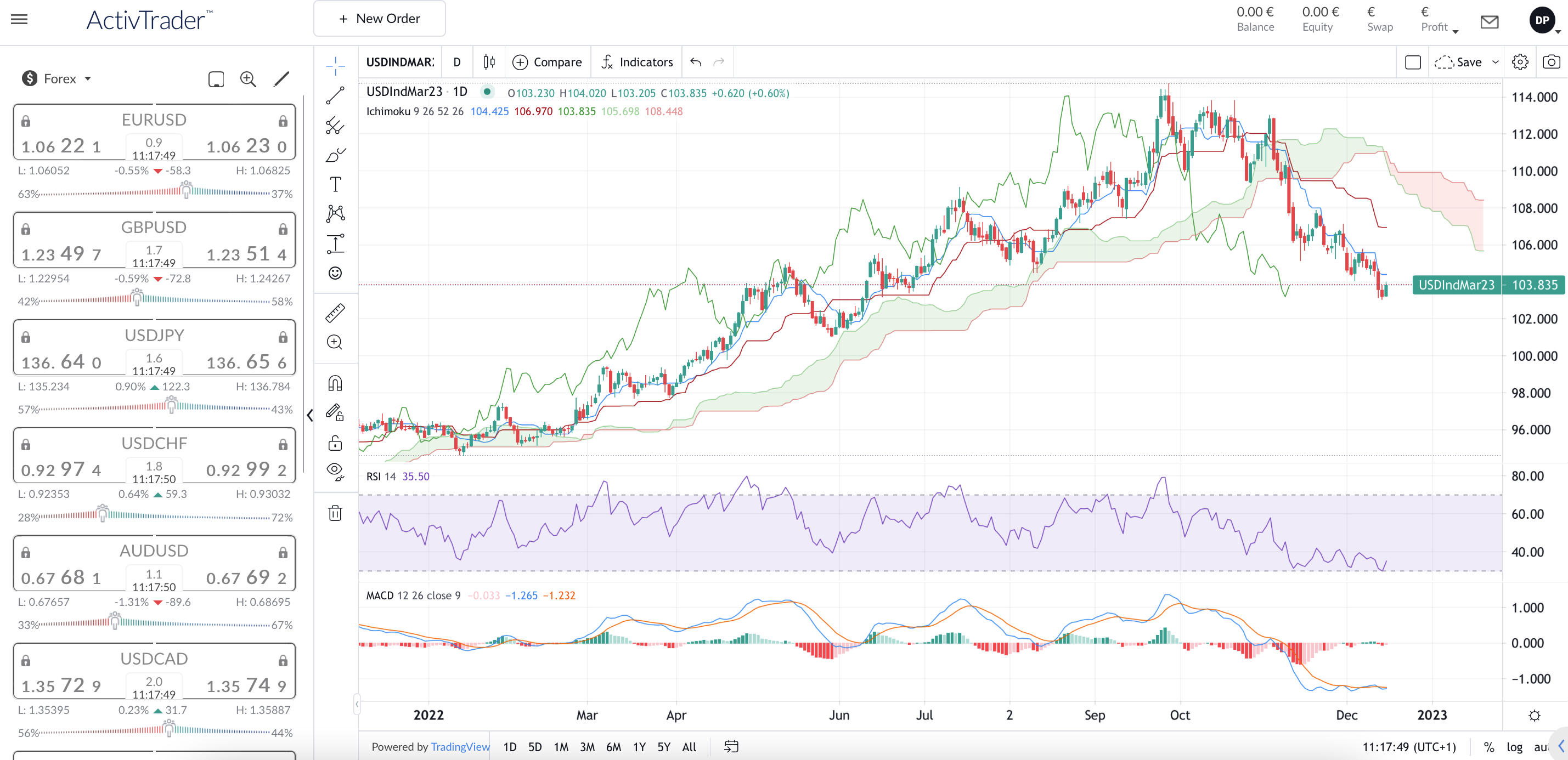
Daily Dollar Index Chart - Source: ActivTrader powered by TradingView
What to expect for the price of Gold in 2023
Because of the numerous unknowns surrounding the future of inflation, monetary policies across the globe, and global GDP, it is highly possible that the price of Gold will be subject to some degree of volatility in the year 2023.
The price of Gold may increase because of growing inflation, or simply because of the acceptance of such high inflation over the medium to long term, particularly if rate rises slow down or even halt entirely. As the possibility of a worldwide recession becomes more likely to materialise, the demand for the yellow metal may also increase.
In addition, the shifting attitude of policymakers towards global geopolitical conflicts (the "war economy mentality") may encourage them to prioritise stockpiling Gold rather than keeping foreign currency reserves in order to support their reserves.
Stay up to date with what's moving and shaking on the world's markets and never miss another important headline again! Check ActivTrades daily news and analyses here.
Author

Carolane de Palmas
ActivTrades
Carolane graduated with a Masters in Corporate Finance & Financial Markets and got the AMF Certification (Financial Markets Regulator in France). Afterward, she became an independent trader, investing mostly in European and American stocks/indices.