What the UK election means for Brexit

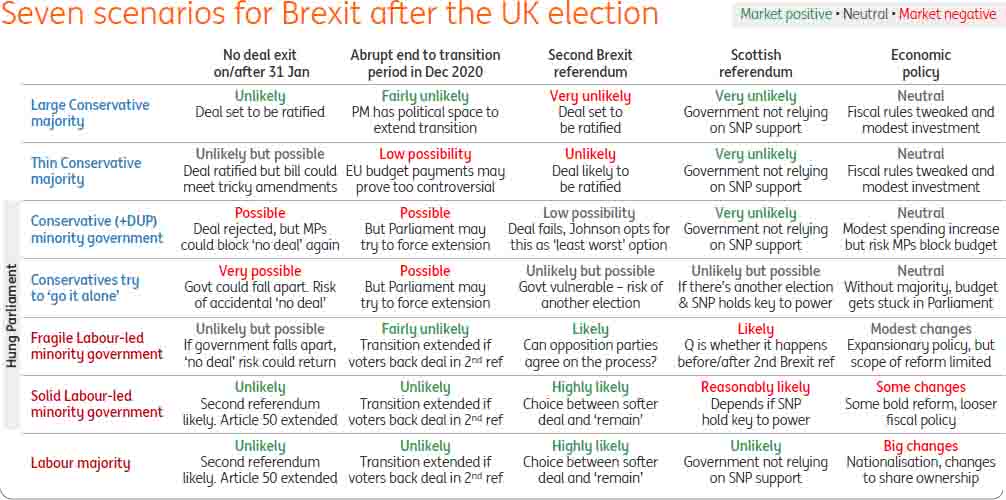
Large Conservative majority
Easy to pass withdrawal agreement bill and UK leaves EU at end of Jan.
Crucially it could also give Johnson the political breathing space to extend the transition period and commit to the associated EU budget payments.
Equally if the government decides it doesn't want to extend the transition, it could be very hard for MPs to force an extension repeat ‘Benn bill' attempts will be tough.
Thin Conservative majority
Brexit deal ratified and the UK to leave the EU at end of Jan, although the legislation could be vulnerable to amendment (MPs trying to set the direction of trade talks).
Johnson could also have limited room to manoeuvre on extending the transition period politically challenging to sign up to extra EU budget payments.
May increase the risk of an abrupt single market/customs union exit in Dec 2020.
Solid Labour led minority government
Conservatives fail to secure majority. Labour gains more seats than expected, so has more scope to build a stable working majority with other parties (most likely using an informal confidence and supply deal).
Second referendum happens perhaps on an accelerated timeline. Article 50 extended.
Either UK remains in the EU, or leaves with a deal (likely ‘softer' than Johnson's). 2 nd Scottish referendum may be avoided if Labour can govern without SNP involvement.
Fragile Labour led minority government
Labour government heavily reliant on multiple parties to support a thin working majority focused only on key policy areas
Second referendum still likely, but scope for disagreement over the question and process. The type of deal that is put forward in a referendum will also be controversial.
Likely that Labour will be reliant on SNP support a second Scottish referendum more likely. Question is when: 2020 or 2021?
Conservative (+DUP) minority government
Conservatives fail to gain a majority. Party secures DUP support (or less likely Brexit Party) but this requires wholesale changes to the deal. Realistically, this three way UK DUP EU deadlock is unlikely to be broken
This leads to more uncertainty and an elevated ‘no deal' risk at the end of Jan, echoing September/October impasse
Conservatives try to ‘go it alone'
Conservatives get the most seats but fall short of a majority and fail to find a partner in Parliament. Labour also can't form a government. Impasse continues, maybe leading to another election. ‘No deal' risk rises'
Labour majority
Labour defies the odds and gains enough seats. Party still likely to push for a second referendum, but bigger focus for markets will be on their economic campaign pledges (e.g. nationalisation, share ownership)
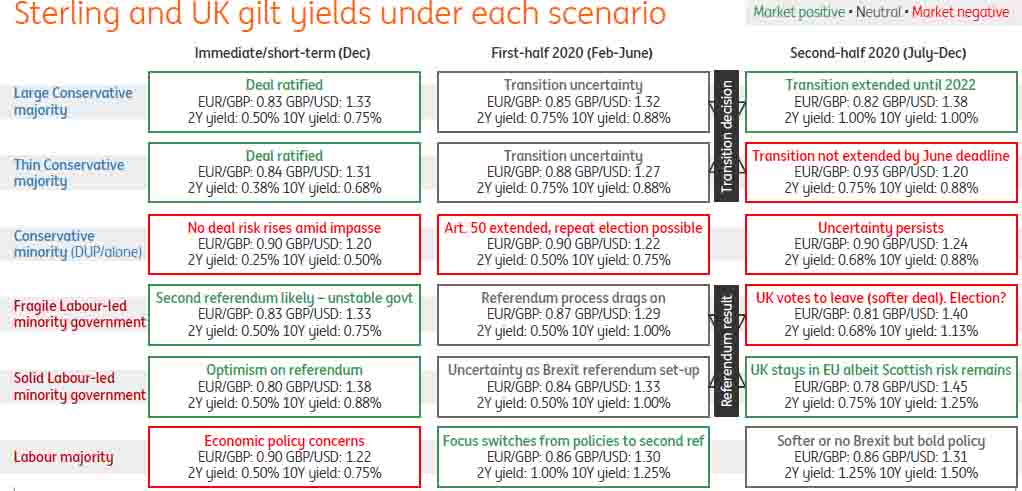
Read the original analysis: What the UK election means for Brexit
Author
James Smith
ING Economic and Financial Analysis
James is a Developed Market economist, with primary responsibility for coverage of the UK economy and the Bank of England. As part of the wider team in London, he also spends time looking at the US economy, the Fed, Brexit and Trump's policies.

















