What the buck is up with the dollar this year?

Dudley Dursley: [on his birthday] "How many are there?"
Uncle Vernon: "36, counted them myself. "
Dudley: "36! But last year, last year I had 37!"
- Harry Potter and the Sorcerer's Stone, 2001
Based on the market's early reaction to today's strong Non-Farm Payrolls report, investors are acting a bit like Harry's stuck-up cousin Dudley.
According to the Bureau of Labor Statistics, the US economy created 235K net new jobs, well above economists' expectations of 200k new jobs. Crucially, the details to the report were similarly strong:
-
The U3 unemployment rate fell by 0.1% to 4.7%
-
The U6 unemployment rate fell to 9.2%
-
Average Hourly Earnings grew at a 2.8% rate over the last year
-
The Labor Force Participation Rate ticked up to 63%
-
Average Hours Worked held steady at 34.4
-
Revisions to previous reports were negligible
If you were one of the last holdouts expecting the Federal Reserve NOT to raise interest rates next week, it's time to abandon your position and join the consensus.
Much like Dudley's 36-present-a-year pace, it's easy to become accustomed to the drumbeat of solid jobs data when it comes month after month, but it's truly amazing how prolonged and consistent the US jobs recovery has been. The US economy has created jobs for a record 77th consecutive month, and based on this month's report, the trend shows more signs of accelerating that reversing at this point.
What the buck is up with the dollar?
Given the strong macroeconomic backdrop and tightening monetary policy, you would expect the world's reserve currency to be gaining more ground today. You would be wrong.
The dollar index is actually ticking lower in a bit of a "buy the rumor, sell the fact" reaction as the market's "whisper" expectations for the jobs report were even higher. Taking a step back, the US Dollar Index is also trading lower by about 2% so far this year, despite a dramatic hawkish revision to the projected path of the Fed Funds rate:
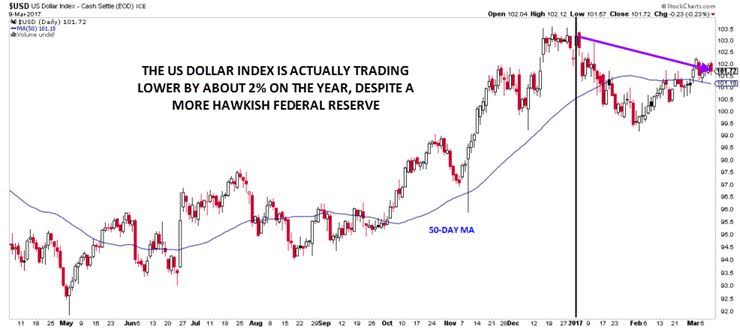
So what gives? In our view, the dollar's relative "underperformance" is part a function of the specific timeframe highlighted. The turn of the year marked the peak of the so-called "Trump Reflation Trade" where FX traders were projecting their most optimistic outlooks on to the new administration. Since then, the realities of governing, namely the likely delay in pro-growth economic policies like a massive infrastructure bill and tax cuts, have taken their toll.
In some ways, the dollar's performance represents a broader theme that we've been watching: the shift in the market's focus from monetary to fiscal policy. After nearly a decade in "The Golden Age of the Central Banker," investors need a new catalyst to drive US assets higher.
Even if economic data allows the Federal Reserve to raise interest rates three times this year, an outcome that's about 60% priced in to the futures markets according to the CME's FedWatch tool, traders may hesitate to drive the greenback substantially higher unless some progress is made on the government's economic goals which could boost growth prospects for years to come.
Perhaps Dudley Dursley was more insightful than we realized: he immediately identified a change in the trend of his ever-rising birthday presents and did everything he could to arrest the trend, in his case by throwing a fit. There's a chance dollar bulls could get the same idea if the Trump Administration puts off its pro-growth economic goals for too long...though it's unclear if Trump and company would play along!
Author

Matt Weller, CFA, CMT
Faraday Research
Matthew is a former Senior Market Analyst at Forex.com whose research is regularly quoted in The Wall Street Journal, Bloomberg and Reuters. Based in the US, Matthew provides live trading recommendations during US market hours, c