Week ahead: The split-screen market — Where AI fever meets Fed fatigue

The split-screen market
The market feels like it’s running on two monitors — one flashing with the manic glow of AI euphoria, the other dimmed by Powell’s steady hand on the throttle. The S&P 500 closed October with its sixth straight monthly gain, up 2.3%, but it doesn’t feel like a victory lap. This rally is resilient, yes — but also restless. Traders are watching the tape like pilots flying into cloud cover: the instruments say “climb,” but the gut says “watch your altitude.”
Powell’s latest delivery didn’t exactly calm the cabin. A quarter-point cut came through on schedule, but the chairman’s tone was anything but dovish — his “not a foregone conclusion” line about December landed like a mild threat. The market had already baked that cut in as certainty, and now it’s staring at a data-dependent horizon.
Meanwhile, corporate America keeps punching above its weight. Roughly 83% of S&P 500 companies have beaten estimates so far, with profits tracking a near-14% annual gain — a remarkable showing considering the policy backdrop. But the issue isn’t growth, it’s gravity: valuations are now straining the upper deck. The S&P’s forward P/E has crept past 23x — its highest altitude since the dot-com bubble.
As I put it late Friday — earnings have to carry the rally now; valuations have already done all the stretching they can. And of course, there’s no shortage of bears arguing that the holiday cheer has already been spent early — the future borrowed to fund the present. That’s little more than opinionated balderdash, but I’ll tell you this: the last time tech looked this can’t-lose, it did. Market concentration keeps on climbing, hitting a new record print of 42%. Big Tech keeps taking over the world — the Magnificent 7 just extended their breakout against the rest of the S&P 500 this week.
Still, history has a sense of humor. Since 1950, whenever the S&P has been up more than 15% through October, it’s gone on to finish higher in 20 of 21 cases. November and December have historically been the two most generous months for equity returns — the so-called “Santa Rally Trade.” So maybe the sleigh still has fuel left. But the air up here is thin, and we’re now relying on earnings thrust, not multiple expansion, to keep the climb going.
The AI story remains the market’s most intoxicating and misunderstood variable. Meta and Microsoft sold off despite promising growth — investors are finally asking how much that promise costs. Alphabet and Amazon, by contrast, reassured the street that their cash flow can handle the spend. The message from Silicon Valley is clear: the AI arms race isn’t cooling; it’s entering the capital-expenditure endgame. AMD, Qualcomm, and Palantir will carry that baton next week — the next checkpoint in proving whether AI can convert hype into hard returns.
Meanwhile, macro conditions abroad stay uneven. The RBA will likely hold steady; Korea’s exports keep humming; Taiwan’s trade is booming; Japan’s wages are finally catching a bid; China’s trade growth looks set to cool again; and the Philippines risks slipping into a policy funk after corruption-linked spending cuts. It’s a reminder that Asia’s growth mosaic still shines, but with cracks around the edges.
Back in the U.S., the government shutdown keeps the macro dashboard half-dark. Traders are forced to rely on alternate data — ADP prints, job cuts, consumer sentiment — to read the pulse. Amazon’s 14,000 headcount reduction made waves, feeding the narrative that labor softness may quietly be building under the surface.
So here we are — a market both overbought and under-trusted, running on faith and feedback loops. AI keeps the lights on, the Fed keeps the guardrails up, and traders keep playing both sides of the split-screen. The rally’s resilience isn’t just about liquidity or data — it’s about belief. The market’s learning to live with paradox: fear and FOMO, caution and conviction, all flickering together on the same screen.
When the river runs narrow
If you ask any index trader on the street, they’ll tell you the biggest issue we’re dealing with right now is concentration risk — plain and simple. The tape looks unstoppable, but it’s being carried by the same seven names that have been pulling the cart all year. The S&P 500 isn’t so much a market anymore as it is a reflection of Big Tech’s heartbeat.
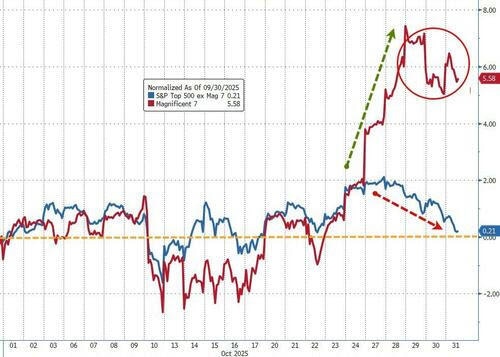
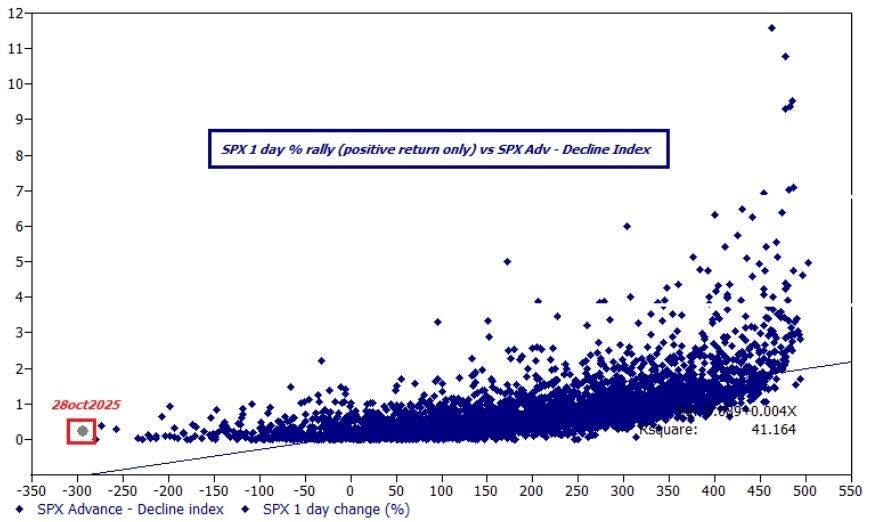
You can see it in every breadth chart and feel it in every desk conversation. The Nasdaq just logged back-to-back 5% months, but last Tuesday’s advance-decline ratio hit the narrowest reading in S&P history. That’s not a rally — that’s a funnel. Liquidity has pooled at the top, leaving the rest of the index gasping for oxygen.
The mega-caps have turned into the entire market’s gravity field. Amazon and Google are doubling down on cloud, Microsoft’s still compounding at near-40% growth, and Meta — love it or hate it — just saw $125 billion of bond demand. That’s not normal financing; that’s a statement of faith. Nvidia hitting $5 trillion didn’t shock anyone on the floor — it just confirmed the new order: capital-light, compute-heavy, and valuation-insulated.
Yet here’s the paradox: even with all that, U.S. equities haven’t been the standout global performers this year. Japan is back in the game, and Europe is quietly rebooting its industrial soul. Airbus, Thales, and Leonardo are merging their satellite arms; ENEL’s becoming an AI-era power play. The old world’s not asleep — it’s recalibrating.
But the risk in a narrow rally is always the same. When just a handful of names carry the load, the entire market becomes a balancing act on thin ice. Credit keeps flooding toward AI and hyperscale infrastructure, but elsewhere, funding is drying up. This isn’t about bubble-spotting; it’s about fragility recognition. The system looks powerful — until it doesn’t.
So enjoy the spectacle, but stay nimble. The boats at the front are massive, the wake is violent, and the river beneath is getting shallower by the day. When the leaders shift course, everything downstream will feel it. That’s the reality of trading in 2025 — liquidity flows uphill, and the river runs narrow.
The whisper before the cut
The Fed’s internal debate is starting to sound like a string section tuning before a major performance — a few discordant notes, the faint edge of tension, but the melody is clear enough: Christopher Waller still hears the rhythm of a December cut.
When one of the Fed’s more academically wired pragmatists steps up and says “the data is telling me to cut,”
The Fed has already trimmed rates twice, a sequence that looks less like a pivot and more like a controlled descent. Waller is simply arguing to stay the course — to follow the glidepath rather than pull the nose up too early. His reasoning is rooted in the classic central-bank playbook: inflation, at 2.5%, isn’t mission accomplished, but it’s close enough to the target to stop treating every data point like a fire alarm.
And then there’s the tariff noise — the new Trump administration’s favorite lever for reshaping global trade flows. Waller all but brushed it off. He framed tariff effects as transient, like a gust that rustles the surface of inflation data but doesn’t change the underlying current. To him, the bigger threat isn’t the price of imported steel — it’s the prospect of a labor market that goes soft faster than policymakers react.
The political backdrop adds a layer of intrigue. Waller, a Trump appointee now floated as a potential successor to Powell, is effectively auditioning for a second act. His message — “cut now, before the slowdown becomes structural” — is not just economic logic; it’s political oxygen for an administration trying to keep growth alive without reigniting inflation.
In the market’s language, this is a forward-vol trade on policy risk. Every hint of a December cut fuels the front end of the curve and keeps risk assets comfortably funded. But it’s also a tell: the Fed is not fighting inflation anymore, it’s negotiating with it. The hawks are still circling, but the doves are already rehearsing the landing.
So Waller’s comment isn’t a soundbite — it’s a signal. A reminder that the Fed’s credibility now depends not on how long it can hold rates high, but on how gracefully it can normalize without breaking the economy’s spine. Traders have seen this movie before: when the labor data weakens faster than inflation cools, the debate isn’t whether the Fed can cut — it’s whether it will be soon enough.
December, then, isn’t just another meeting. It’s the moment when the orchestra stops tuning and starts to play.
Author
Stephen Innes
SPI Asset Management
With more than 25 years of experience, Stephen has a deep-seated knowledge of G10 and Asian currency markets as well as precious metal and oil markets.

















