Week Ahead on Wall Street (SPY) (QQQ): Bear market rally is back but could it become a new bull
- Equity markets end the week higher as risk appetites are back.
- Bitcoin bounces sharply to drag in more trend followers.
- Tuesdays CPI data point the highlight of the week ahead.

Equity markets bucked a three-week losing run when they closed higher on Friday and completed a positive week for all the leading indices. Talk of 75 basis points failed to dent enthusiasm as investors flocked to all sectors including oil. Oil prices had taken a severe downturn last week as fears grew for the health of the global economy. But some further words of encouragement about supply cuts from OPEC+ and in-line economic data convinced oil bulls to return. The US SPR being drained even further was taken as a further bullish sign for oil as traders see it as needing replenishing sooner rather than later. Even Europe's energy woes could not dent the bullish enthusiasm and at least German electricity prices collapsed somewhat but are still sky high compared to this time last year. The ECB stepped up to the plate and swung for the bleachers when announcing its biggest rate hike ever, 75 bps, which seems to be the favorite number from central bankers these days. So is this rally the bottom or yet another bear market rally? Well, the last squeeze moved lower but failed to set a new low (so far). So the potential is definitely there for a bottom. But historically things don't really bottom in this type of environment.
The S&P 500 currently trades at 18x NTM earnings.
— David Marlin (@Marlin_Capital) August 31, 2022
Still a significant premium to the historical valuation $SPY has traded at during periods of high inflation.$QQQ $AAPL $TSLA $NVDA $MSFT pic.twitter.com/DnMOCEKSAQ
#Earnings are so deviated from the long-term growth trend either earnings and #profits will revert to the long-term trend (high profits should attract competition) or #capitalism is entirely broken.
— Lance Roberts (@LanceRoberts) September 9, 2022
h/t @ISABELNET_SA pic.twitter.com/aCfIgGJdnX
So neither of these tweets looks too promising. Also see below from Goldman, there may be a bit more pain to come.
Thanks to @scott_matagrano for flagging this GS piece. If the past is any guide, my ballpark above of us being in just the 3rd inning of this Bear might even be overstated. pic.twitter.com/1youNKx8k7
— Michael Kao (@UrbanKaoboy) September 8, 2022
Oh yeah here's another point for the bears.
— JE$US (@WallStJesus) September 9, 2022
But short term we may see some buying pressure if CTA's jump in.
The bad news: CTA one week net change in positioning is one of the largest net selling in US equities over the last 5 years.
— zerohedge (@zerohedge) September 9, 2022
The good news: if stocks can keep it above 4,000, they start buying aggressively next week. pic.twitter.com/3VKBXtUFnp
And we have all gotten too bearish again it looks like.
AAII Bulls back below 20%https://t.co/NKe1a2nyza pic.twitter.com/jW6zIHLgkR
— JE$US (@WallStJesus) September 9, 2022
But, there's always a but!
Up-volume days of greater than 90% are significant and historically point to much better days ahead. The S&P 500, Nasdaq-100, and NYSE Comp all were 90%+ Friday, while under the 200-ma. See the summary table below for what historically happened after. $SPX $SPY $QQQ $NDX $NYA pic.twitter.com/lwcC4hltww
— Jonathan Harrier, CMT (@jonathanharrier) September 10, 2022
That looks more promising, ok back to max confusion then. It really all boils down to what is priced in. Markets are expecting a Fed pivot soon and lower interest rates. If that assumption is incorrect the bottom is not in. However, we may not get to know that for some time so it does set the scene for a rally into year-end. If inflation does indeed prove sticky and rates are higher for longer we will not find out until next quarter. Right now it seems likely inflation will certainly come down as oil prices have fallen and so too most other commodities. Any inflation print showing the top is in will be seized by bulls. It will take longer to see if it is sticky. It does seem that markets are a tad optimistic in forecasting inflation to collapse to 2% within 18 months. But for now, the likely data will be supportive.
SPY forecast
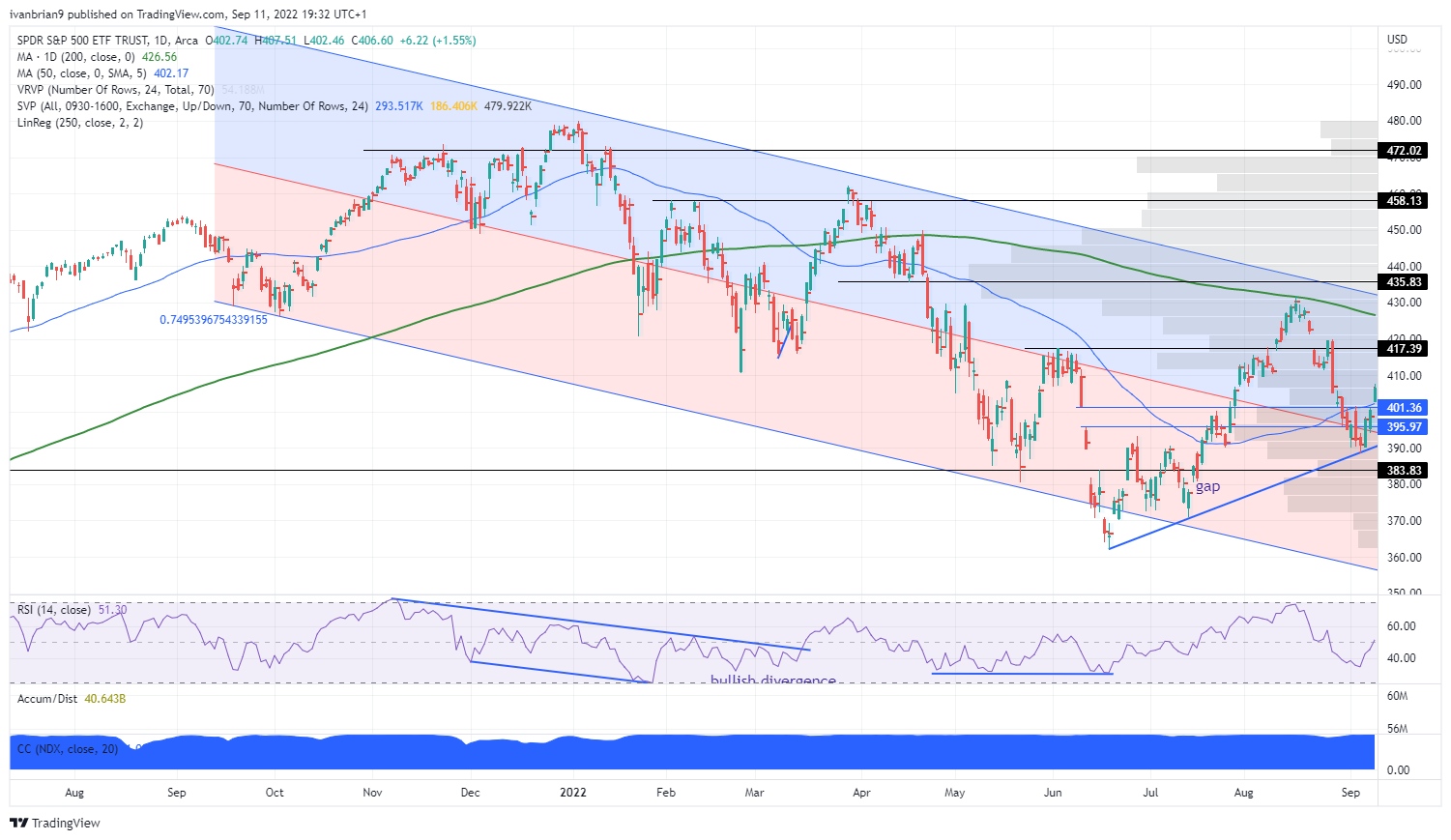
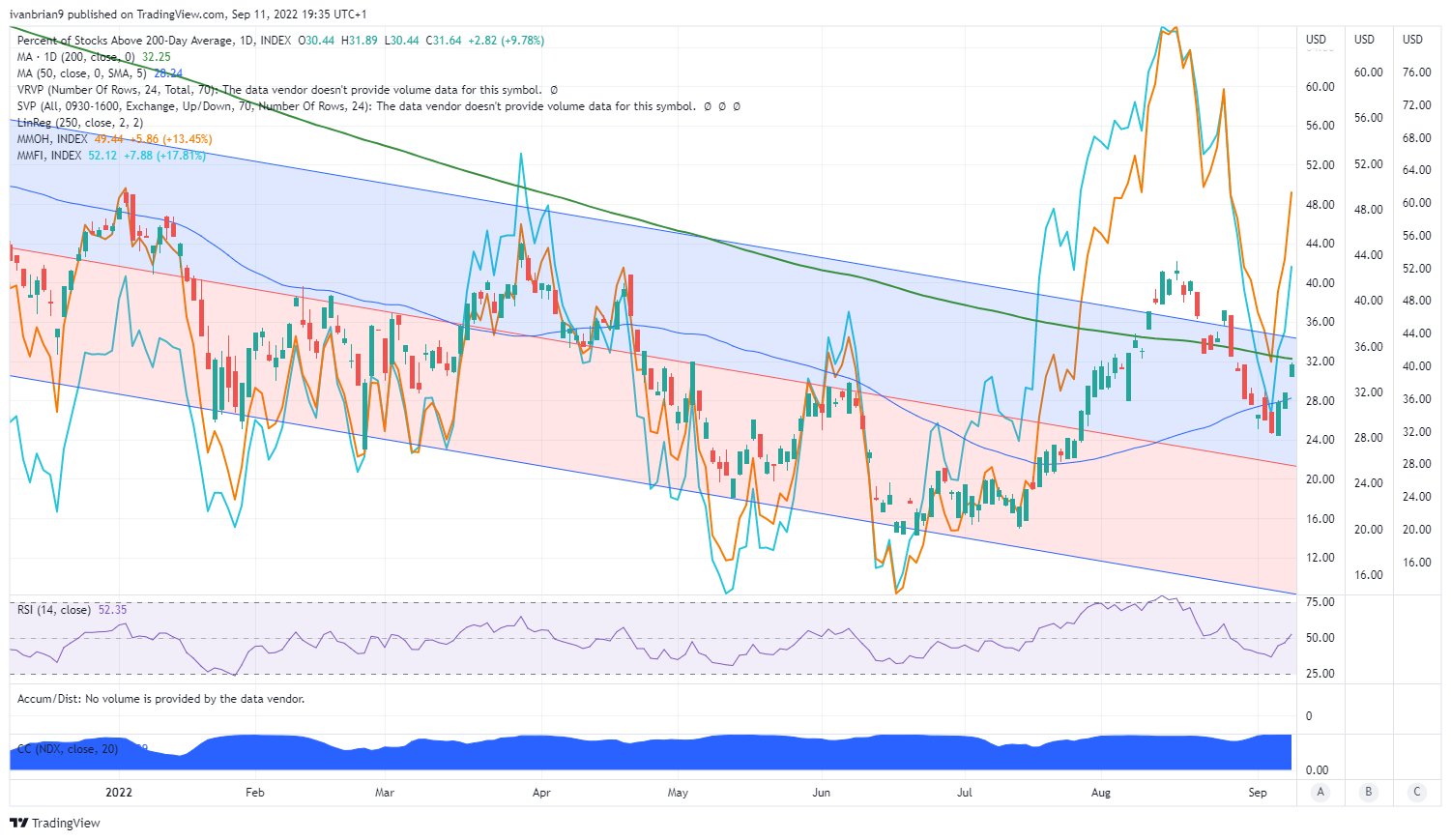
So this looks promising. We had a bear market rally, it failed and we fell back. But so far we set a higher low. The next phase is crucial. Can the SPY retake the 200-day moving average? If it does then we likely make a new high above $430. Market breadth is improving. Chart below shows stocks above 200, 100, and 50-day moving averages.
Earnings week ahead
#earnings for the week https://t.co/lObOE0dgsr $ORCL $ADBE $AKTS $DOOO $CNM $LICY $RENT $MTRX $TNP $EPM $PL $ADSE $ASPU $VWE $IREN $INNV $MMMB $HITI $MYTE $IRNT $BQ $CNTB $BRZE $VNCE $RFIL $KSPN $ERYP $LPTH $IPHA pic.twitter.com/ee6GZfvU5e
— Earnings Whispers (@eWhispers) September 10, 2022
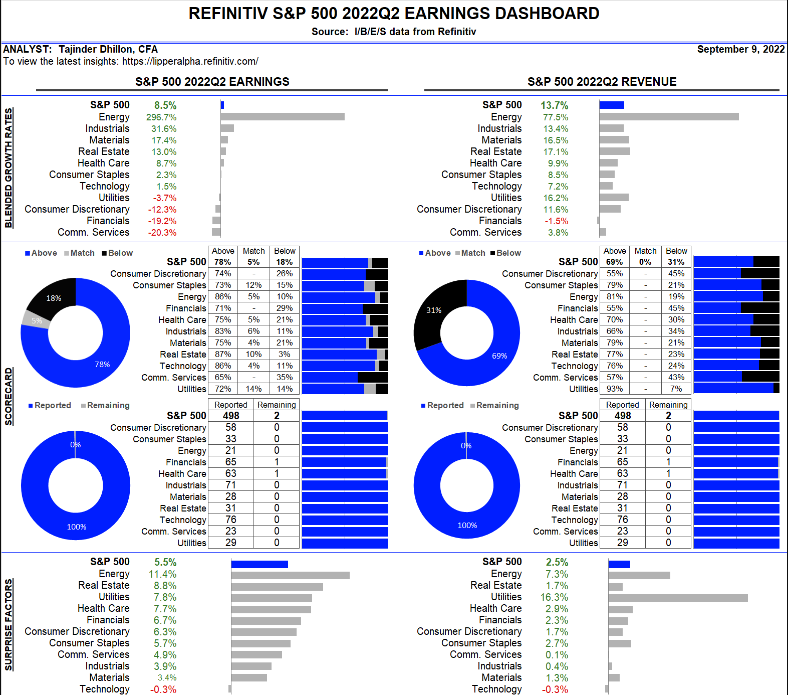
498 companies from the S&P 500 have reported earnings, so I think we can call it. Below is the latest from Refinitiv Lipper Alpha. No surprise, energy leads the way. Still strong beat rates across the board but already estimates are being revised down for Q3. Technology growth rates are nearly flat, just as well the S&P 500 isn't full of tech, oh wait!
Source: lipperalpha.refinitiv.com
Economic releases
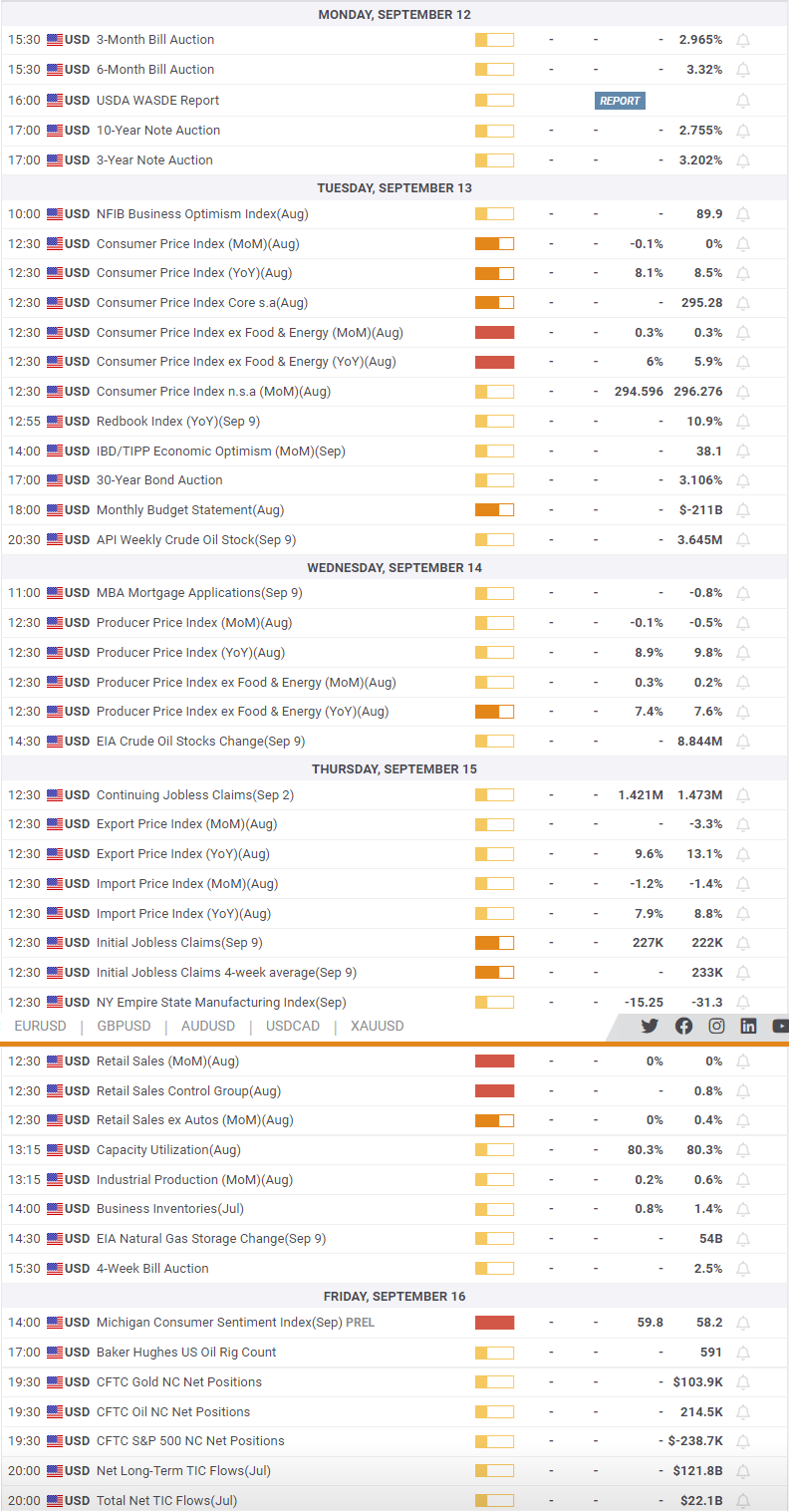
With Monday the last day ahead of CPI expect it to be a quiet one and I would now expect some profit taking. CPI is the big data point of the weak and expectations are for it to ease and show we have reached peak inflation. If it doesn't and we haven't then look out below. Have a great week all.
Author

Ivan Brian
FXStreet
Ivan Brian started his career with AIB Bank in corporate finance and then worked for seven years at Baxter. He started as a macro analyst before becoming Head of Research and then CFO.
















