We are in the midst of a plague of uncertainty and anxiety


Today we get the US trade report (both goods and services) plus some Fed speeches. We have a death of hard data and need to wait for the Reserve Bank of New Zealand overnight tonight.
The stock market is not the economy, except when we have no hard data and then it may be a decent proxy. Reuters has a column today saying just that. “That may sound flippant, but the connection between U.S. equity prices, consumer spending and economic growth is strengthening. By some measures, it has never been stronger.
“This helps explain one of economists' big 'misses' this year: stubbornly resilient U.S. consumption. They seem to have underestimated the powerful, positive feedback loop of gravity-defying strength on Wall Street and consumer spending, the so-called wealth effect.
“U.S. households have rarely been richer and have never had so much of their wealth in the stock market. The epic rally in equities is therefore making a lot of Americans feel a lot richer, increasing their propensity to spend. This is particularly true of the wealthiest households, who account for an outsized share of consumer spending.”
What about that softening labor market? “Consumption may always be driven by the wealthy, but that's especially true today. The richest 10% of Americans account for around half of all consumer spending, which itself represents around 70% of all U.S. economic activity.” Will they keep spending? “The answer is likely "yes." Economists at Goldman Sachs reckon that positive wealth effects may be strong enough to support consumer spending growth over the next year, especially after it gets a boost from the Trump administration's tax cuts.”
What about those dreadful consumer confidence indices? Ah, but those are ordinary people, not the rich. And if confidence were low, the savings rate should be rising—but it’s not. What about the tech bubble? Well, nobody knows.
The most interesting thing about this Reuters article is the boatload of Wall Street banks and brokers whose opinions are citied. Clearly this is the Wall Street point of view. And since we do not know if and when the stock market will collapse, we can’t say they are wrong.
Forecast
We are in the midst of a plague of uncertainty and anxiety. For FX, that means risk-off and therefore, whatever safe-haven still clings to the dollar. In this moment, the political mess in France and the prospect of a Thatcherite PM in Japan are dominating. The dollar is up because those currencies are down, not because anyone approves of what is happening in the US. (How weird is cities suing the president?) Since no end is in sight on those matters, we must expect more of the same, for a while, at least.
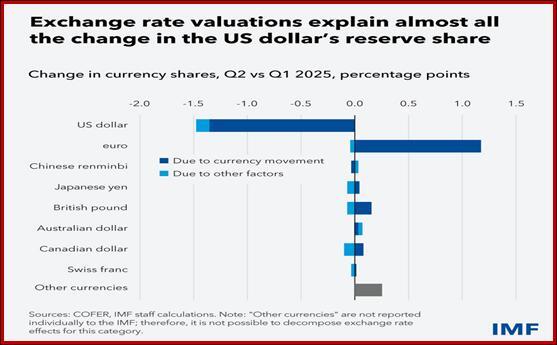
So-There Department: Searching for a handy chart to update the IMF reserve currency chart in the Chart Package, we ran across an article on the IMF website pointing out that nearly all of the seeming loss of dollar reserve dominance is due to the dollar devaluation since Trump took office. See the table from Dollar’s Share of Reserves Held Steady in Second Quarter When Adjusted for FX Moves.
“This year, exchange rate shifts have been noticeable.
-
The DXY index—a benchmark measure of the US dollar’s performance against the euro and the currencies of Japan, the United Kingdom, Canada, Sweden, and Switzerland—fell more than 10 percent in the first half of the year, its biggest drop since 1973.
-
The dollar depreciated by 7.9 percent against the euro in the second quarter, and by 10.6 percent in the first half.
-
It fell by 9.6 percent against the Swiss franc in the second quarter, and by more than 11 percent in the first six months, its weakest first-half performance against the franc in more than a decade.
“This means that even if central banks made no changes to their portfolios, the value of their non-dollar holdings—when expressed in dollars—increased, resulting in a corresponding decrease in the share of dollar holdings.
“At first glance, the raw data suggest a drop in the dollar’s share of allocated reserves to 56.32 percent at the end of the second quarter from 57.79 percent at the end of the first quarter, down 1.47 percentage points. However, by holding exchange rates constant, its share would have fallen only slightly to 57.67 percent.”
We still haven’t found a clever pie chart. If you have one, please send.
Tidbit: Bloomberg’s Authers had this yesterday on the LDP party vote that chose the Iron Lady: “The sight of the ruling party treating the political situation as an emergency and doing what voters want is positive in the eyes of investors. The LDP is a minority government, its polling numbers are terrible, and voters are furious about inflation, so it’s encouraging to see that those in power understand this.
“As for investors, their immediate reaction was to sell the yen and buy stocks. The currency had its worst day since US-China trade armistice in May was announced.”
Authers points out the probability of a BoJ rate hike fell from 56% last week to 20% yesterday. Technically the LDP party leader and/or PM cannot fire the head of the BoJ, whose terms ends in 2028. Sound familiar?
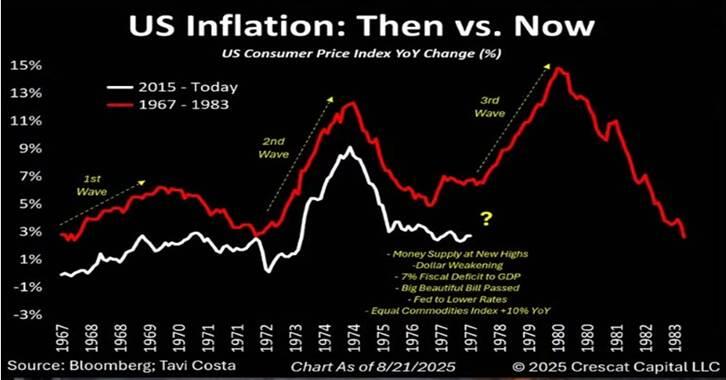
Food for Thought: We ran across this Bloomberg chart. We have very little confidence in the idea of cycles or of history repeating itself—usually the data has to be jiggered pretty hard to make a chart like this. But golly, the factors are lining up, are they not?
This is an excerpt from “The Rockefeller Morning Briefing,” which is far larger (about 10 pages). The Briefing has been published every day for over 25 years and represents experienced analysis and insight. The report offers deep background and is not intended to guide FX trading. Rockefeller produces other reports (in spot and futures) for trading purposes.
To get a two-week trial of the full reports plus traders advice for only $3.95. Click here!
This is an excerpt from “The Rockefeller Morning Briefing,” which is far larger (about 10 pages). The Briefing has been published every day for over 25 years and represents experienced analysis and insight. The report offers deep background and is not intended to guide FX trading. Rockefeller produces other reports (in spot and futures) for trading purposes.
To get a two-week trial of the full reports plus traders advice for only $3.95. Click here!
Author
Barbara Rockefeller
Rockefeller Treasury Services, Inc.
Experience Before founding Rockefeller Treasury, Barbara worked at Citibank and other banks as a risk manager, new product developer (Cititrend), FX trader, advisor and loan officer. Miss Rockefeller is engaged to perform FX-relat

















