Very Deflationary Outcome Has Begun: Blame the Fed


Flashback January 6, 2020
Ben Bernanke Just Won't Stop Making a Fool Out of Himself
Former Chairman Bernanke says Fed Has Many Tools to Deter Recession.
Dear Mr. Bernanke
Please do yourself a favor and stop making a fool out of yourself.
For starters, let me point out it was indeed impossible to unwind the Fed's balance sheet. How far did you get? And what is the Fed doing now?
Secondly, you would not know inflation if if jumped up and spit you in the eye. You and your group-think buddies never consider asset bubbles as inflation.
Economic Challenge to Keynesians
Of all the widely believed but patently false economic beliefs is the absurd notion that falling consumer prices are bad for the economy and something must be done about them.
My Challenge to Keynesians “Prove Rising Prices Provide an Overall Economic Benefit” has gone unanswered.
BIS Deflation Study
The BIS did a historical study and found routine deflation was not any problem at all.
“Deflation may actually boost output. Lower prices increase real incomes and wealth. And they may also make export goods more competitive,” stated the BIS study.
Deflationary Outcome
The existing bubbles ensure another deflationary outcome.
So prepare for another round of debt deflation, possibly accompanied by a lower CPI especially if one accurately includes home prices instead of rents in the CPI calculation.
Central banks’ seriously misguided attempts to defeat routine consumer price deflation is what fuels the destructive asset bubbles that eventually collapse
For a discussion of the BIS study, please see Historical Perspective on CPI Deflations: How Damaging are They?
Supply Shock and a Demand Shock Coming Up
A Supply Shock and a Demand Shock are Coming Up.
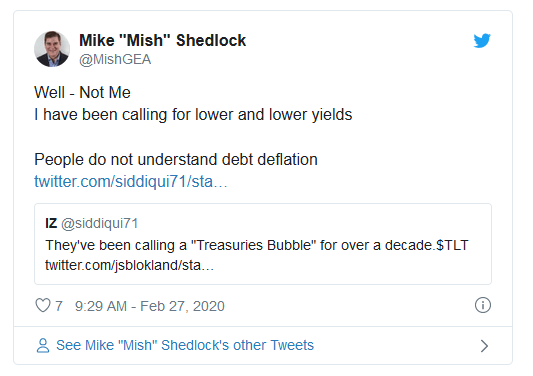
Deflation is not really about prices. It's about the value of debt on the books of banks that cannot be paid back by zombie corporations and individuals.
That is what the Fed fears. It takes lower and lower yields to prevent a debt crash. But it is entirely counterproductive and it does not help the consumer, only the asset holders. Fed (global central bank) policy is to blame.
These are the important point all the inflationistas miss.
Fed Can Blame Itself
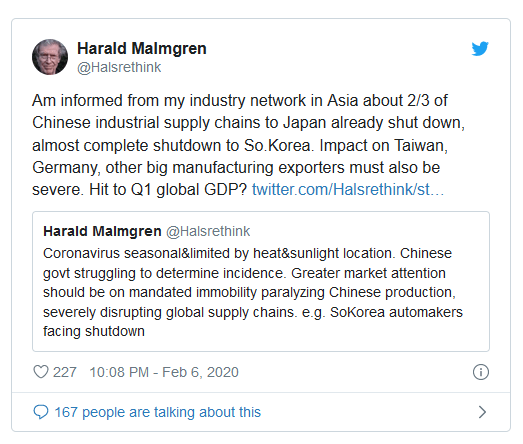
I am not blaming the Fed for the coronavirus and these shocks.
However, I am blaming the Fed for its erroneous inflationary tactics that blew three of the biggest economic bubble in succession: 2000, 2007, 2020.
Bubbles are inherently deflationary.
It’s asset asset bubble deflation that is damaging, not routine price deflation.
When asset bubbles burst, debt deflation results.
Here we go again.
Author

Mike “Mish” Shedlock's
Sitka Pacific Capital Management,Llc
Mike “Mish” Shedlock is a registered investment advisor for SitkaPacific Capital Management.