|

USDJPY retains medium-term neutral outlook, short-term bullish phase intact

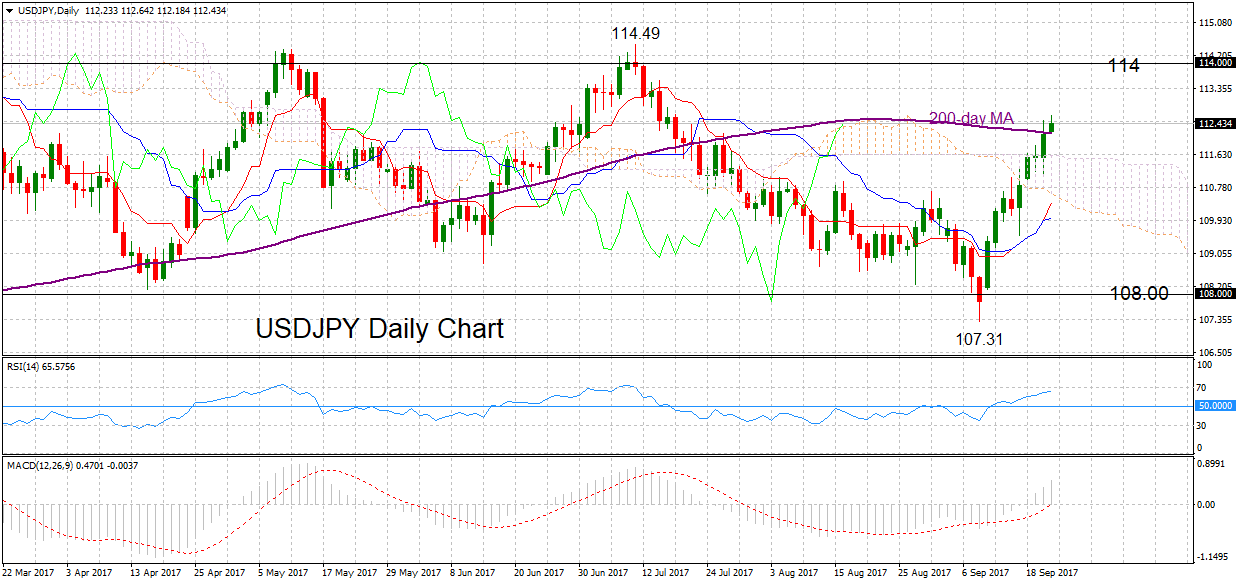
USDJPY remains neutral in the medium term and has been trading in a broad range between 108 and 114 over the past 6 months. The near-term bullish phase that started last week from near solid support in the 108-area is still in place.

Momentum indicators are providing bullish signals, as the RSI has crossed above 50 and the MACD above zero. Ichimoku cloud analysis shows the market has risen above the cloud, while the Tenkan-sen line has crossed above the Kijun-sen line, giving a bullish signal.

The bounce off the September 8 low of 107.31 is still in progress. The short-term bias is strongly bullish after USDJPY rose above the 200-day MA to hit a high of 112.64 so far. There is scope for another push higher towards the top of the range at 114. Breaking above the July 11 high of 114.49 would allow the uptrend to extend further to target the next major peak at 115.50. From here the market would shift its neutral medium-term bias to a bullish one.

Failure to rise above resistance at 114 could see USDJPY reverse back down towards the lower end of the range. Immediate support is at the top of the cloud at 111.60. A drop into the cloud would change the short-term bullish technical tone and focus would turn to the 108-support area. Should this solid support level be broken, USDJPY would move out of the 6-month range and the medium-term picture would turn from neutral to bearish.

In the short term, there is limited risk to the downside but the medium-term outlook remains neutral within the established 6-month range between 108 and 114.
USDJPY

Author

XM Research Department

Manned by a powerful team of professionals, along with certified forex instructors, the XM Research and Education Center provides a full range of up-to-date marketing tools essential for profitable trading, including market analys


More from XM Research Department
Share:

Editor's Picks

EUR/USD holds firm above 1.1900 as US NFP looms

EUR/USD holds its upbeat momentum above 1.1900 in the European trading hours on Wednesday, helped by a broadly weaker US Dollar. Markets could turn cautious later in the day as the delayed US employment report for January will takes center stage. 

GBP/USD recovers losses despite rising UK political risks, BoE rate cut bets

Pound Sterling advances against the US Dollar after registering modest losses in the previous session, trading around 1.3650 during the Asian hours on Wednesday. The pair could extend losses as the Pound Sterling faces pressure from rising political risks in the UK and growing expectations of near-term Bank of England rate cuts.

Gold sticks to gains near $5,050 as focus shifts to US NFP

Gold holds moderate gains near the $5,050 level in the European session on Wednesday, reversing a part of the previous day's modest losses amid dovish US Federal Reserve-inspired US Dollar weakness. This, in turn, is seen as a key factor acting as a tailwind for the non-yielding yellow metal ahead of the critical US NFP release. 

Bitcoin, Ethereum and Ripple show no sign of recovery

Bitcoin, Ethereum, and Ripple show signs of cautious stabilization on Wednesday after failing to close above their key resistance levels earlier this week. BTC trades below $69,000, while ETH and XRP also encountered rejection near major resistance levels. With no immediate bullish catalyst, the top three cryptocurrencies continue to show no clear signs of a sustained recovery.

Dollar drops and stocks rally: The week of reckoning for US economic data

Following a sizeable move lower in US technology Stocks last week, we have witnessed a meaningful recovery unfold. The USD Index is in a concerning position; the monthly price continues to hold the south channel support.

BNB prolonged correction signals deeper bearish momentum
BNB (BNB), formerly known as Binance Coin, is trading below $618 on Wednesday, marking the sixth consecutive day of correction since the weekend. The bearish price action is further supported by rising short bets alongside negative funding rates in the derivatives market.