USD/CAD bears seek dominance as BoC rate decision looms [Video]
![USD/CAD bears seek dominance as BoC rate decision looms [Video]](https://editorial.fxstreet.com/images/Markets/Currencies/Majors/USDCAD/hundred-dollar-bills-canadian-3057589_XtraLarge.jpg)

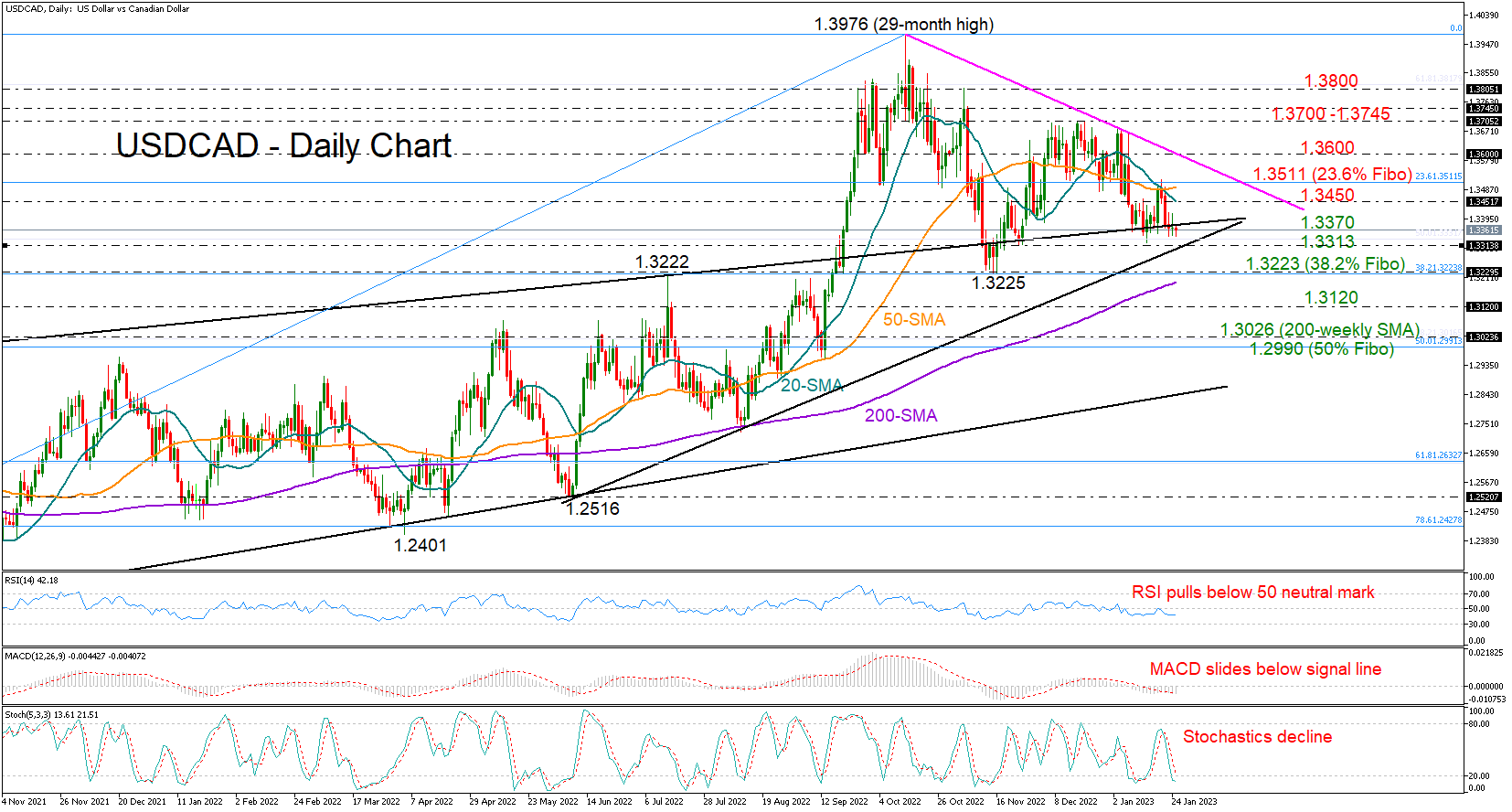
USDCAD has been moving sideways over the past two weeks, building a floor around 1.3370, but the bears seem determined to lead their market on their own way ahead of the BoC rate decision today at 15:00 GMT.
With the RSI pulling below its 50 neutral mark and the MACD sliding back below its red signal line within the negative area, downside moves are more likely than upside ones in the coming sessions. The stochastic oscillator is also on a decline, though it’s not far away from oversold territory, suggesting that some consolidation may soon develop.
The tentative support trendline from June’s low could immediately come to the rescue at 1.3313 if selling pressures strengthen. Should the bears snap that base, the price could revisit the 38.2% Fibonacci retracement of the 1.2006-1.3976 upleg at 1.3270, where November’s bullish rotation took place. Note that the 200-day simple moving average (SMA) is converging towards that zone. Hence, a decisive close lower could aggressively press the price towards the crucial 1.3026 level, where the constraining 200-SMA is flattening in the weekly chart, unless the 1.3120 handle provides a strong footing beforehand.
In the bullish scenario, a bounce higher may initially rechallenge the 20-day SMA at 1.3450 ahead of the 23.6% Fibonacci level of 1.3511. Still, only a sustainable recovery above the tentative resistance trendline currently around 1.3600 could prompt a meaningful rally up to the key 1.3700-1.3745 constraining area. The 1.3800 psychological number could be the next target.
Summing up, the technical picture for USDCAD is currently discouraging, flagging more downside. Yet traders may wait for a close below 1.3313 before they reduce their exposure to the market.
Author
Christina joined the XM investment research department in May 2017. She holds a master degree in Economics and Business from the Erasmus University Rotterdam with a specialization in International economics.

















