USD/JPY Weekly Forecast: The view from Kyiv
- Mid-week safe-haven yen flows close below 115.00 on Thursday.
- Fed January minutes circumspect on rates, balance sheet.
- US Treasury rates fall with Ukrainian risks weakening the greenback.
- FXStreet Forecast Poll is essentially neutral with a 40 point range above 115.00.

Vladimir Putin had more to say about the USD/JPY this week than anyone else. Russian intentions in Ukraine and the news flow around the military and diplomatic situation were the chief catalysts for the USD/JPY movement.
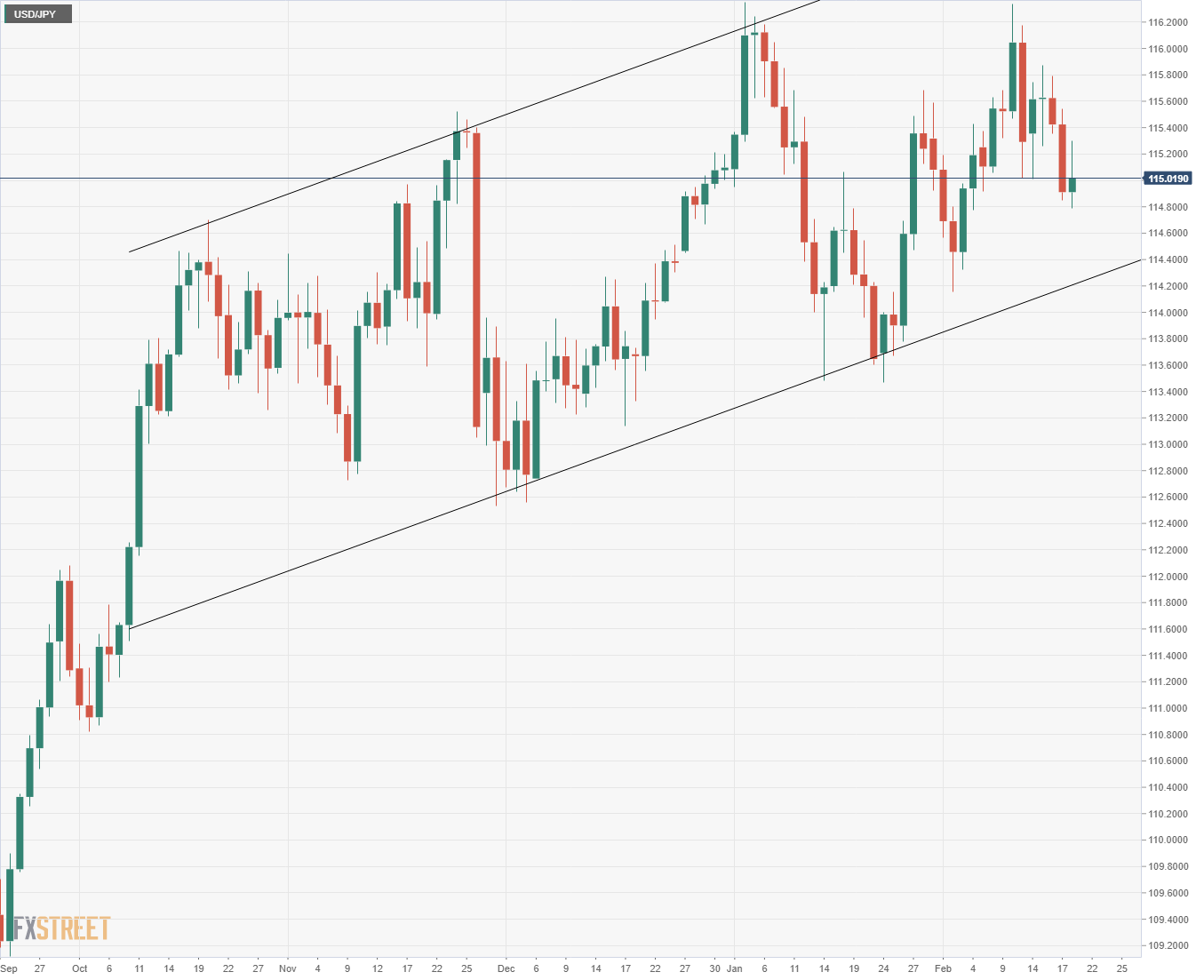
Unverified reports of artillery exchanges on Wednesday were the trigger for safe-haven flows to the yen which continued into Thursday and brought the USD/JPY to close at 114.91, its lowest in two weeks. An agreement for US Secretary of State Anthony Blinken to meet with Russian Foreign Minister Sergey Lavrov in Moscow next week put the USD/JPY above 115.00, but the stand-off remains rife with potential market impact.
Treasury rates drifted lower with markets favoring the security of US bonds. The 10-year yield dropped below 2% on Thursday and Friday after finishing above the two previous days. The 2-year yield lost its 1.5% handle on Thursday and continued lower in early Friday trading.
The minutes of the January Federal Reserve meeting were tribute to the Fed’s public relations efforts. Inflation was mentioned 73 times in the text, surely a record even though we do not know how many of the more than 70 people present spoke.
Participants supported a significant reduction in the balance sheet given its “high level of Federal Reserve securities holdings.” No indication was given for the timing or size of the expected reduction or whether it might be a passive roll-off or active sales. No clue was provided to the most timely market question, will the March rate cut be 0.25% or 0.5%.
Within the context of tighter monetary conditions, the Fed is keeping its options as wide as possible.
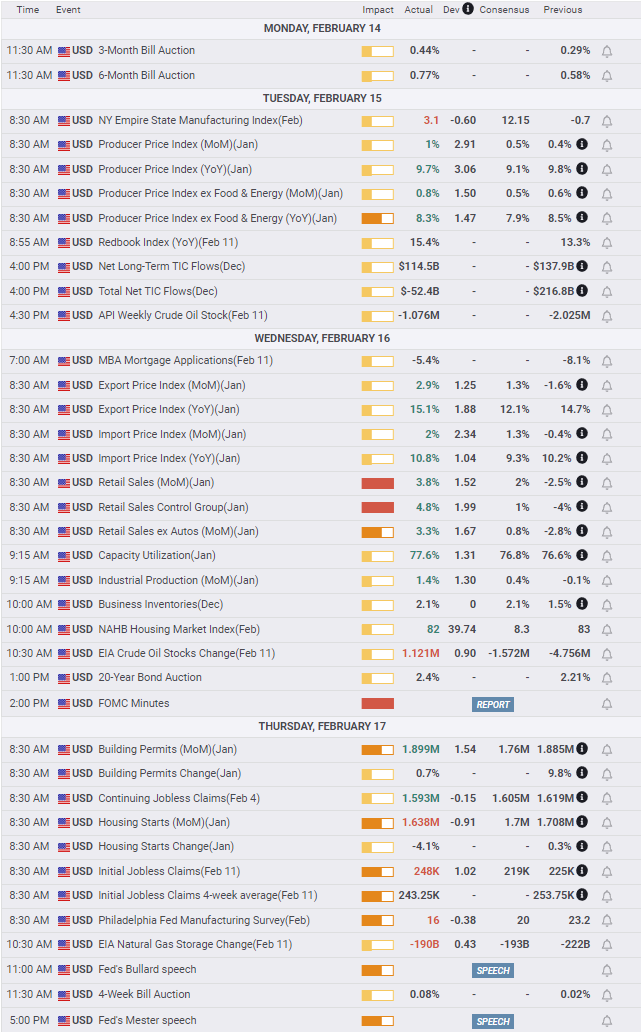
Retail Sales in the US at 3.8% in January were nearly double the 2% forecast, though December's total was downgraded to -2.5% from -1.9%. The result temporarily removes one Fed’s greatest worries, that the decade low in consumer outlook will translate into a pull-back in the spending that is 70% of US economic activity. A sustained drop in US consumption would quickly make a Fed rate tightening campaign difficult or impossible
Thus far US household consumption has rebounded from the 0.5% overall decline in the fourth quarter. Annualized economic growth was 6.9% in the fourth quarter, though the Atlanta Fed GDPNow estimate for the first three months of 2022 is currently just 1.3%. The tight labor market, with an average of more than 10.5 million unfilled jobs for seven months, is the likely reason for the consumer expansiveness, even if wages are steadily losing ground to inflation.
Producer prices in the US rose 9.7% on the year in January well above the 9.1% prediction, though a slight improvement from December’s 9.8% increase. Core prices were 8.3% higher on a 7.9% forecast and 8.5% the prior month.
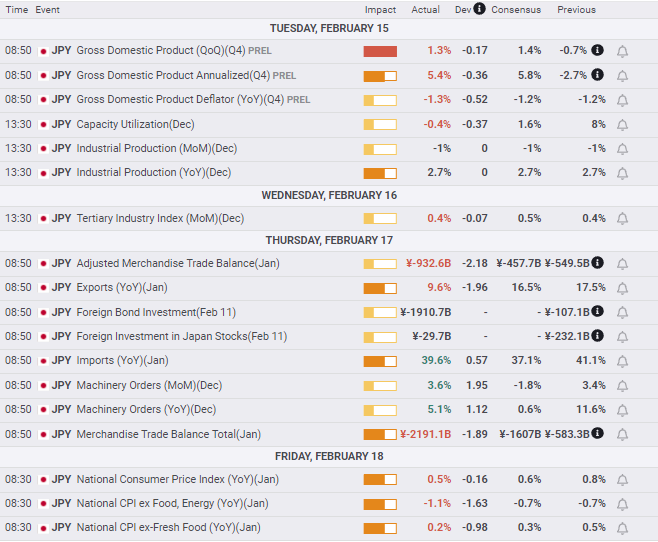
Japanese fourth quarter GDP (QoQ) at 1.3% was weaker than the 1.4% forecast but a reverse of the third quarter’s 0.7% decline. Annualized GDP was 5.4% with a 5.8% expectation and previous 2.7% decrease. National consumer prices rose 0.5% on the year in January and the core index fell 1.1%, both worse than expected.
USD/JPY outlook
Ukrainian political and military tension weaken the USD.JPY in two ways. First, safe-haven flows in the pair favor the yen over the dollar, even though in the general market the US dollar is the choice against most other currencies. Second, safety purchases of US Treasuries lower yields weakening the greenback.
As long as the situation in the Ukraine is unresolved, and that promises to be for many weeks, the USD/JPY will be subject to these overriding influences.
Left alone the US economy would maintain sufficient growth this year to tolerate the Fed’s anti-inflation campaign. However, the US recovery is likely more fragile than it looks and a Russian invasion of Ukraine would fling oil and commodity prices higher. The disruption to the global economy would make a worldwide and US recession a distinct possibility.
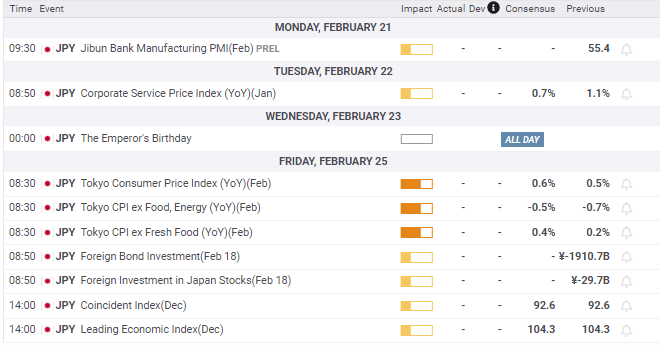
Japanese economic data in the week ahead includes Tokyo CPI for February. The slightly weaker than expected January National CPI tilts the February Tokyo tendency lower. Bank of Japan (BoJ) policy will be unaffected.
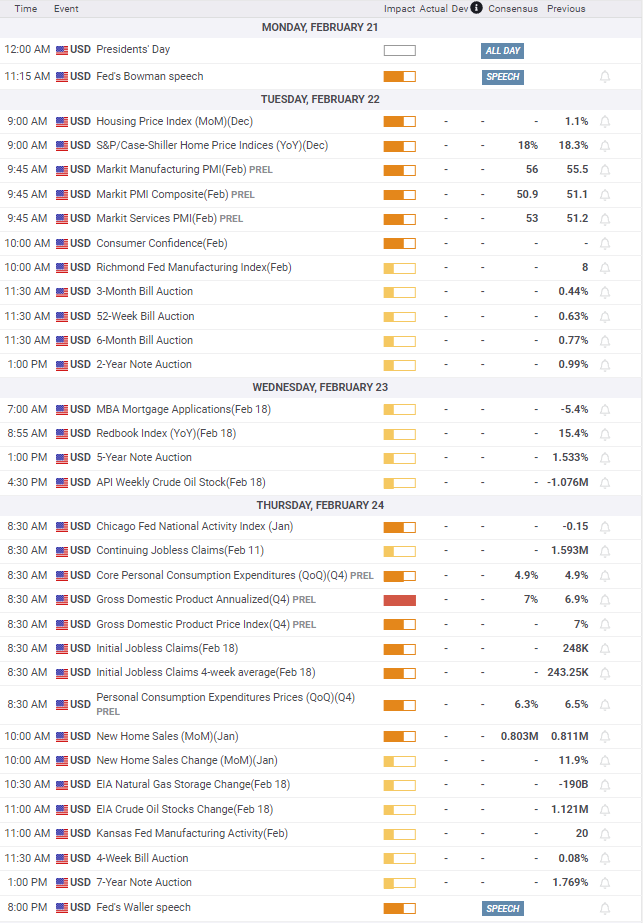
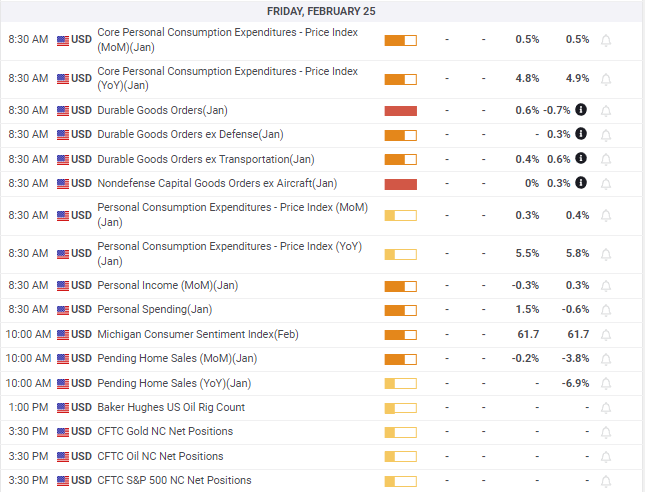
In the US, the first revision of fourth quarter GDP will be unremarkable. Durable Goods Orders for January should duplicate the better-than-expected Retail Sales numbers, but there will be no surprise and little market impact.
Given the fraught and undecided nature of the global economic and political picture, and the market tendency for defensive measures, the outlook for the USD/JPY is neutral with a pronounced weakness to Ukrainian political tension.
Japan statistics February 14–February 18
FXStreet
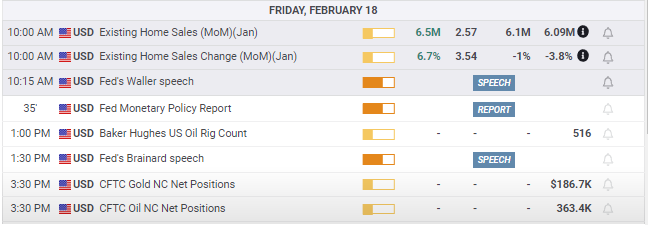
US statistics February 14–February 18
FXStreet
Japan statistics February 21–February 25
FXStreet
US statistics February 21–February 25
USD/JPY technical outlook
The MACD (Moving Average Convergence Divergence) cross of the signal line in Thursday's drop below 115.00 is not a technical indication. The lower USD/JPY movement was driven by the political and military situation in Ukraine. If the confrontation continues to escalate the USD/JPY will drop and the divergence will increase. The USD/JPY and the MACD will also reverse should negotiations start or a settlement be reached, which would have no technical antecedent.
The Relative Strength Index (RSI) reflects the USD/JPY position near the center of the three-month range. The vagaries of the Ukranian stand-off have given the USD/JPY considerable volatility without providing direction. That will continue until the situation resolves. Average True Range (ATR) shows limited volatility but as with the MACD and RSI, the indicator is, at the moment, dependent on external events.
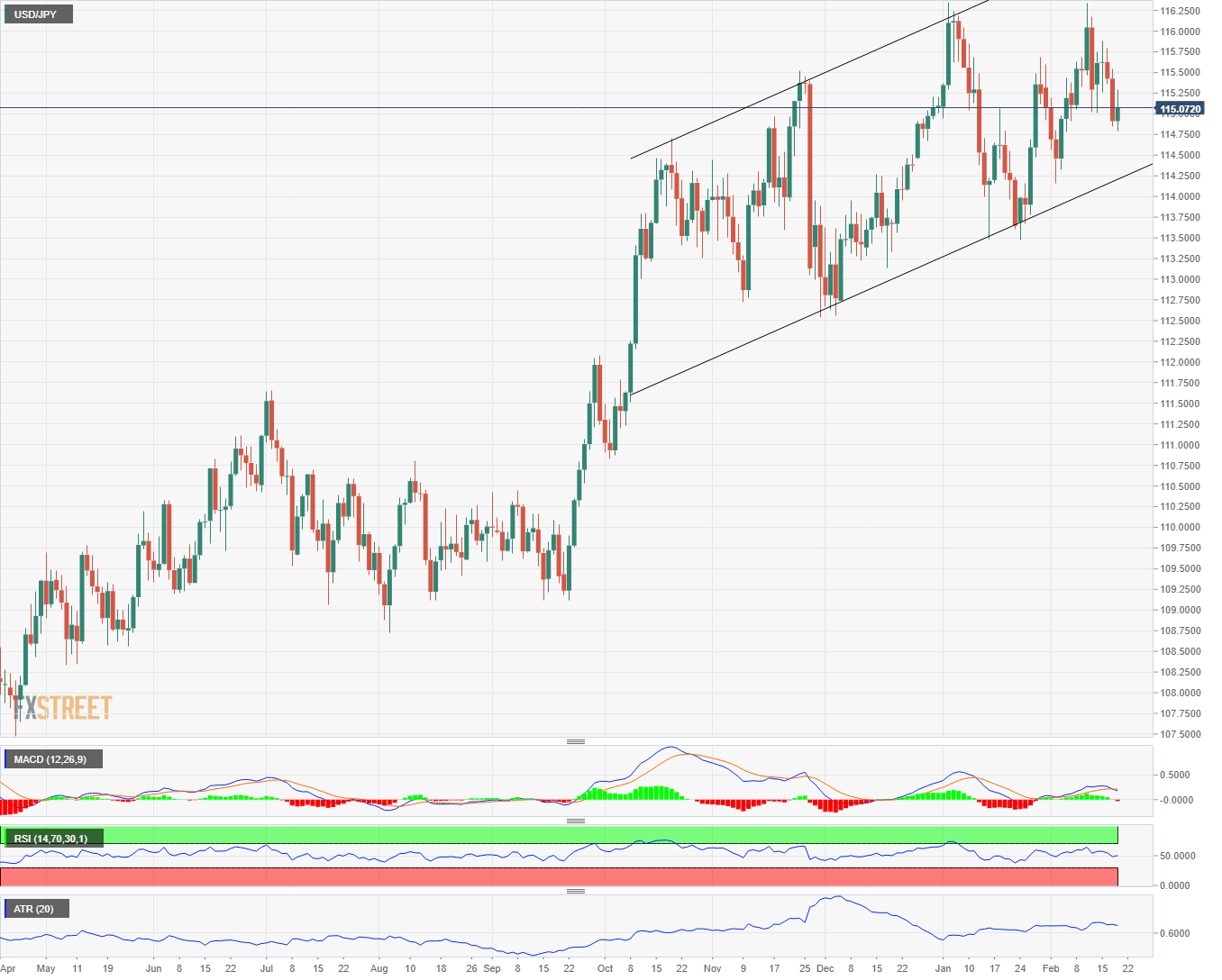
The moving averages (MA) are part of a significant support structure in the USD/JPY. The 21-day MA at 115.02 is part of support at that figure. The 50-day MA at 114.79 backs support at 114.80 and the 100-day MA is coincides with the lower border of the five-month channel at 114.20.
The extensive technical support is poised against the USD/JPY weakness from Ukraine based safety trading.
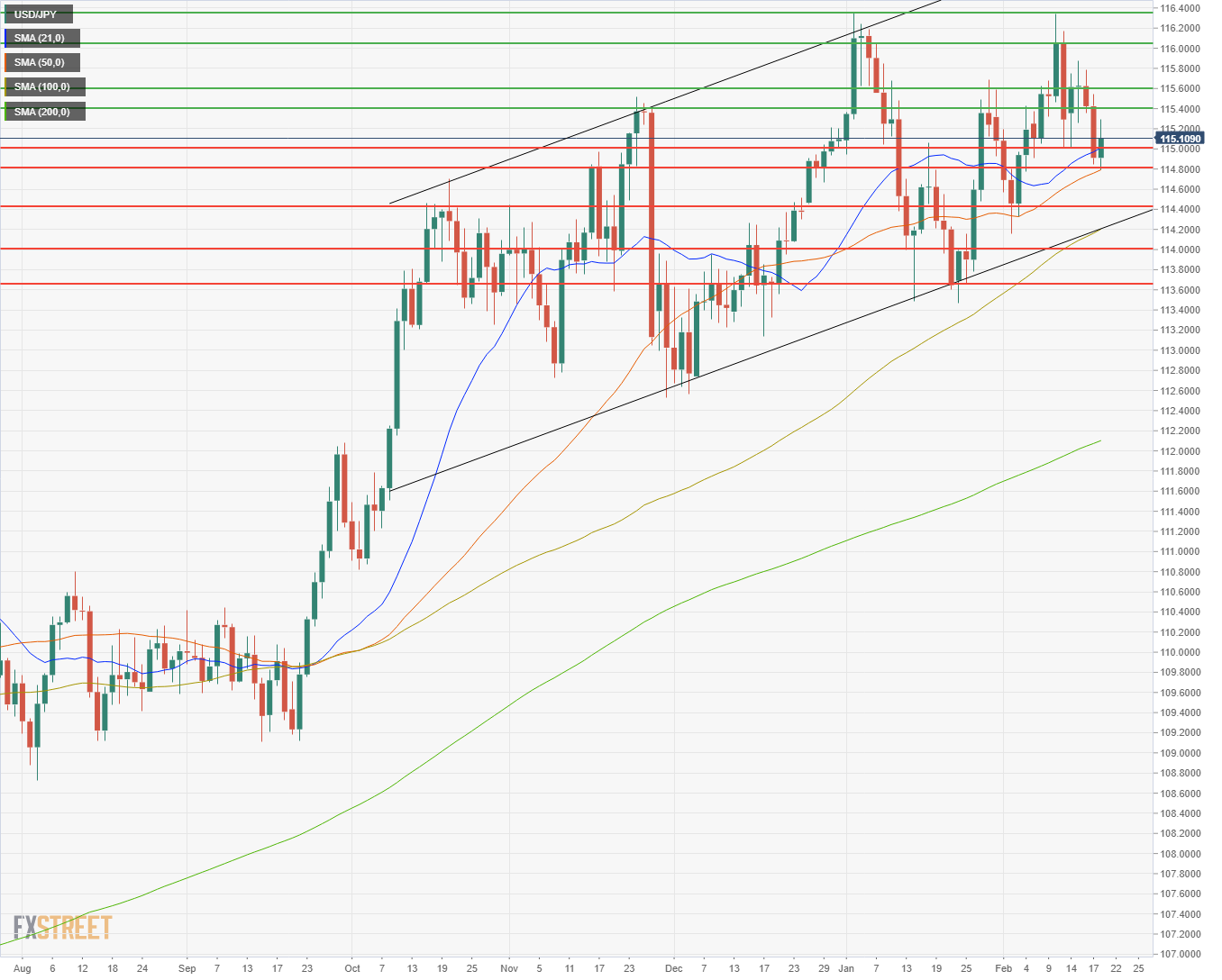
Resistance: 115.40, 115.60, 1156.05, 116.35
Support: 115.00, 114.80, 114.40, 114.00, 113.65
FXStreet Forecast Poll
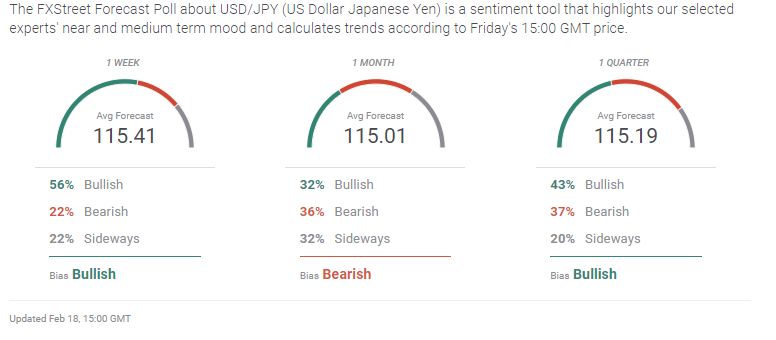
The FXStreet Forecast Poll though bullish in the one week and one quarter views, is restricted to a 40 point range, leaving it effectively neutral.
Author

Joseph Trevisani
FXStreet
Joseph Trevisani began his thirty-year career in the financial markets at Credit Suisse in New York and Singapore where he worked for 12 years as an interbank currency trader and trading desk manager.