USD/JPY Weekly Forecast: Is Omicron the pandemic’s last hurrah?
- BOJ keeps overnight call rate at -0.1%, completing six years.
- Fed doubles taper to $30 billion, ends program in mid-March.
- USD/JPY stalls and reverses at 114.00 as risk aversion takes over.
- The FXStreet Forecast Poll indicates a strong base for an eventual move higher in the USD/JPY.

In the most eagerly awaited Federal Reserve meeting since, well since the November one, the US central bank advanced it’s exit from pandemic support from June to March and tripled its 2022 rate hike forecast. The policy evolution was exactly in line with market expectations, producing negligible changes in Treasury rates or the dollar.
Fed communication was so thorough that the central bank managed to enact a major acceleration in rate policy that completely abandoned its own inflation analysis, and markets reacted as if it represented no change in the underlying economic conditions.
Modest gains in Treasury rates and the dollar after the Fed meeting were reversed on Thursday and Friday as traders sought refuge in US debt and the Japanese yen from the latest pandemic surge.
The Dow and S&P 500 executed a relief rally on Wednesday with some retreat on Thursday. The NASDAQ slipped on Wednesday and then crashed 2.47% on Thursday.
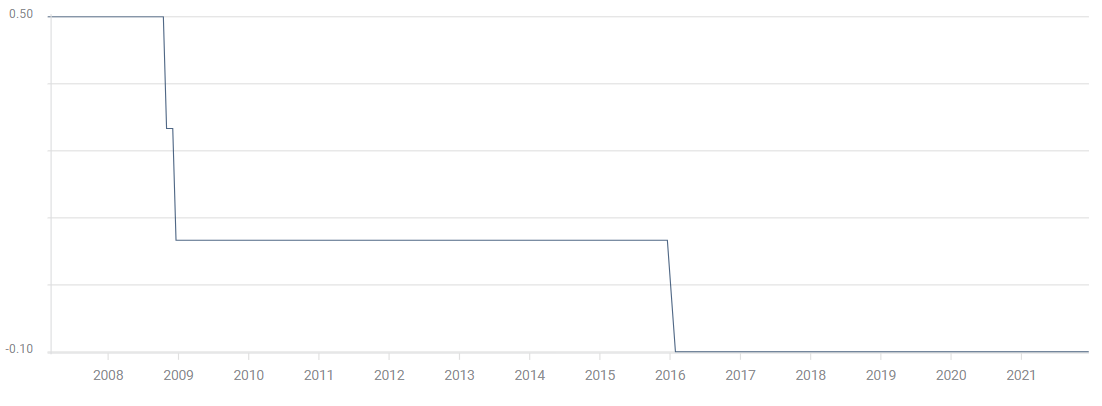
The Bank of Japan kept its overnight call rate at -0.1%, completing its sixth year of negative rates, and reduced some of its pandemic business aid, again, to no market interest.
BOJ Overnight Call Rate
FXStreet
The USD/JPY opened the week at 113.38 and by Friday morning was on par at 113.36, after having closed at 114.05 on Wednesday after the Fed.
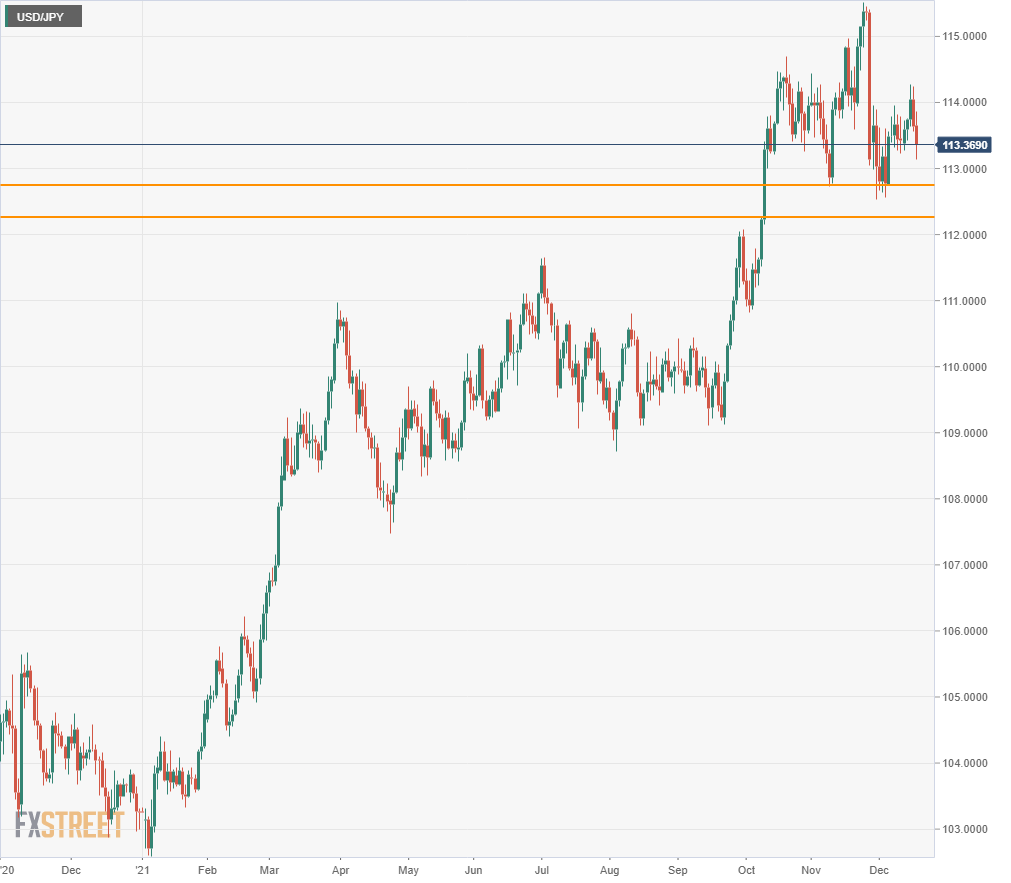
Rising Covid cases around the world, mostly of the apparently less dangerous Omicron variant, and restrictions in Europe, Japan and elsewhere, brought risk aversion back, pushing US Treasury rates lower and lifting the Japanese yen, despite the Fed’s aggressive actions.
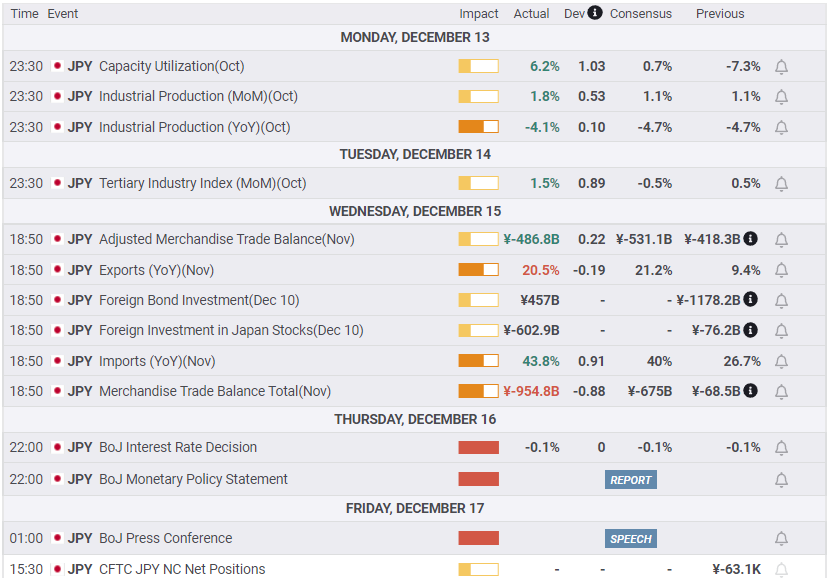
Japanese data was nondescript. Industrial Production fell less on the year in October than forecast, 4.1% vs. 4.7%. Export expansion in November was a bit below expectations while Imports were stronger.
The Fed meeting dominated the week to Wednesday. The governors doubled the monthly bond taper to $30 billion from $15, which will end the purchase program in mid-March. A majority of members projected three fed funds rate hikes by the end of next year, with a consensus estimate of 0.9%.
The Producer Price Index (PPI) on Tuesday and Retail Sales on Wednesday morning offered notable results but market reaction was nil in front of the Fed meeting. Producer prices jumped 9.6% in the year to November, the second record in a row, ensuring that consumer inflation will continue to rise. October’s PPI result was revised to 8.8% from 8.6%. Retail Sales for November were weaker than forecast though positive and October’s totals were adjusted higher. Product shortages and inflation likely encouraged consumers to begin holiday shopping early.
USD/JPY outlook
Federal Reserve policy has flipped from economic support to inflation control but you might not know it from the market reaction. Once again the pandemic has intervened. Unlike the previous COVID panics, this minor risk reversion will not be deep or long-lasting. Preliminary data from South Africa, where the Omicron variant was first discovered, shows the strain is mild and fast-dissipating. It may take a few weeks for the markets to get the message but they will and then the USD/JPY will revive.
The laws of economics and finance have not been repealed. The Federal Reserve is tightening, as is the Bank of England and soon the Bank of Canada. The Bank of Japan and the European Central Bank are not. Those policies will order currencies in the first half of the year.
For the moment, the USD/JPY is under risk-aversion pressure, though it is neither as strong or as pervasive as in prior bouts. The result is likely to be a balancing of forces in the week ahead as the Fed’s rate predictions compete with Omicron fears and the economic restrictions that governments are again imposing.
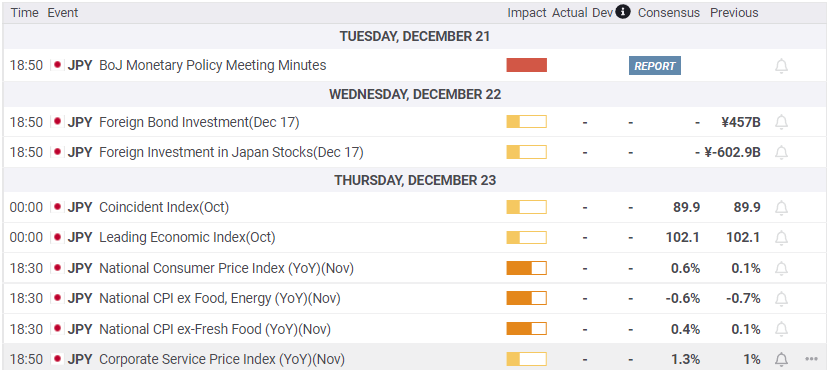
Japan's National CPI for November may indicate that global inflation is helping to mitigate deflation. It will not alter BOJ policy.
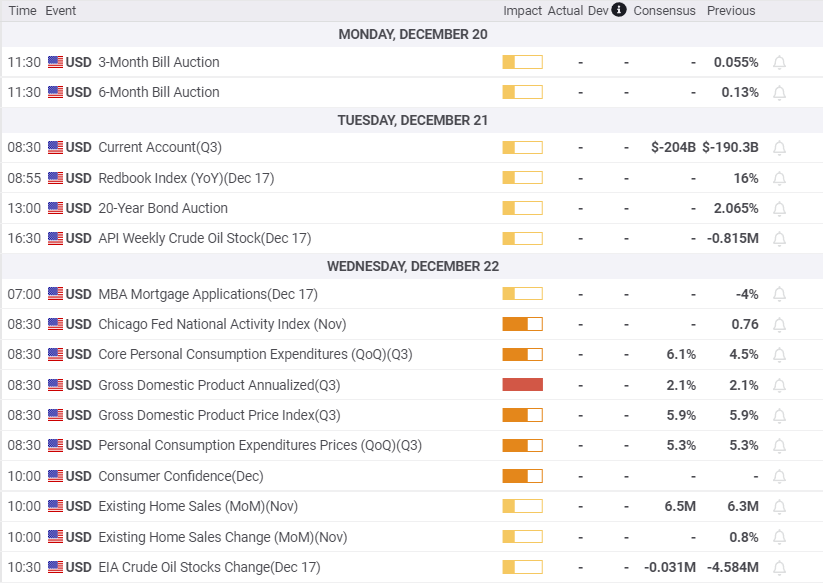
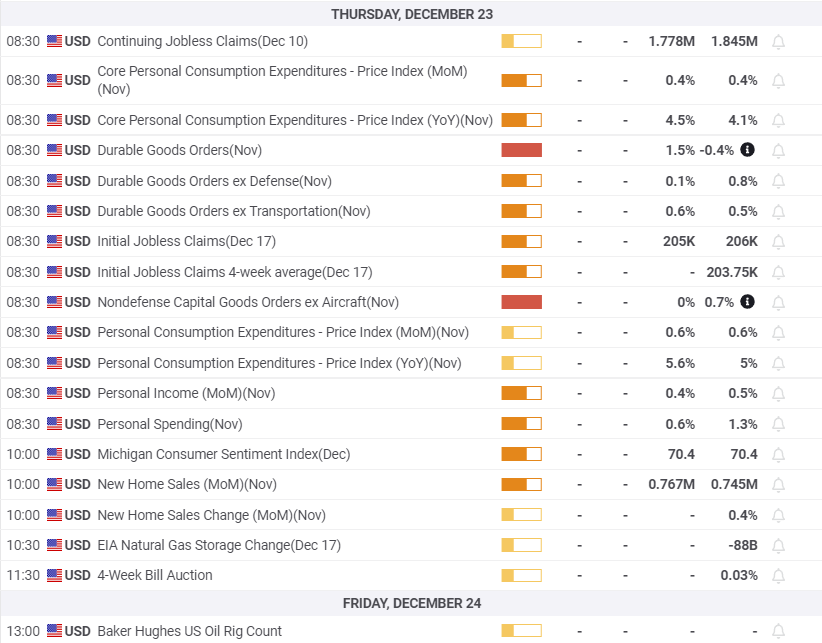
American statistics include the final issue for third quarter GDP, November's Durable Goods Orders and Personal Income and Spending figures. These numbers restate information already released and will have no impact on markets.
The USD/JPY bias is neutral because the Omicron situation is balanced against the Fed's clear intention to raise US interest rates.
Japan statistics December 13–December 17
FXStreet
US statistics December 13–December 17


FXStreet
Japan statistics December 20–December 24
FXStreet
US statistics December 20–December 24
USD/JPY technical outlook
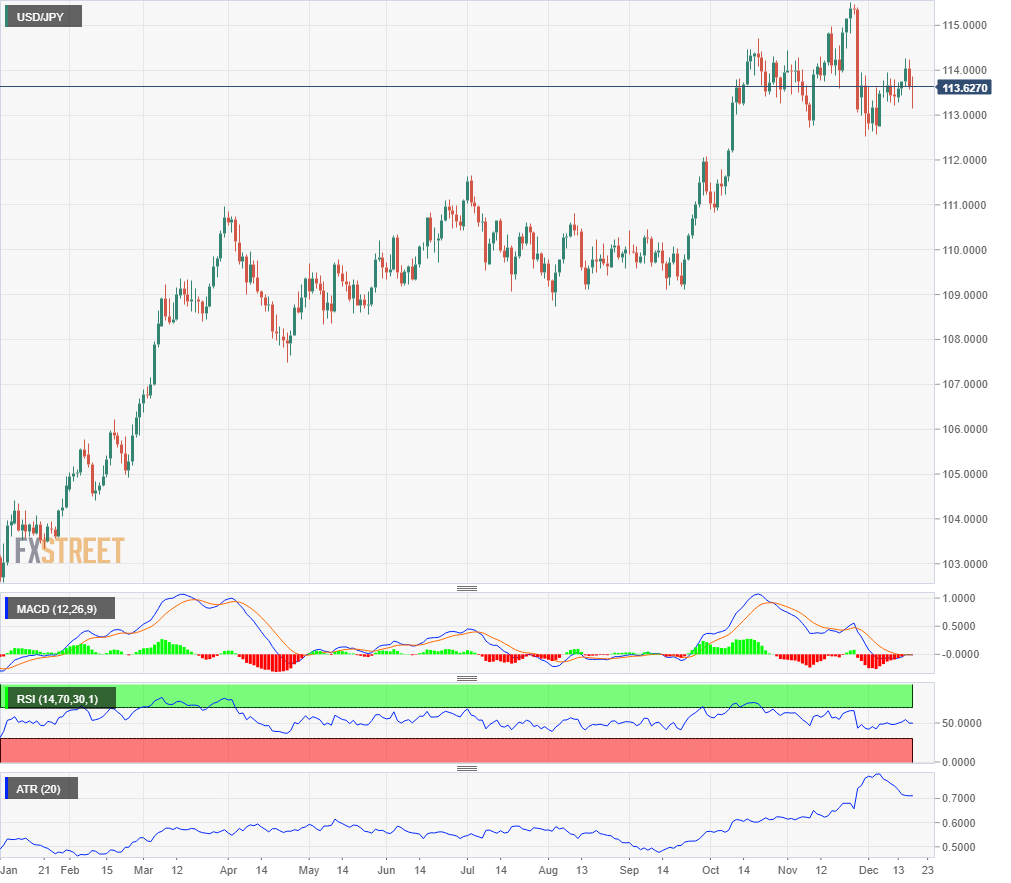
Technical considerations back a move higher in the USD/JPY, even as the pair is subject to the vagaries of the latest case of pandemic risk-aversion.
The bare end-to-end movement this week has left the MACD (Moving Average Convergence Divergence) and the Relative Strength Index (RSI) at neutral. The MACD nearly executed a cross of the signal line on Wednesday but Thursday's drop prevented the completion. Given the directional movement in both indicators in December they provide a base for a higher USD/JPY. Average True Range could go nowhere but down after the spike on November 26, but the volatility indicates that the area above 113.00 will be the proving ground for an eventual ascent.
The 21-day moving average (MA) at 113.78 and the 50-day MA at 113.83 were the effective high on Friday. Since these averages did nothing to block the rise and fall of USD/JPY on Wednesday and Thursday their efficacy at resisting encroachement higher is doubtful. The 100-day MA at 112.00 will be a strong addition to support at that level should the USD/JPY move lower.
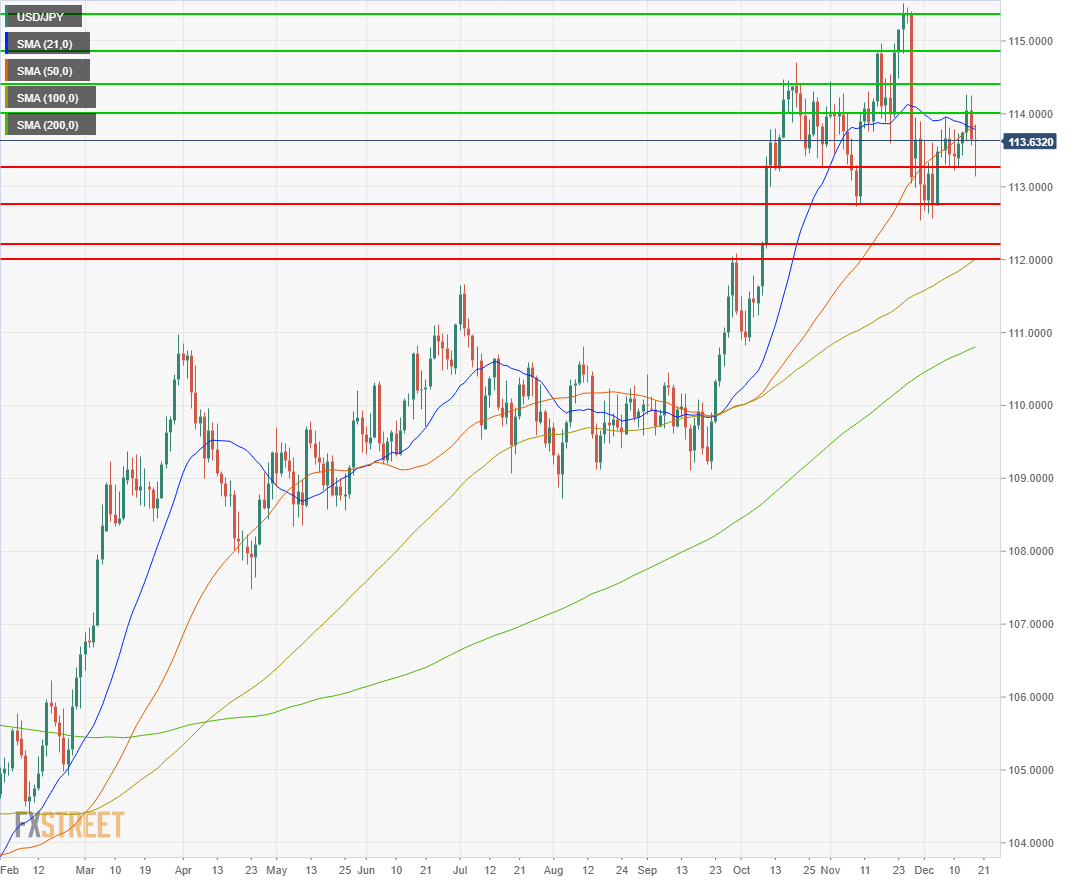
Resistance: 114.00, 114.40, 114.85, 115.35
Support: 113.25, 112.75, 112.20, 112.00
FXStreet Forecast Poll
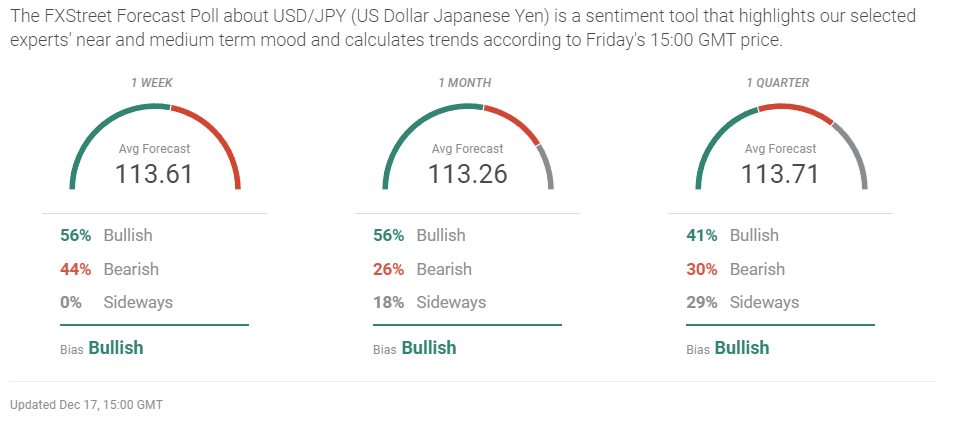
The FXStreet Forecast Poll is uniformly bullish in direction if not movement. The restraint of risk-aversion is evident in the ranges which do not break 114.00.
Author

Joseph Trevisani
FXStreet
Joseph Trevisani began his thirty-year career in the financial markets at Credit Suisse in New York and Singapore where he worked for 12 years as an interbank currency trader and trading desk manager.