USD/JPY tests 154.80 as CPI delay freezes Dollar momentum
- USD/JPY tests 154.80 as traders await the delayed U.S. CPI release.
- Government shutdown disrupts key U.S. data flow, tempering dollar strength while yen weakness persists.
- Bias remains bullish above 153.80, though the 154.80 resistance could trigger near-term distribution before the next expansion.

Market overview: CPI delay keeps traders in caution mode
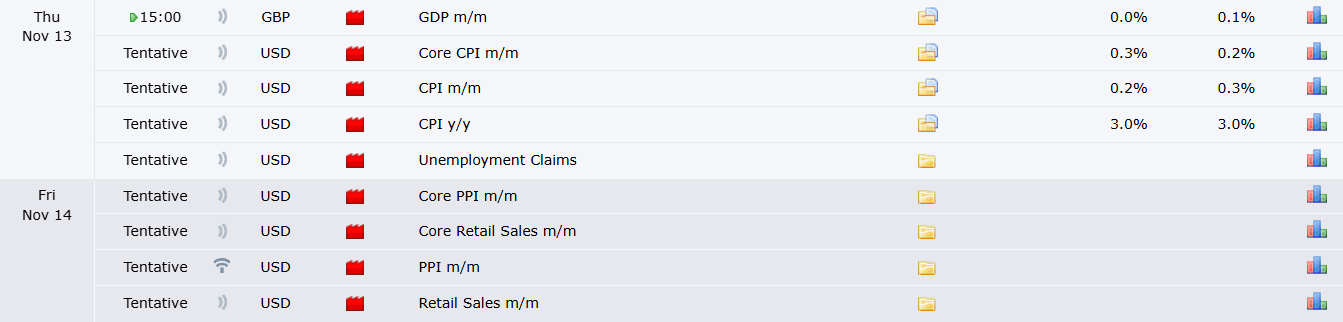
USDJPY remains in focus this week as the pair consolidates near the 154.80 resistance zone, following a firm rebound from 153.70 support. The move reflects an ongoing tug-of-war between yen weakness and U.S. dollar hesitation, with the latter driven by the postponement of the U.S. CPI report due to the government shutdown.
The CPI report—originally scheduled for Thursday—has been delayed indefinitely, leaving traders without the single most important data point for the Federal Reserve’s inflation outlook. This delay has effectively paused major positioning across dollar pairs, with volatility compressing as traders wait for clarity on when data releases will resume.
Without fresh inflation data, the market lacks confirmation of whether inflation remains sticky or is cooling off, leaving policy expectations in limbo. The absence of this data-driven catalyst has led to a temporary stall in USD momentum, though the yen’s fragility continues to underpin USDJPY at elevated levels.
Fundamental drivers
1. US CPI delay dampens momentum
The absence of CPI data means traders are flying blind on inflation trends—one of the most significant inputs for the Fed’s policy path.
- If inflation had come in hot, expectations for a prolonged period of elevated rates would have strengthened the dollar.
- If inflation had cooled, it would have revived speculation of mid-2026 rate cuts.
Instead, the data vacuum has created a muted market tone, leaving USDJPY drifting within a tight range despite its higher yield appeal.
This delay also feeds into a broader concern: the credibility of U.S. fiscal operations amid the ongoing shutdown. Repeated disruptions to data and spending add layers of uncertainty, potentially weighing on U.S. confidence and Treasury demand if prolonged.
2. Yen weakness remains the structural anchor
While the dollar is muted, the yen remains under consistent pressure. The Bank of Japan (BOJ) continues to maintain its ultra-loose policy stance, reiterating that rate normalization will only occur once inflation sustainably exceeds the 2% target.
Recent Japanese data—including weak household consumption and tepid wage growth—gives the BOJ no urgency to tighten policy, keeping Japan as one of the few economies still maintaining negative real rates.
This policy divergence continues to fuel carry trade demand, favoring USDJPY upside as investors borrow in yen to invest in higher-yielding currencies.
3. Rate divergence and global context
While the Federal Reserve remains on hold, it is still far from cutting rates—unlike the BOJ, which has yet to even begin tightening. This rate differential keeps USDJPY structurally supported, even in the face of temporary dollar softness.
Moreover, the global macro backdrop remains mixed:
- U.S. equities are stable but vulnerable to policy uncertainty.
- Treasury yields have eased slightly but remain historically elevated.
- Japan’s bond yields continue to lag, reinforcing capital outflows.
Together, these forces preserve the broader bullish undertone in USDJPY, even as immediate momentum pauses.
Technical outlook
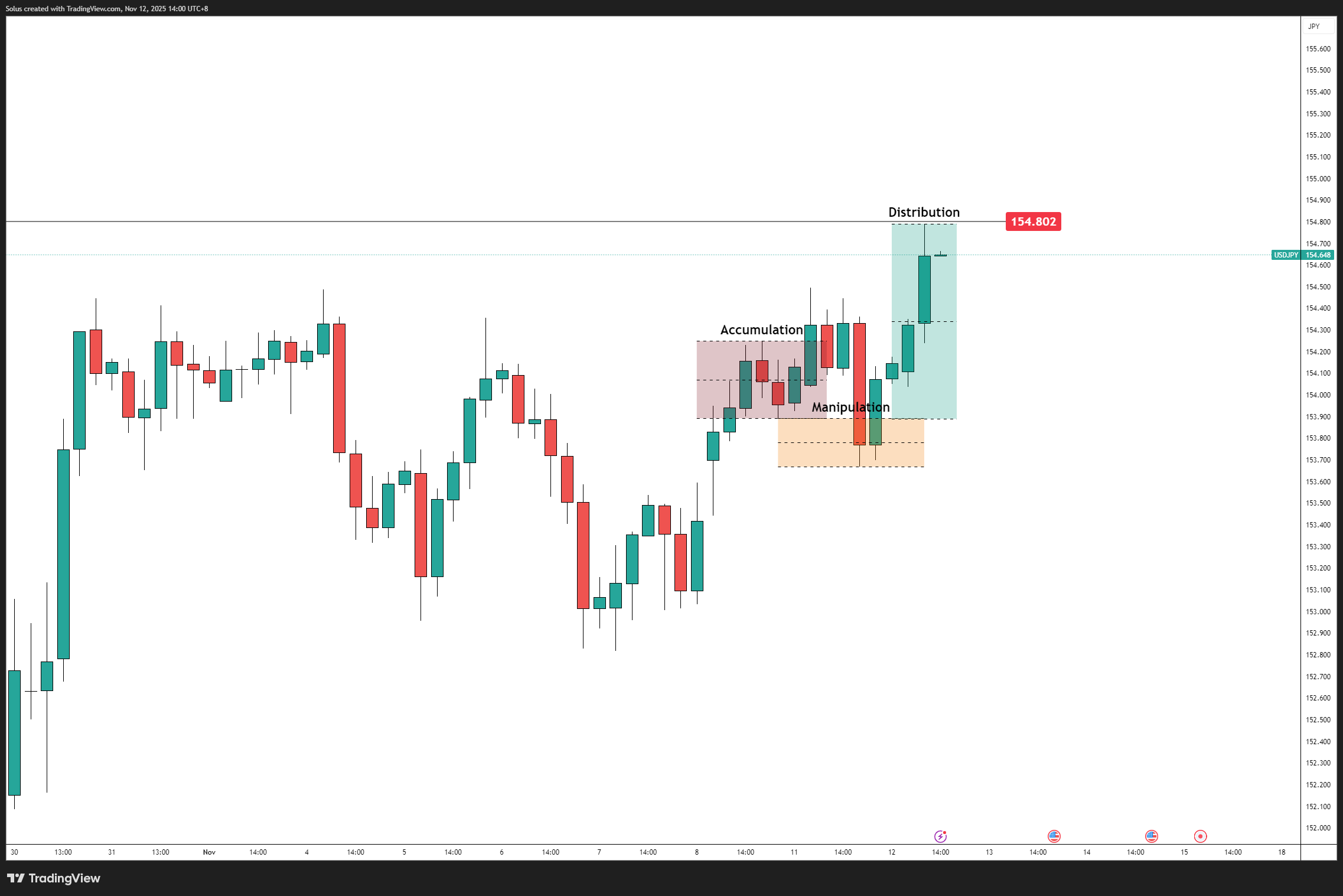
Technically, USDJPY is consolidating after a strong rebound from 153.70–153.90 support, now hovering near 154.80, where prior liquidity and short-term distribution zones are visible.
Bullish scenario
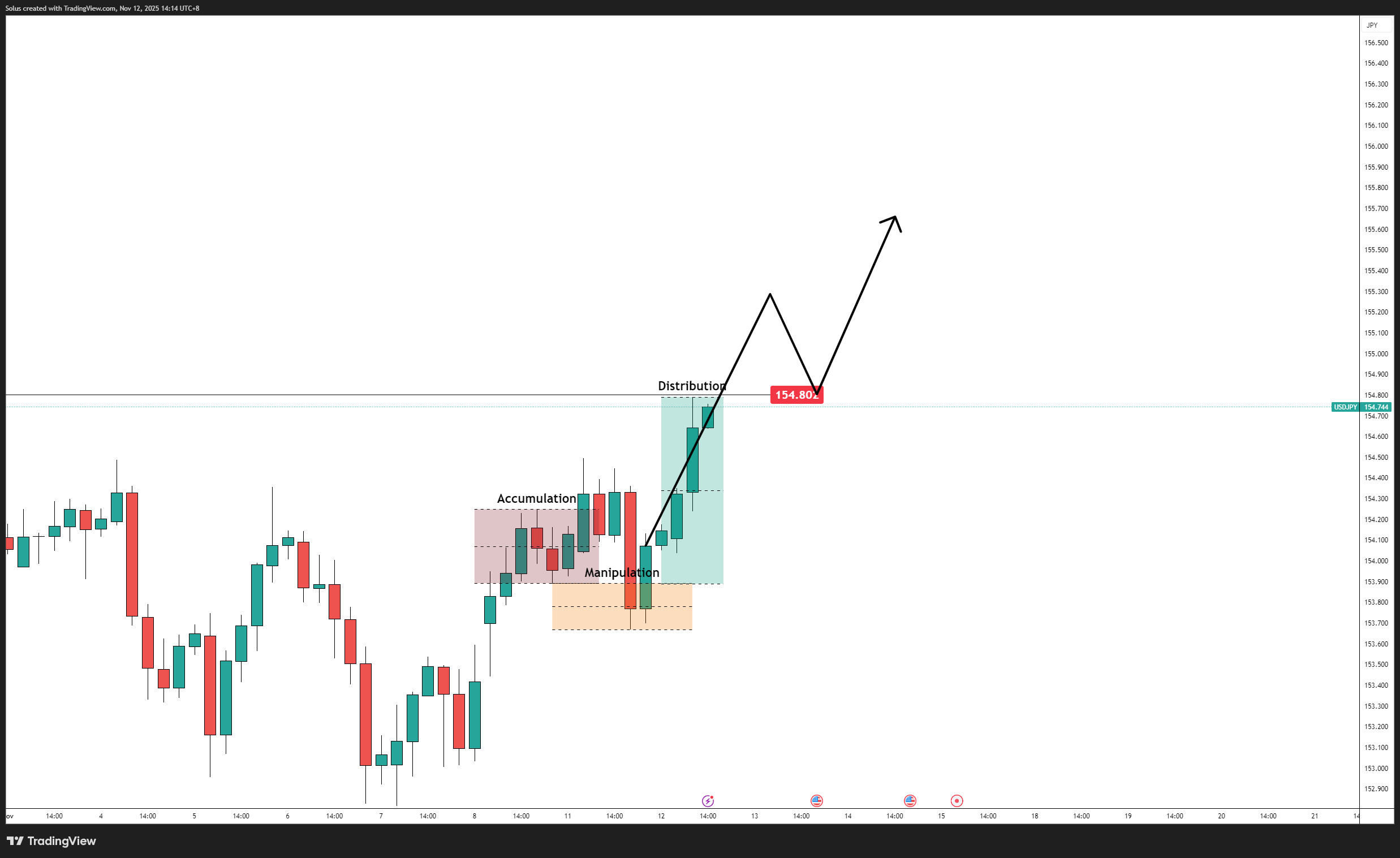
A sustained break above 154.80 could open the door toward 155.20–155.50, supported by ongoing yen weakness and carry trade flows. As long as 153.80 holds, the structure remains firmly bullish.
Bearish scenario
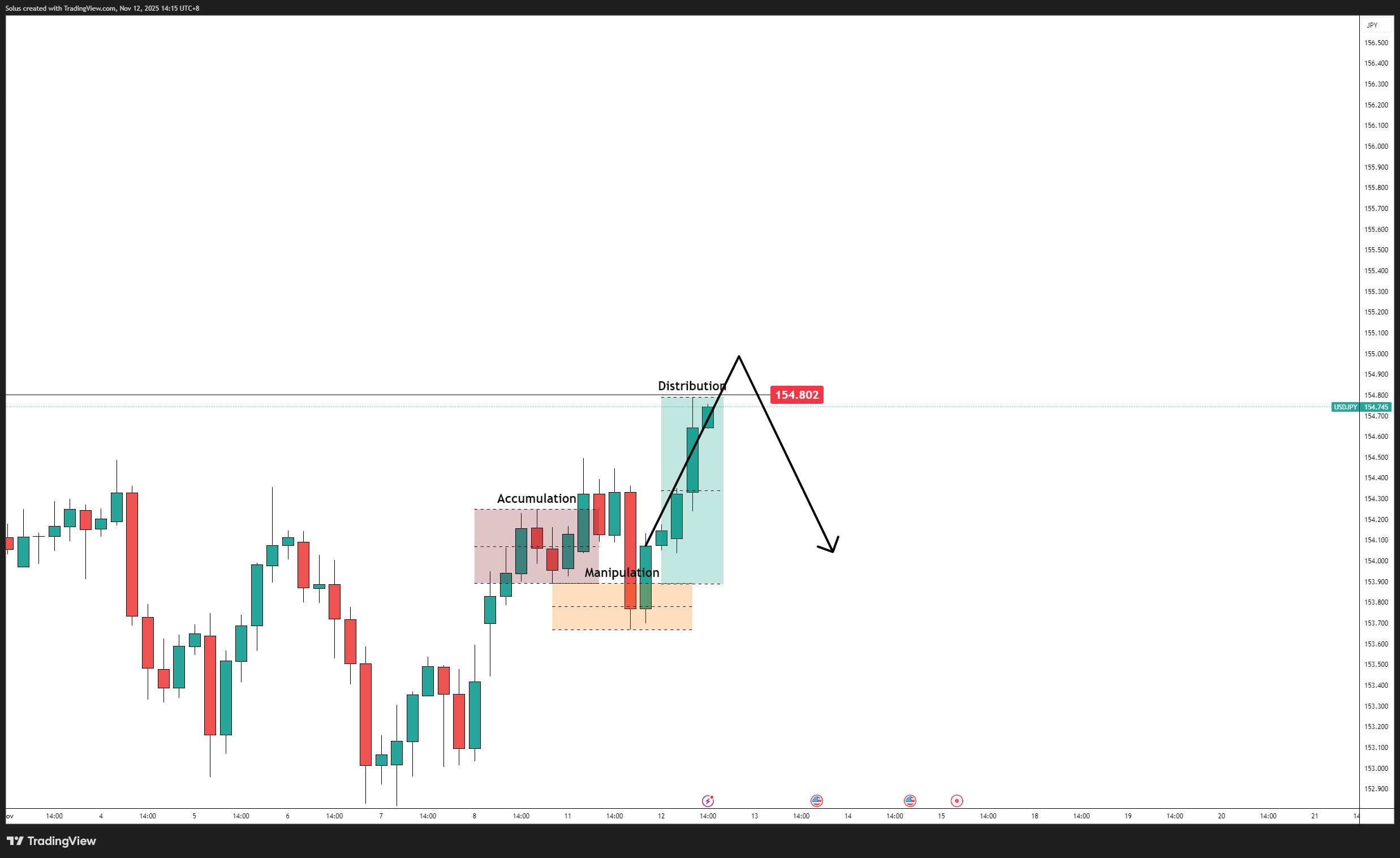
A rejection at 154.80 may trigger a corrective move back toward 154.00–153.80. A break below 153.70 would signal a deeper retracement toward 153.00, especially if risk sentiment turns defensive ahead of the rescheduled CPI release.
Key levels to watch
- Resistance: 154.80 – 155.20.
- Support: 153.80 – 153.00.
For now, USDJPY’s resilience reflects the yen’s structural weakness more than new dollar strength—an important distinction as the market awaits clarity from the Fed’s next inflation signal.
Market sentiment summary
The broader sentiment remains cautious but not bearish. Investors are holding long-term bullish exposure on USDJPY but are hesitant to extend positions without confirmation from inflation data.
While near-term pullbacks are possible, the underlying macro divergence continues to favor upside once data normalization resumes.
Author

Jasper Osita
Independent Analyst
Jasper has been in the markets since 2019 trading currencies, indices and commodities like Gold. His approach in the market is heavily accompanied by technical analysis, trading Smart Money Concepts (SMC) with fundamentals in mind.