USD/JPY Price Forecast: Seems vulnerable as BoJ rate hike bets offset weaker Japan’s Q1 GDP
- USD/JPY drifts lower for the fourth straight day amid bets for additional BoJ rate hikes in 2025.
- Prospects for further policy easing by the Fed undermine the USD and contribute to the slide.
- The US-China trade optimism might cap the safe-haven JPY and lend some support to the pair.


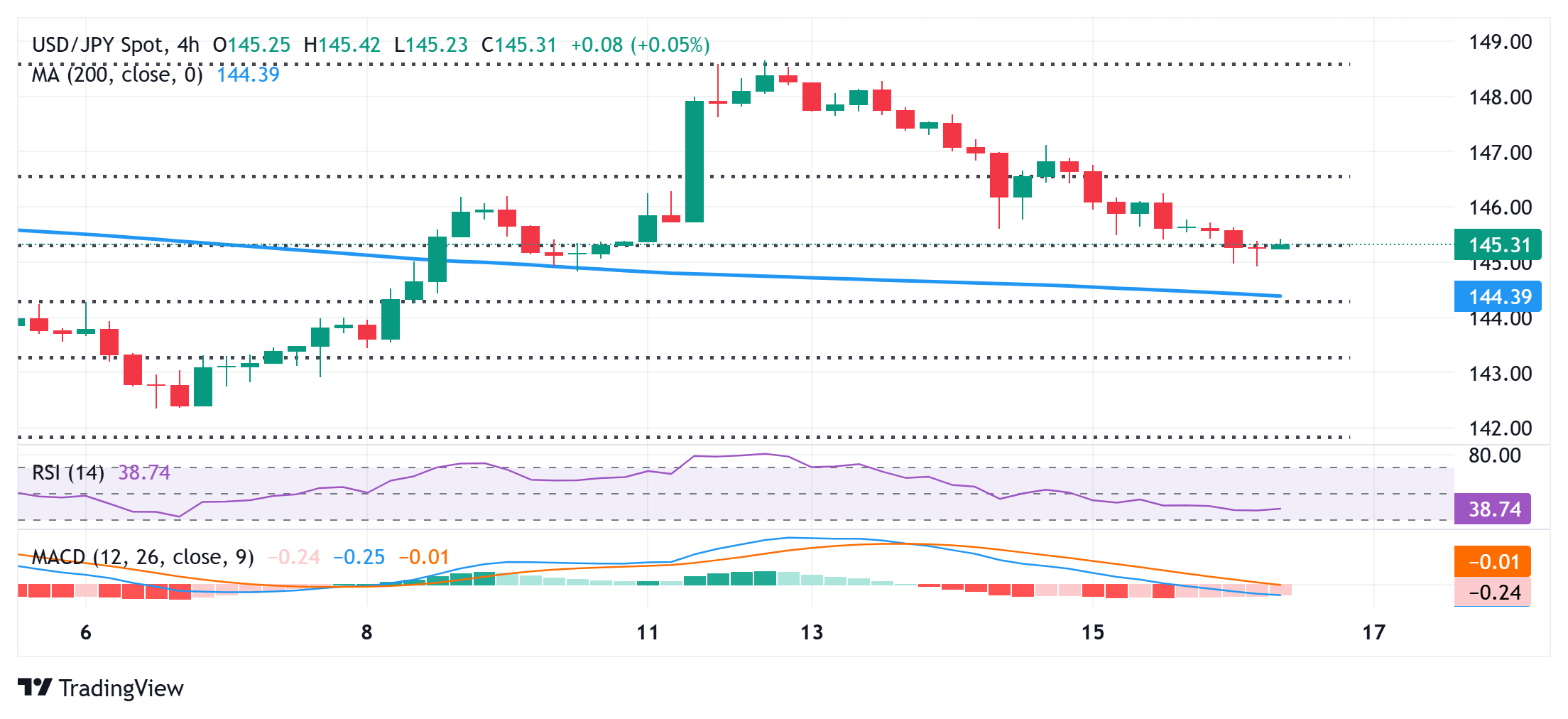
The USD/JPY pair prolongs this week's retracement slide from the 148.65 area, or its highest level since April 3, and attracts some follow-through selling for the fourth successive day on Friday. The downward trajectory drags spot prices to a fresh weekly low and seems unaffected by Japan's weaker Q1 GDP print amid the growing conviction that the Bank of Japan (BoJ) will hike rates again in 2025, which is seen underpinning the Japanese Yen (JPY). This, along with a softer US Dollar (USD), weighs on the pair.
The preliminary reading released by Japan’s Cabinet Office showed that the economy contracted by 0.2% during the first quarter of 2025 compared to a 0.1% fall expected and a growth of 0.6% recorded in the previous quarter. On an annualized basis, Japan’s Gross Domestic Product (GDP) shrank much more than consensus estimates, by 0.7% during the January to March period – marking the first decline in a year. The market reaction, however, turned out to be muted amid hawkish BoJ expectations.
The BoJ's April 30-May 1 Summary of Opinions released earlier this week revealed that policymakers haven't given up on hiking rates further. Moreover, some BoJ board members saw scope to resume rate hikes after a temporary pause if developments over US tariffs stabilise. US-Japan trade negotiations appear to be progressing as officials continue to meet regularly. In fact, Japan's top trade negotiator, Ryosei Akazawa, could reportedly travel to Washington next week for a third round of trade talks.
Meanwhile, BoJ Deputy Governor Shinichi Uchida signaled the central bank’s resolve to maintain its rate-hike stance. Adding to this, a Reuters survey indicated on Thursday that a slight majority of economists see at least a 25-basis-point hike by the end of this year. This marks a sharp divergence in comparison to bets for more interest rate cuts by the Federal Reserve (Fed), bolstered by Thursday's US macro data, which keeps the USD depressed and lends additional support to the lower-yielding JPY.
The US Bureau of Labor Statistics reported on Thursday that the US Producer Price Index (PPI) dropped 0.5% in April and rose 2.4% on a yearly basis. Furthermore, the annual core PPI climbed 3.1% during the reported month, down from 4% in March, which can be seen as a precursor to a fall in the overall consumer price inflation. The US Department of Commerce reported that Retail Sales rose slightly by 0.1% in April compared to the previous month's upwardly revised growth of 1.7%, pointing to sluggish consumer spending.
This, in turn, increases the likelihood that the US economy will experience several quarters of sluggish growth and should allow the Fed to lower borrowing costs further. The outlook leads to a further decline in the US Treasury bond yields, which continues to weigh on the USD and contributes to the USD/JPY pair's ongoing downfall. However, the optimism over the de-escalation of the potentially damaging US-China trade war caps the upside for the safe-haven JPY and helps limit further losses for the pair.
Nevertheless, the USD/JPY pair remains on track to end the week on a weaker note and seems vulnerable to slide further amid a bearish fundamental backdrop. Traders now look forward to the release of the Preliminary Michigan Consumer Sentiment Index and Inflation Expectations. This might influence the USD price dynamics and provide some impetus to the USD/JPY pair heading into the weekend.
USD/JPY 4-hour chart
Technical Outlook
From a technical perspective, the intraday slide below the 38.2% Fibonacci retracement level of the recent goodish recovery from the year-to-date low could be seen as a key trigger for bearish traders. Moreover, oscillators on the daily chart have just started gaining negative, suggesting that the path of least resistance for the USD/JPY pair remains to the downside.
However, it will be prudent to wait for acceptance below the 145.00 psychological mark before positioning for additional losses. The USD/JPY pair might then slide to the 144.55 area, representing the 200-period Simple Moving Average (SMA) resistance breakpoint on the 4-hour chart. This is followed by the 50% Fibo. level, around the 144.30 region, which, if broken decisively, should pave the way for an extension of the downward trajectory.
On the flip side, the Asian session peak, around the 145.70 region, now seems to act as an immediate hurdle ahead of the 146.00 round figure. Any further move up could be seen as a selling opportunity and remain capped near the 146.60 area, or the 23.6% Fibo. level. A sustained move beyond the latter, however, might trigger a short-covering rally and lift the USD/JPY pair beyond the 147.00 mark, towards the 147.70 intermediate hurdle en route to the 148.00 round figure.
Author
Haresh Menghani
FXStreet
Haresh Menghani is a detail-oriented professional with 10+ years of extensive experience in analysing the global financial markets.