USD/JPY Price Forecast: Japan's election outcome tempers BoJ rate hike bets and favors bulls
- USD/JPY opens with a bearish gap in reaction to Japan’s election outcome.
- A mildly softer USD exerts additional downward pressure on spot prices.
- Reduced BoJ rate hike bets should cap the JPY and lend support to the pair.


The USD/JPY pair opens with a bearish gap on Monday and retains its negative bias below the 148.00 mark through the first half of the European session. The downside, however, seems limited amid domestic political uncertainty. Japan's upper house election dealt a big blow to the ruling coalition and raised concerns about an increase in debt, amid calls from the opposition to boost spending and cut taxes. Having already lost its majority in the more powerful lower house last October, Japan's Liberal Democratic Party (LDP) and its junior partner Komeito failed to secure a majority in the House of Councillors in the tightly-contested election on Sunday. This raises the risk of policy paralysis amid a tricky time when Japan is struggling to strike a trade deal with the US ahead of the August 1 deadline, which turns out to be a key factor holding back traders from placing bullish bets around the Japanese Yen (JPY).
Moreover, history suggests that domestic political uncertainty tends to keep the Bank of Japan on the sidelines. Adding to this, the slowing economic growth, declining real wages, and signs of cooling inflation in Japan could allow the BoJ to forgo raising interest rates in the near term. This, along with worries about the economic fallout from higher US tariffs, contributes to capping gains for the JPY. However, a modest US Dollar (USD) downtick keeps a lid on the attempted intraday recovery for the USD/JPY pair. Federal Reserve (Fed) Governor Christopher Waller last week backed the case for a July interest rate cut as he expects that tariffs are likely to have a limited impact on inflation. This keeps the USD Index (DXY), which tracks the Greenback against a basket of currencies, below its highest level since June 23, touched last week, and acts as a headwind for the currency pair at the start of a new week.
Traders, however, seem convinced that the Fed would wait until the September policy meeting before pulling the trigger. Moreover, Fed Chair Jerome Powell expects inflation to rise this summer in the wake of higher US tariffs. Adding to this, data released on Friday showed that the University of Michigan’s US Consumer Sentiment Index unexpectedly rose to 61.8 in July. This pointed to an increasing optimism among consumers regarding the economic conditions, which should limit deeper USD losses and offer some support to the USD/JPY pair. In the absence of any relevant market-moving economic data from the US on Monday, the aforementioned fundamental backdrop warrants some caution before positioning for any further depreciating move for the currency pair. Moving ahead, traders now look forward to the release of the flash global PMIs for some impetus during the latter part of the week.
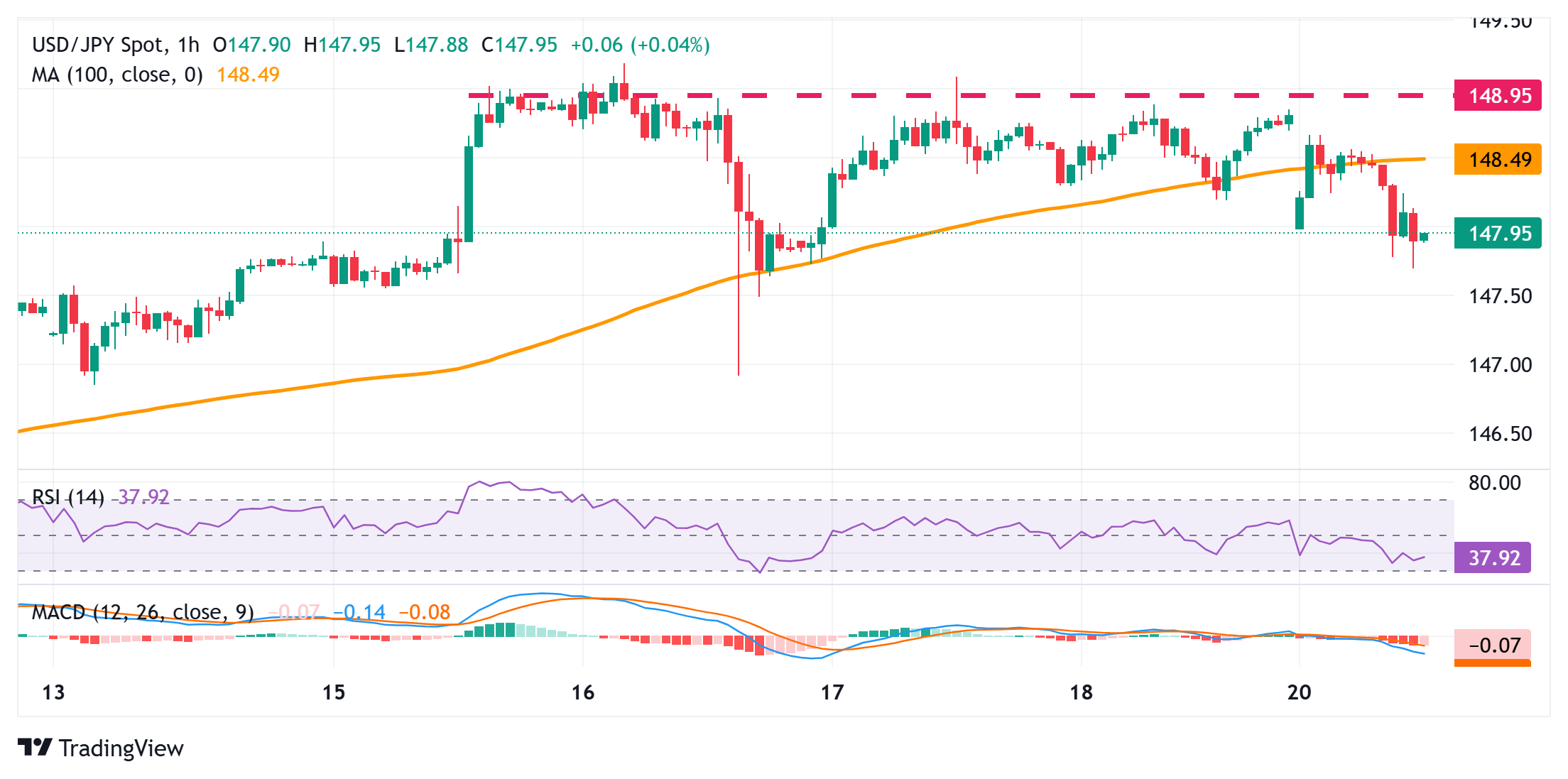
USD/JPY 1-hour chart
Technical outlook
An intraday break and acceptance below the 100-hour Simple Moving Average (SMA), along with negative oscillators on the 1-hour chart, backs the case for a further intraday depreciating move for the USD/JPY pair. However, technical indicators on the daily chart are still holding comfortably in positive territory and favour bullish traders. Hence, any further slide could be seen as a buying opportunity and remain limited near last week's swing low, around the 147.00-146.90 region. This is followed by the 100-day SMA, currently pegged near the 146.55 area, which if broken would make spot prices vulnerable.
On the flip side, any meaningful move up beyond the 148.00 mark now seems to confront resistance near the daily swing high, around the 148.65 region. Some follow-through buying should allow the USD/JPY pair to make a fresh attempt to conquer the 149.00 mark. A sustained strength above the said handle, leading to a subsequent move beyond the 149.15-149.20 region, or a multi-month peak, might then push spot prices towards the 150.00 psychological mark.
Author
Haresh Menghani
FXStreet
Haresh Menghani is a detail-oriented professional with 10+ years of extensive experience in analysing the global financial markets.

















