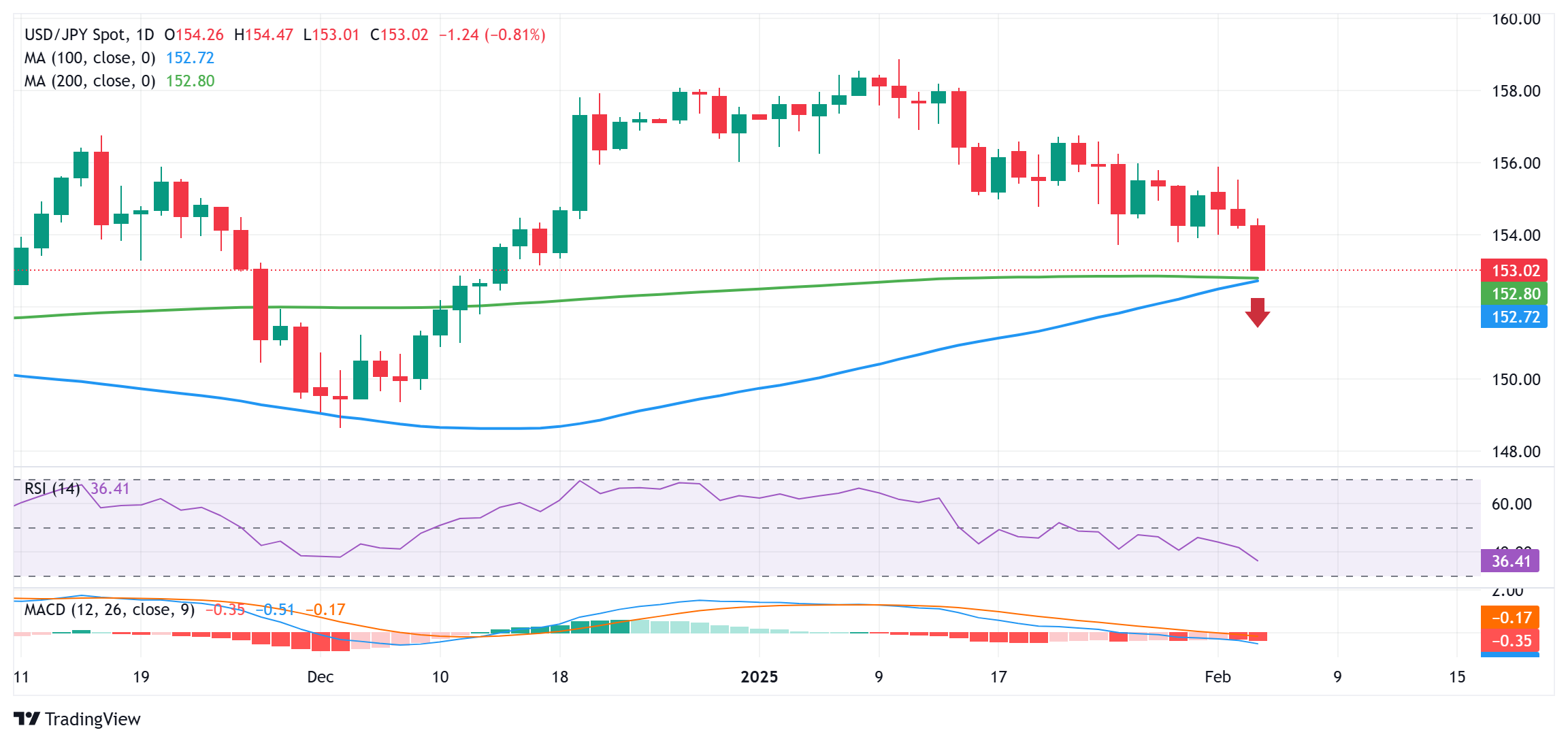
USD/JPY Price Forecast: Bears await a break below 100/200-day SMAs confluence support
- USD/JPY plummets to a near two-month low as a rise in Japanese wages lifts BoJ rate hike bets.
- The USD slides to a fresh weekly low amid Fed rate cut bets and also contributes to the downfall.
- Traders now look forward to the US ADP report and the US ISM Services PMI for a fresh impetus.

The USD/JPY pair attracts heavy follow-through selling on Wednesday and dives to the 153.00 neighborhood, or its lowest level since December 13 during the first half of the European session amid hawkish Bank of Japan (BoJ) expectations. A preliminary government report released earlier today showed that nominal wages in Japan climbed 4.8% in December from a year earlier, or the fastest pace in nearly three decades. Adding to this, real wages grew for a second consecutive month, by 3.6% during the reported month, which should keep the BoJ on track for further policy tightening.
Separately, a survey compiled by S&P Global Market Intelligence showed that Japan's service activity expanded for a third straight month in January. In fact, the au Jibun Bank Service Purchasing Managers’ Index (PMI) rose from 50.9 to 53.0 in January, marking the highest level since September 2024. This reaffirms market expectations that the BoJ will hike interest rates further and provide a strong boost to the Japanese Yen (JPY). Apart from this, some follow-through US Dollar (USD) selling bias turns out to be another factor that contributes to the USD/JPY pair's intraday downfall.
In fact, the USD Index (DXY), which tracks the Greenback against a basket of currencies, drifts lower for the third straight day and drops to over a fresh weekly amid expectations that the Federal Reserve (Fed) will stick to its easing bias. The bets were reaffirmed by Tuesday's data, which indicated a slowdown in the job market. The Job Openings and Labor Turnover Survey (JOLTS) published by the US Bureau of Labor Statistics (BLS) revealed that there were 7.6 million job openings on the last business day of December, down from the 8.09 million in November and missing estimates.
This should allow the Fed to lower borrowing costs further, despite sticky inflation, marking a big divergence in comparison to the hawkish BoJ. The resultant narrowing of the rate differential between Japan and the US supports prospects for a further near-term appreciating move for the lower-yielding JPY. Apart from this, concerns about the economic fallout from US President Donald Trump's tariffs and US-China trade war fears validate the positive outlook for the safe-haven JPY. Traders now look to the US ADP report on private-sector employment and the US ISM Services PMI for a fresh impetus.
USD/JPY daily chart
Technical Outlook
From a technical perspective, any intraday breakdown and acceptance below the 154.00 mark was seen as a key trigger for bearish traders. Moreover, oscillators on the daily chart have been gaining negative traction and are still away from being in the oversold territory. This, in turn, suggests that the path of least resistance for the USD/JPY pair remains to the downside. That said, it will be prudent to wait for some follow-through selling below the 152.80-152.75 confluence – comprising the very important 200- and the 100-day Simple Moving Averages (SMAs) – before placing fresh bearish bets.
On the flip side, any meaningful recovery attempt might now confront an immediate hurdle near the 153.70-153.80 region ahead of the 154.00 round figure. A sustained strength beyond the latter could trigger a short-covering rally and allow the USD/JPY pair to reclaim the 155.00 psychological mark. A further move up, however, could be seen as a selling opportunity and remain capped near the 155.25-155.30 region. The latter should act as a pivotal point, which if cleared decisively would shift the near-term bias in favor of bullish traders.
Author

Haresh Menghani
FXStreet
Haresh Menghani is a detail-oriented professional with 10+ years of extensive experience in analysing the global financial markets.