USD/JPY holds as Yen weakens under BoJ policy divergence
- USD/JPY consolidates above the 153.70–153.90 H4 Fair Value Gap, staying in bullish territory with eyes on 154.80.
- Divergent policy paths between the Fed and the Bank of Japan keep the Yen under pressure as U.S. yields stay firm.
- As long as price holds above 153.70, the bias stays bullish toward 154.80; a break below 153.30 shifts tone bearish toward 152.80–152.00.

The USD/JPY pair continues to trade within a tight but constructive range, maintaining its upward bias as monetary divergence and yield spreads remain decisive. Despite intermittent risk-off flows that occasionally favor the Yen, the broader structure reflects a persistent preference for the Dollar, driven by robust U.S. fundamentals and the Bank of Japan’s reluctance to tighten policy aggressively.
As the week unfolds, traders are monitoring whether the pair can sustain its footing above the H4 Fair Value Gap (153.739–153.895) to fuel another leg higher toward 154.80 — or if a failure to hold that zone opens the door for a corrective decline.
The main driver behind USD/JPY
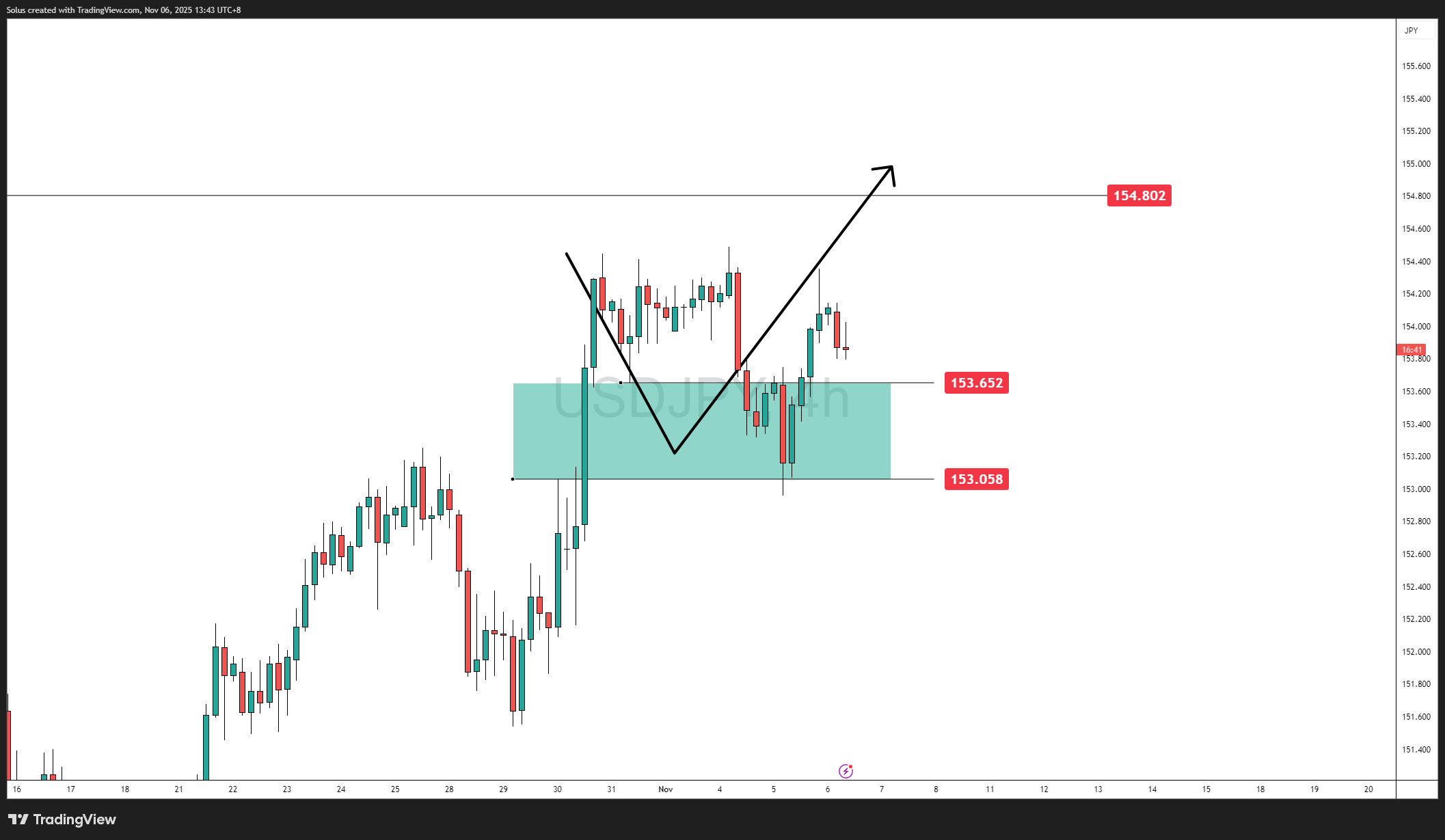
The dominant catalyst steering USD/JPY remains the interest-rate differential between the United States and Japan.
While the Federal Reserve has slowed its tightening cycle, the U.S. economy’s resilience—supported by strong labor market data and steady consumer spending—keeps Treasury yields elevated. This yield advantage continues to attract investors toward the Dollar, maintaining a bullish undertone for USD/JPY.
At the same time, U.S. monetary policy remains significantly tighter than Japan’s, creating a sustained flow into carry trades, where investors borrow in low-yielding Yen to purchase higher-yielding U.S. assets. This structural imbalance remains a core reason why dips in USD/JPY are often shallow and short-lived.
Bank of Japan’s role: Why the Yen remains weak
The Bank of Japan (BOJ) remains one of the last major central banks clinging to ultra-accommodative policy. While markets speculated earlier this year that Japan might move toward normalization, recent BOJ statements have reinforced a cautious tone.
Governor Kazuo Ueda has repeatedly emphasized that inflation momentum is not yet self-sustaining and that premature tightening could derail the fragile recovery. As a result, the BOJ continues to maintain near-zero interest rates and a flexible yield-curve control framework.
This stance is directly impacting USD/JPY:
- It suppresses Japanese bond yields, widening the yield gap with U.S. Treasuries.
- It encourages capital outflows as investors seek better returns abroad.
- It limits Yen demand during periods of moderate risk-off sentiment.
In short, the BOJ’s dovish commitment continues to anchor the Yen at weaker levels, keeping USD/JPY supported above key technical zones despite occasional pullbacks.
Price action narrative
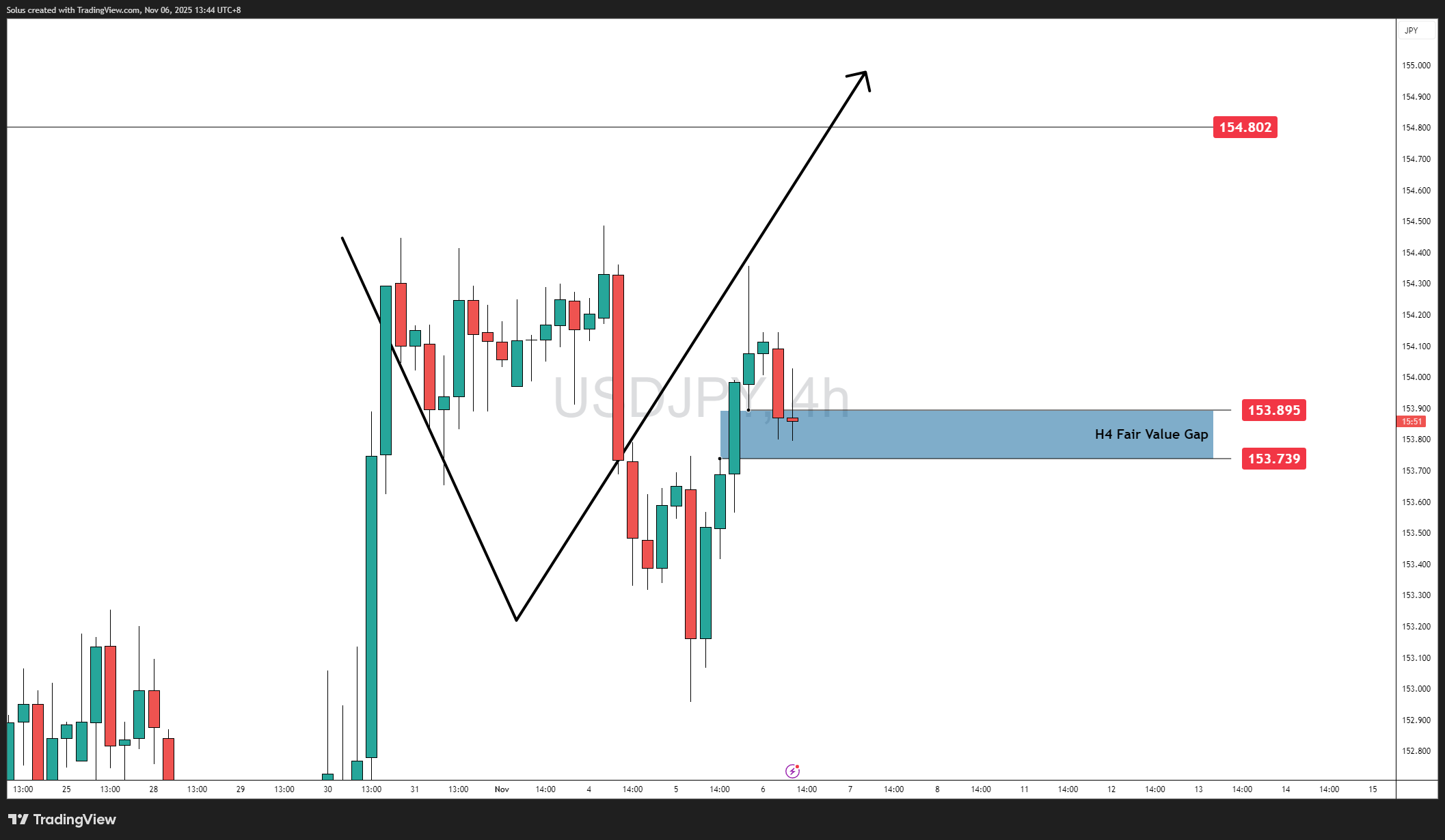
On the H4 timeframe, USD/JPY is retesting a Fair Value Gap (153.739–153.895) following a strong impulsive rally. This zone now serves as a reaccumulation area, where liquidity mitigation could prepare the market for another bullish continuation.
The sequence is clean:
- Prior bearish leg swept liquidity below late-October lows.
- A strong displacement shifted structure bullish.
- Current retracement is targeting the imbalance left behind—the FVG zone.
A rejection from this zone would confirm buyer presence and continuation toward 154.80, aligning with the prior swing high and liquidity cluster visible on the H4 chart.
Technical outlook
Bullish scenario: FVG rejection and upside continuation
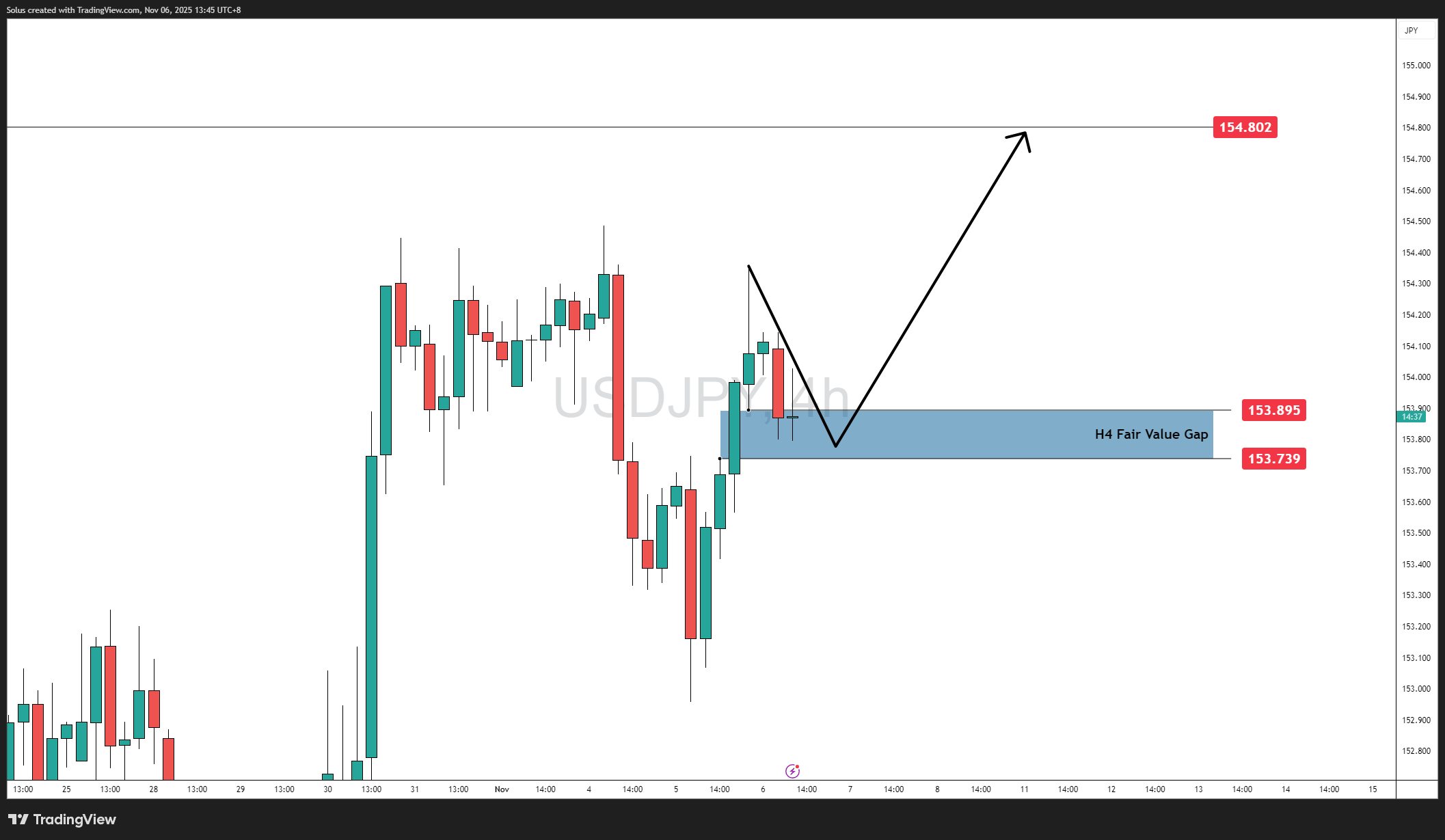
If the H4 Fair Value Gap holds, expect a rebound toward 154.80 followed by a potential extension into 155.30.
Confirmation signs:
- Bullish reaction from within 153.70–153.90.
- Break of minor intraday structure (M15–H1) to the upside.
- Continued Dollar strength and firm U.S. yields.
Bullish targets:
- 154.80 → 155.30 → 156.00
Bearish scenario: FVG failure and structural shift
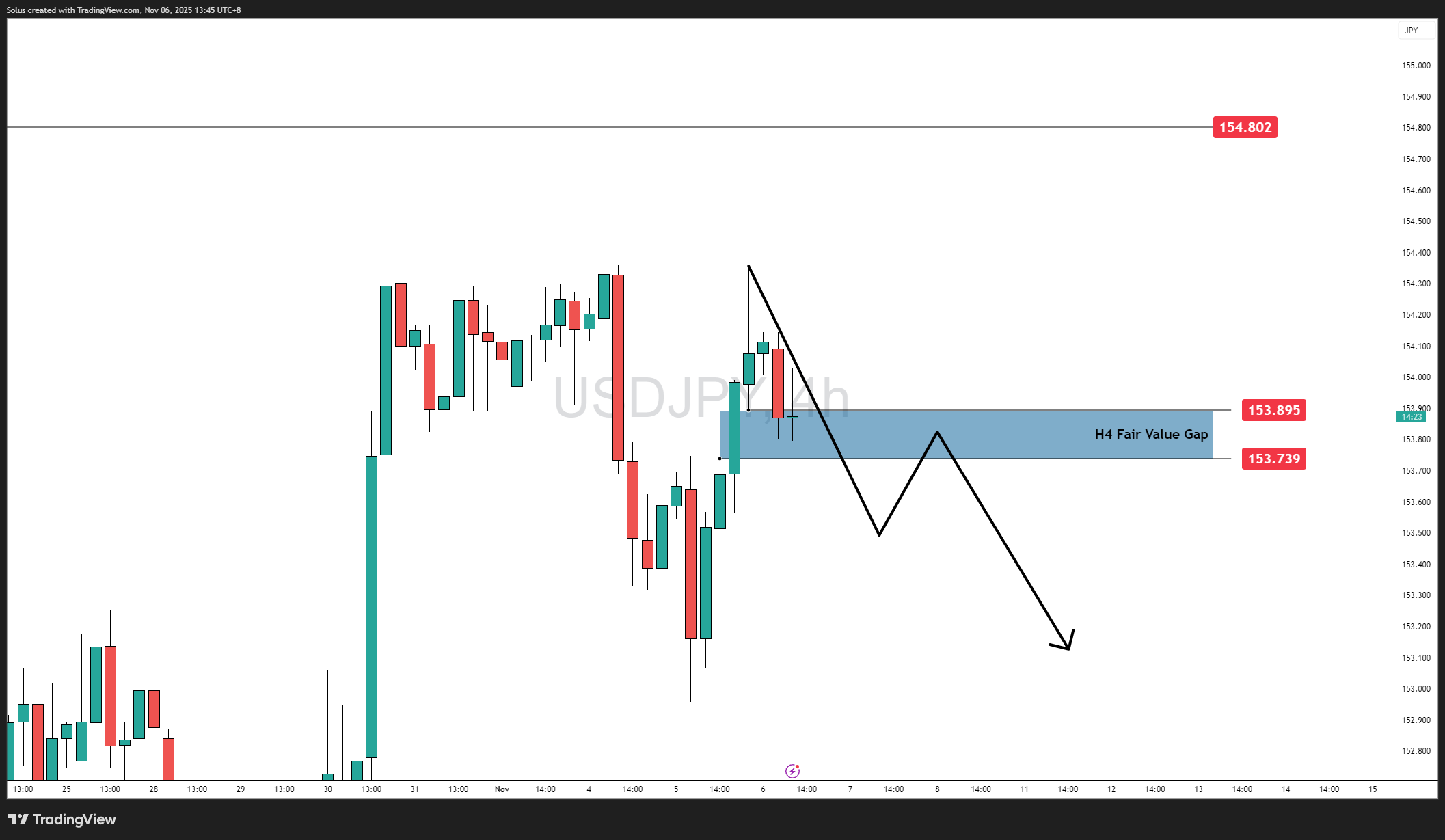
A decisive break below 153.70, followed by a close beneath 153.30, would imply that the market is entering a short-term distribution phase. This could trigger a correction toward 152.80–152.00, aligning with prior liquidity lows and untested demand zones.
Bearish confirmation:
- Sustained weakness below 153.30.
- Global risk-off sentiment or hints of BOJ intervention rhetoric.
Downside targets:
- 152.80 – 152.00
Market outlook summary
Bias | Key Zone | Target | Invalidates |
|---|---|---|---|
Bullish | 153.739–153.895 (H4 FVG) | 154.80 → 155.30 | Below 153.30 |
Bearish | Breakdown below 153.30 | 152.80 → 152.00 | Above 154.20 |
Final thoughts
USD/JPY remains one of the most yield-sensitive pairs in the FX market. The BOJ’s dovish persistence and Fed’s relative tightness form the backbone of the pair’s uptrend, keeping buying interest intact above the 153.70 region.
However, traders should remain cautious ahead of U.S. data releases and BOJ commentary, as any sudden shift in tone could spark short-term volatility.
For now, the technical and fundamental landscapes align toward continuation — provided the H4 Fair Value Gap holds as support.
Author

Jasper Osita
Independent Analyst
Jasper has been in the markets since 2019 trading currencies, indices and commodities like Gold. His approach in the market is heavily accompanied by technical analysis, trading Smart Money Concepts (SMC) with fundamentals in mind.















