USD/JPY Forecast: Seems vulnerable near two-week low as BoJ’s Ueda lift rate hike bets
- USD/JPY kicks off the new week on a downbeat note as BoJ rate hike bets boosts the JPY.
- Dovish Fed expectations drag the USD to a two-week low and contribute to the downfall.
- Traders now look forward to this week’s important US macro releases for a fresh impetus.

The USD/JPY pair attracts heavy selling on Monday and sticks to its intraday losses around mid-155.00s, or a one-and-a-half-week low, during the early European session. Bank of Japan (BoJ) Governor Kazuo Ueda offered the strongest signal yet of an interest rate hike later this month. This, along with a weaker risk tone, provides a goodish lift to the safe-haven Japanese Yen (JPY) and exerts downward pressure on the currency pair amid a bearish tone surrounding the US Dollar (USD).
In a speech to business leaders in the city of Nagoya, Ueda said that the likelihood of the BoJ's economic and price projections being met is rising and signaled that conditions for a rate hike were falling into place. Traders were quick to react and are now pricing in a roughly 80% chance of a rate hike at the December 18-19 BoJ policy meeting, up from around 60% last week. This, in turn, pushed the rate-sensitive two-year Japanese government bond (JGB) yield to 1% for the first time since June 2008, and the 20-year yield to levels not seen since November 2020. The resultant narrowing of the rate-differential between Japan and other major economies turns out to be a key factor driving flows towards the lower-yielding JPY.
On the economic data front, Japan's Ministry of Finance reported earlier today that Capital Spending rose for the third straight quarter, by 2.9% from a year earlier during the July-September quarter. This, however, marks a notable slowdown from the 7.6% rise recorded in the previous quarter. Japan's Composite PMI 2025 was finalized at 52.0 for November, up from 51.5 in the previous month. This pointed to modest growth in the overall private sector due to a combination of the slower decline in factory activity, which shrank for the fifth straight month, and continued growth in services. This, however, does little to dent the intraday bullish sentiment surrounding the JPY or lend any support to the USD/JPY pair.
The USD, on the other hand, drops to a nearly two-week low amid the growing acceptance that the Federal Reserve (Fed) will lower borrowing costs again this month. The bets were reaffirmed by the recent comments from several Fed officials. Even a mixed set of US economic data released last week did little to dent expectations and continues to undermine the buck. This, in turn, exerts additional downward pressure on the USD/JPY pair and backs the case for a further near-term depreciating move. Traders now look forward to this week's important US macro releases, starting with the ISM Manufacturing PMI later today, which will influence the USD price dynamics and provide some impetus to the currency pair.
USD/JPY 4-hour chart
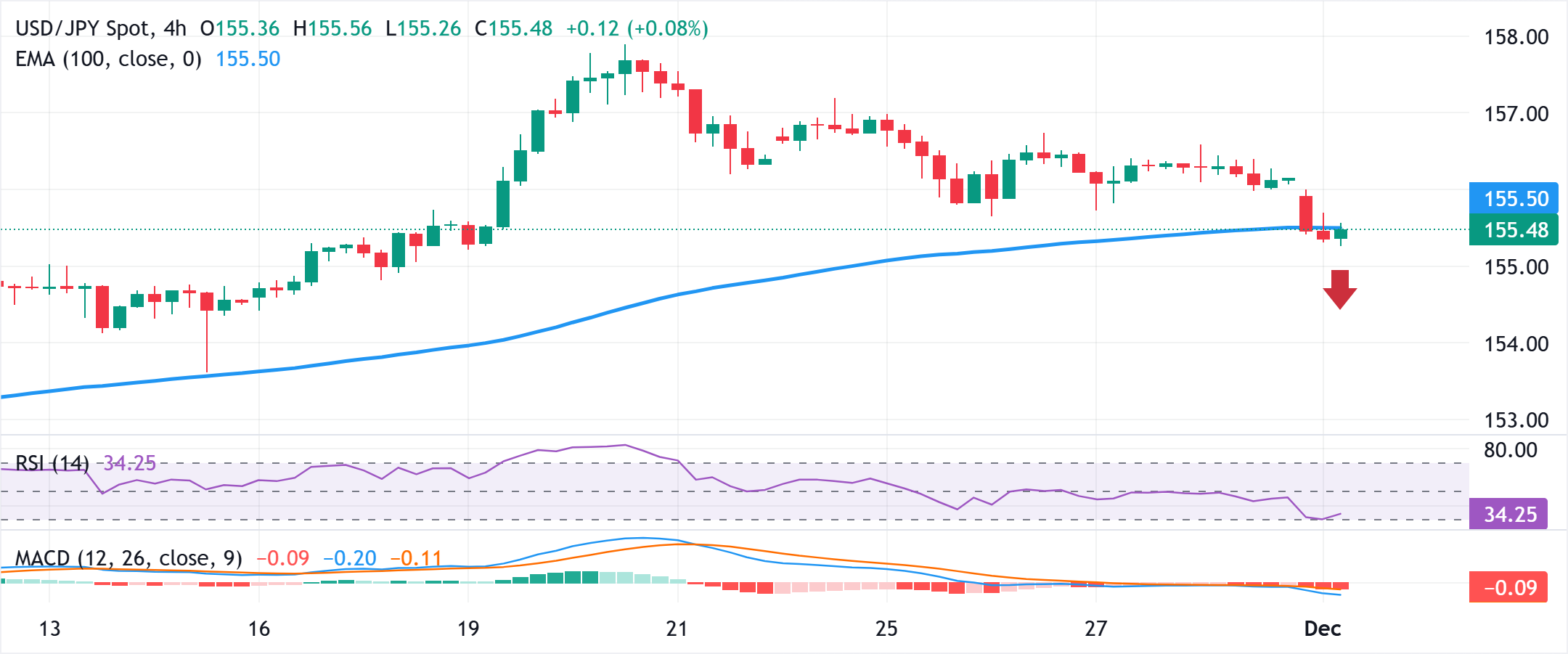
Technical Outlook
The USD/JPY pas now seems to have found acceptance below the 155.40-155.30 support, marking the 100-period Simple Moving Average (SMA) on the 4-hour chart. Oscillators on the said chart have been gaining negative traction, though technical indicators on the daily chart are still holding in positive This, in turn, suggests that spot prices could find decent support near the 155.00 psychological mark. Some follow-through selling, however, will confirm a breakdown and set the stage for an extension of a one-week-old downtrend.
On the flip side, any meaningful recovery attempt might now confront an immediate hurdle ahead of the 156.00 round figure. A sustained strength beyond could trigger a short-covering move towards the 156.65-156.70 region, above which the USD/JPY pair could reclaim the 157.00 mark. The momentum could extend further toward the 157.45-157.50 intermediate hurdle en route to the multi-month high, around the 158.00 neighborhood, touched in November.
Author

Haresh Menghani
FXStreet
Haresh Menghani is a detail-oriented professional with 10+ years of extensive experience in analysing the global financial markets.