|

USD/JPY bear flag points towards 151.70
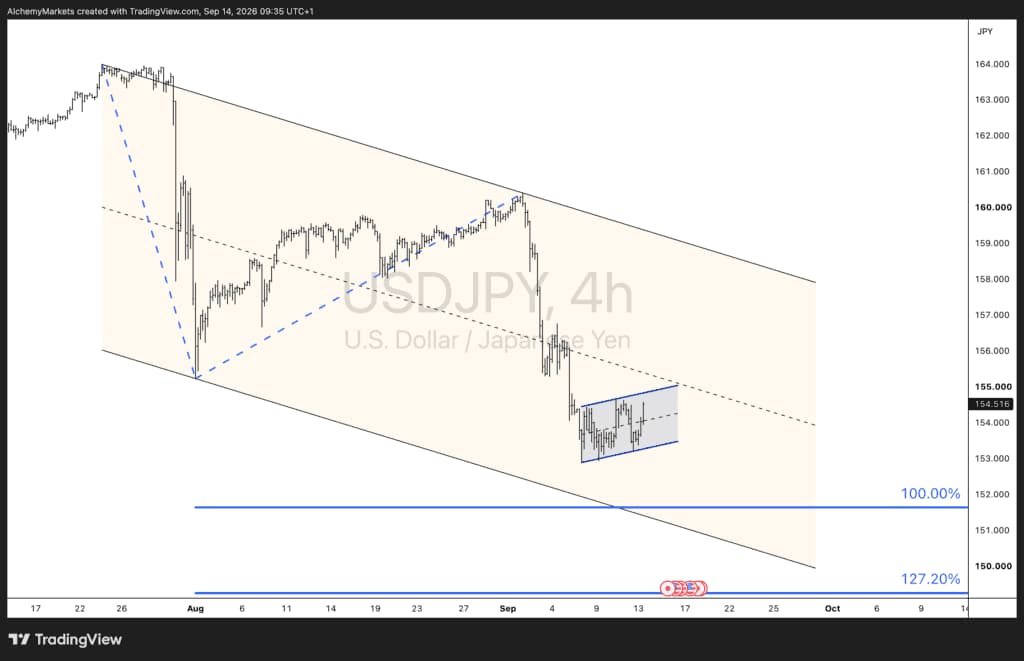
USD/JPY remains technically heavy on the four-hour chart, with price continuing to trade inside the broader descending channel that has controlled the pair since the late-July high near 164.00.
usdjpy

The latest move lower has taken USD/JPY from around 160.00 towards the 153.00–154.00 region. Since then, price has started consolidating inside a small upward-sloping channel. Given that this consolidation follows a sharp bearish impulse, the structure resembles a bear flag rather than the beginning of a meaningful reversal.

The key area to watch is the lower boundary of the flag around 153.30–153.50. A clean break below this area would signal that sellers are regaining control and could open the door for another leg lower.

The technical target comes from projecting the previous bearish leg from the flag structure. The 100% Fibonacci extension sits around 151.70, making this the first major downside objective. Importantly, that level also sits close to the lower boundary of the broader descending channel, creating additional technical confluence.

For now, therefore, the bias remains bearish while USD/JPY stays contained beneath the flag resistance and the broader falling channel. A break below the flag would strengthen the case for 151.70, while a sustained move above roughly 155.00–155.30 would weaken the immediate bearish setup and suggest the consolidation may have further to run.

Key level: 153.30–153.50 bear-flag support
Bearish target: 151.70 – 100% Fibonacci extension
Invalidation area: sustained break above 155.00–155.30

ChatGPT can make mistakes. Check important info.

Author

Zorrays Junaid

Zorrays Junaid

Alchemy Markets

Zorrays Junaid has extensive combined experience in the financial markets as a portfolio manager and trading coach. More recently, he is an Analyst with Alchemy Markets, and has contributed to DailyFX and Elliott Wave Forecast in the past.


More from Zorrays Junaid
Share:

Editor's Picks

AUD/USD shows resilience below 38.2% Fibo. near mid-0.7100s

The AUD/USD pair touches a one-and-a-half-week low, around the 0.7140 region during the Asian session on Monday, though it lacks follow-through. Spot prices currently trade just above mid-0.7100s, down nearly 0.25% for the day.


USD/JPY: Japanese Yen edges lower vs USD amid Middle East jitters as Fed, BoJ meetings loom

The USD/JPY pair attracts some buyers at the start of a new week and climbs closer to the 154.00 mark during the Asian session, reversing a part of Friday's losses. Spot prices, however, remain confined in a range held over the past week or so and within striking distance of a nearly seven-month low, touched last Tuesday, as traders await this week's key central bank events.


Gold: Fed’s rate decision to drive the next move
Gold reflects a subdued performance at the start of the Federal Reserve’s (Fed) monetary policy week at around $4,330. Fed’s interest rate expectations heavily influenced last week after the release of the hot United States (US) Producer Price Index (PPI) and Consumer Price Index (CPI) reports for August.
Pi Network extends gains as ecosystem development supports recovery

Pi Network (PI) extends its recovery on Monday, trading above $0.097 after two consecutive weeks of gains. Continued ecosystem development and improved developer tools are boosting utility. Meanwhile, the technical indicators point to a tentative recovery, but overhead Exponential Moving Averages remain a challenge and cap PI gains.

Canada CPI expected to show steady inflation in August

Canada’s August Consumer Price Index figures will be the focus of attention when published on Monday. Indeed, Statistics Canada data will provide markets with an update on price pressures following the Bank of Canada’s September 2 meeting, when officials kept the interest rate steady at 2.25%, broadly in line with analyst consensus.

Venezuela’s 65-billion-barrel Oil deal could reshape America’s inflation fight
The United States (US) has secured unprecedented access to part of Venezuela’s vast Oil reserves. The timing is particularly significant as the war with Iran is disrupting Middle Eastern supplies, keeping energy prices elevated and reviving concerns about inflation.