USD/JPY August outlook: Diverging central bank policies keep Yen under pressure

BoJ stance and domestic dynamics
The BoJ maintained its policy rate at 1.00% via an 8-1 vote during its Jul 31 meeting while upgrading its economic outlook. The central bank signaled its intention to continue rate hikes, warning that core inflation might overshoot its 2% target in the near term. Nevertheless, the broader economic outlook remains bright, underpinned by solid labor market dynamics and robust wage growth.
The BoJ projects 2026 real GDP growth at 0.6%. Meanwhile, officials revised headline inflation forecasts downward from 2.8% to 2.5%, largely reflecting the impact of government subsidies. Currently, inflation figures show signs of re-acceleration as energy price declines moderate and select subsidies expire, aligning inflation metrics more closely with underlying market realities. Consequently, the BoJ retains sufficient momentum to proceed with policy normalization, driving interest rates back into positive territory over the long term to maintain price stability and permanently extricate the economy from protracted deflation.
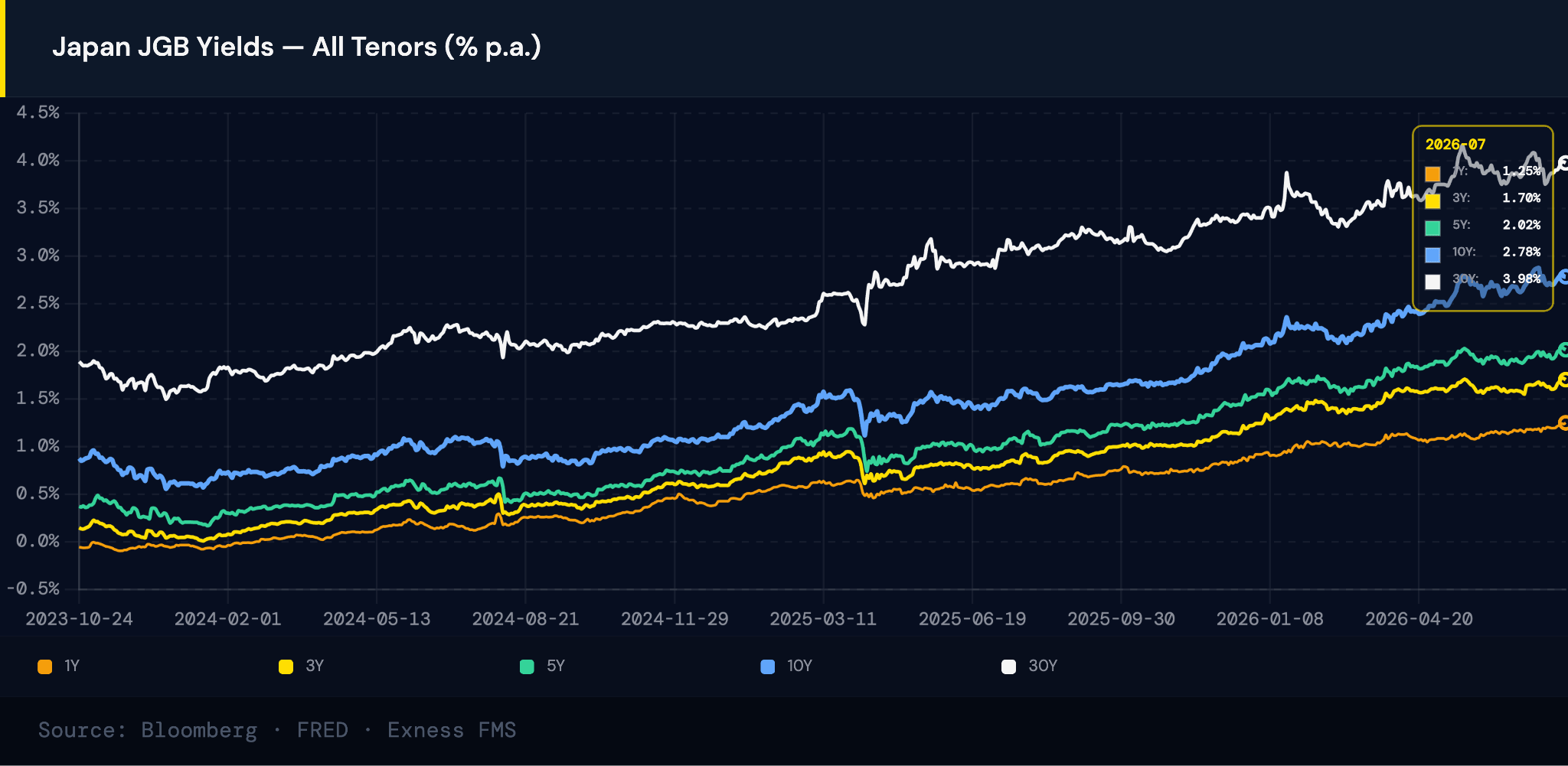
However, financial markets recently perceived the BoJ’s pace of two rate hikes per year as overly gradual, insufficient to curb cost-push inflationary pressures in a timely manner. This skepticism is visibly reflected in the bond market, where the 30-year JGB yield surged to around 4%, hitting a 30-year high. This repricing underscores market anxieties that inflation might spike abruptly rather than stabilizing near the BoJ’s target. This dynamic stands as a primary catalyst pushing the US dollar - yen pair upward toward historical lows for the yen. Despite three direct market interventions by the Ministry of Finance this year, yen rapidly resumed its downward trajectory following each episode.
US macro environment and yield differentials
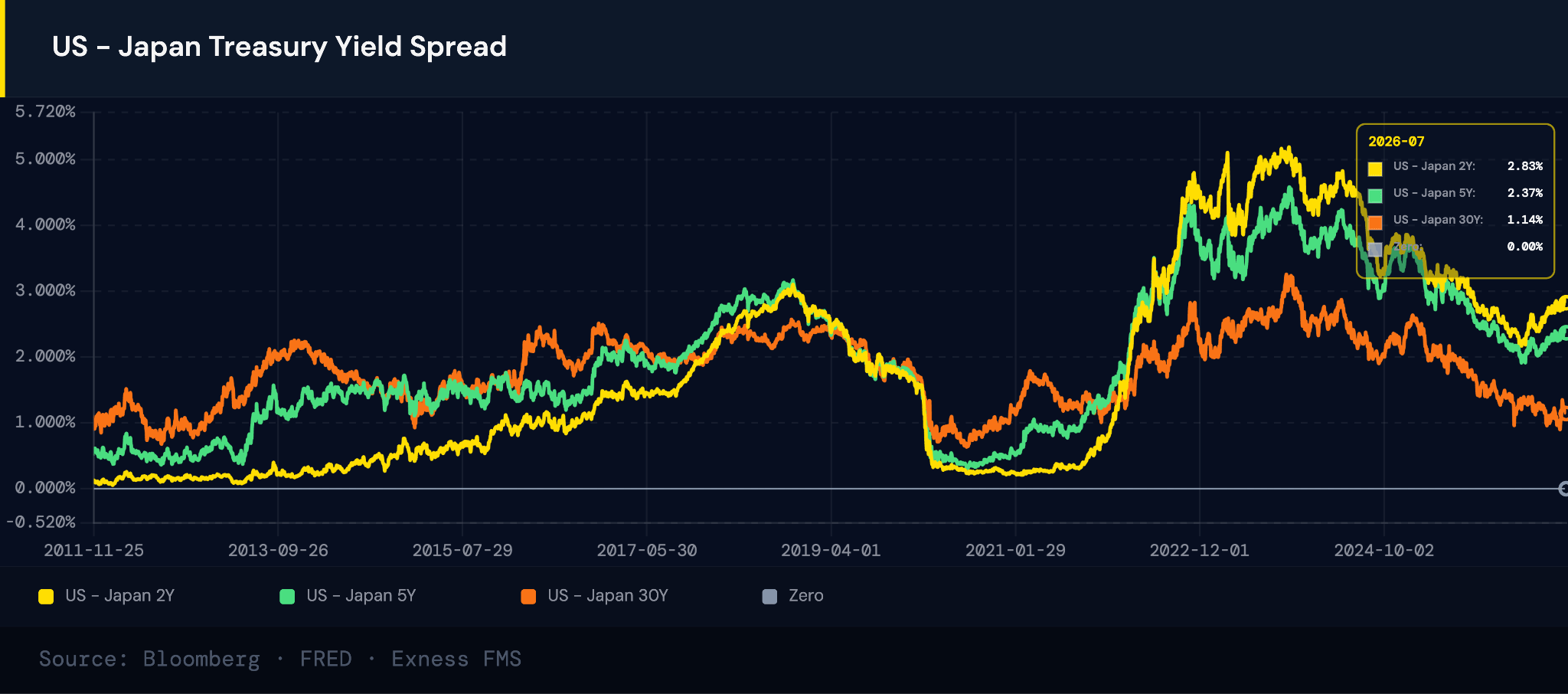
On the counter side, US dollar strength has acted as a major tailwind for the pair’s upside. The US-Japan 30-year sovereign yield spread widened sharply back to 2.83% by late July, driven by lingering market expectations of further Fed rate hikes this year, even after the Fed held the target rate steady at 3.50%-3.75% at its latest meeting.
Although US CPI moderated to 3.5% YoY in June, re-escalating Middle Eastern tensions spillovers into the Red Sea added another layer of supply-side pressure on global oil markets. Disruptions threaten key transit routes, including pipeline shipments of approximately 7 mln barrels per day from Saudi Arabia through the Red Sea. Consequently, crude oil prices remain elevated around 90 USD/bbl, compared to over 60 USD/bbl prior to the conflict and 70 USD/bbl following the June US-Iran ceasefire agreement.
The oil price variable poses a significant latent risk for an inflation rebound. Combined with resilient US consumer spending, inflationary pressures might prove structurally sticky. Although 2Q US GDP growth missed expectations at 1.5% YoY, a granular breakdown reveals robust personal consumption growth at 3.2% YoY, complemented by aggressive capital expenditure driven by AI infrastructure demand. Earnings guidance from Big Tech points to sustained, heavy capital allocation toward AI and cloud infrastructure through this year and next, positioning business investment as a primary GDP growth engine.
Accordingly, despite the Fed holding rates steady in July, the US 30-year Treasury yield surged to its highest level since 2007. This suggests the market remains deeply concerned about persistent US inflation, viewing the Fed's current stance and communication as insufficiently hawkish, thereby pricing in a higher likelihood of stricter monetary tightening ahead.
Market drivers and outlook
In summary, JPY faces dual-directional pressure:
- US dynamics: Hawkish market expectations regarding Fed monetary policy.
- BoJ dynamics: Perceived policy inertia by the BoJ, triggering market disappointment and JPY depreciation.
These combined forces continue to widen Treasury-JGB yield spreads, fueling Yen carry trades and driving further JPY depreciation.
A pullback in US Dollar - Yen would require a pivot in either force. For instance, a softer-than-expected upcoming US Non-Farm Payrolls (NFP) report might dial back US inflation expectations, weighing on the US dollar and offering relief to the yen. Conversely, increasingly hawkish communications from BoJ officials advocating for earlier rate hikes would provide structural support for the yen from the domestic side.
Technical analysis
USDJPY retested its ascending trendline and key support at 158.50 before staging a rebound, exhibiting mean-reversion behavior following a sharp sell-off. EMA contraction points to a temporary consolidation phase within the 158.50 – 160.70 range.
Bullish scenario: A decisive breakout above resistance at 160.70 might confirm trend continuation toward the next key resistance barrier at 163.60.
Bearish scenario: A failure to hold above 158.50 would risk breaking the long-term uptrend, exposing the pair to a deeper retracement toward secondary support around 156.50.
Author

Van Ha Trinh
Exness
Bachelor’s in Finance & Banking – Ho Chi Minh University of Banking Passed CFA Level II – CFA Institute CFA Research Challenge participant Over 10 years of experience across banking, brokerage, and analysis