USD/CHF Is On Track For A Bearish Engulfing Month (Which Forecasts April Showers)

With USD/CHF on the cusp of a bearish engulfing month, we take a look at the pattern’s forward returns alongside the Swiss franc’s seasonality.
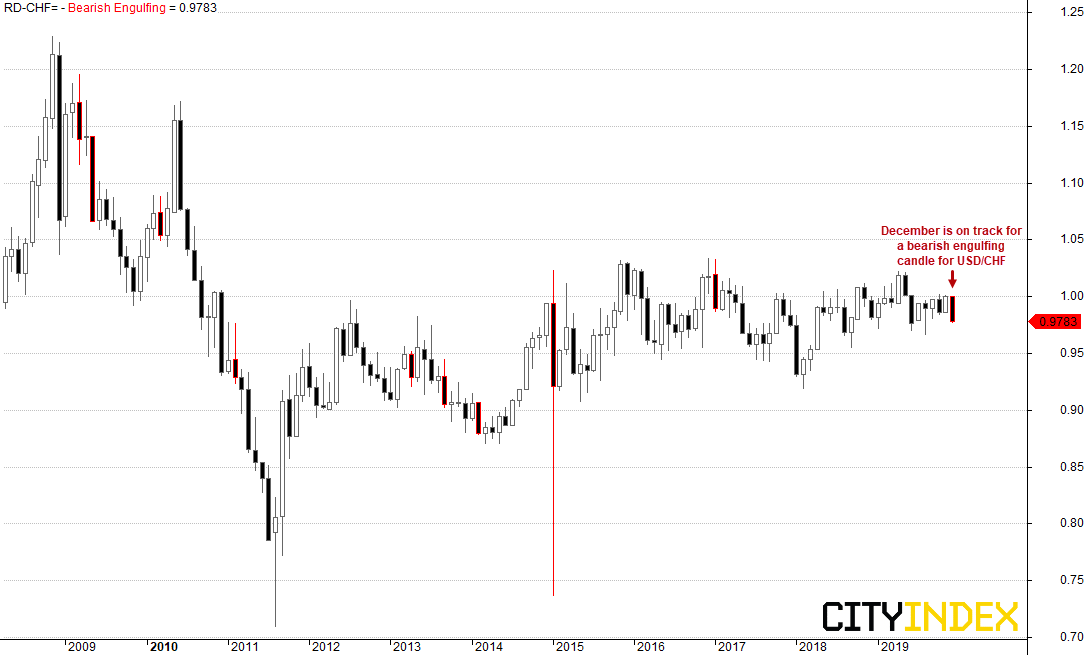
Unless USD/CHF can close above 0.9864 by the end of the year, its on track to close December with a bearish engulfing candle. It’s by no means a not a common event, having only occurred 19 times since 1982 and its last instance was in January 2017. But it does appear to be a bearish one overall looking at the forward returns.
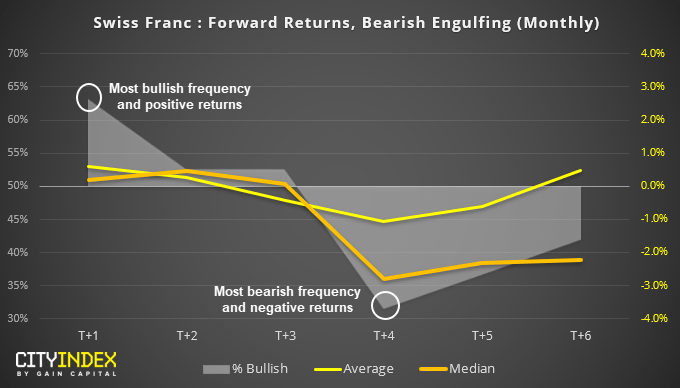
Monthly Reuters data since 1982
Yet again we see a pattern which reverses at T+1. This suggests that the probability of January being bullish is 63.1% if December closes with a bearish engulfing month. Also notice that both median and average returns are positive to show its not being supported by outliers.
The stats become a little murky at T+3 (February) as median returns are +0.2% whilst average returns are -6.8%. T+2 also closed higher 52.6% of the time, meaning less frequent yet more bearish returns weighed on the average. Ultimately, T+3 doesn’t fill us with confidence of a reliable read.
T+4 (April) provides the most compellingly bearish result, as it is bearish 68.4% of the time with average and median returns at -2.8% and -15.5% respectively. Given median returns are more ‘typical’, then it adds greater weight to the bearishness of the engulfing candle +4 months out.
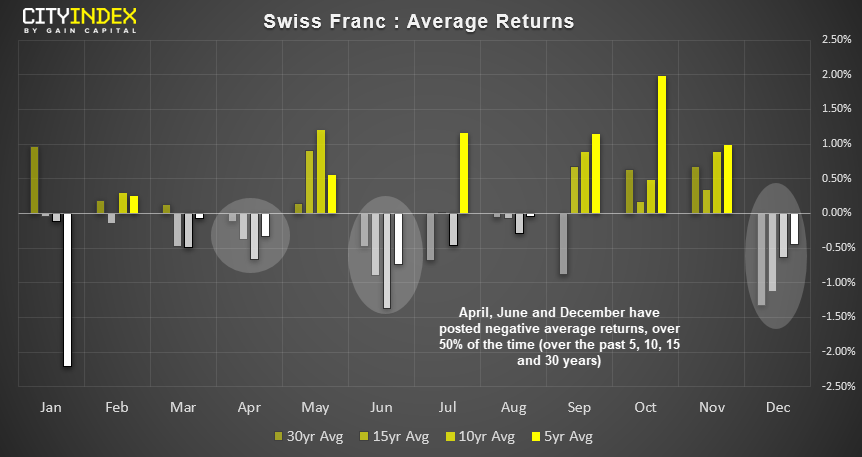
Seasonality points towards a rainy April:
Has luck would have it, April tends to be a bearish month according to seasonality. Moreover, April has provided negative average returns for USD/CHF over 50% over the past 5, 10, 15 and 30 years of data.
We can also see that December has followed its seasonal tendency for negative returns this month (albeit a miraculous turnaround before the end of the year).
Takeaways:
-
USD/CHF has followed its seasonal tendency in December and is likely to close lower
-
Monthly bearish engulfing candles have provided their most bearish returns +4 months after the pattern occurred.
-
Whilst the pattern flags April has a potentially bearish month, seasonality has also favoured the bears in April.
Author

Matt Simpson, CFTe, MSTA
CityIndex
Matt Simpson is a certified technical analyst who combines charts and fundamentals to generate trading themes.