USD/CAD Weekly Forecast: Safety vs oil
- Risk aversion and its retreat whipsaw markets on Thursday and Friday.
- WTI soars above $100 on Thursday, falls below $92 on Friday.
- Kyiv remained in Ukrainian hands on Sunday despite Russian assaults.
- Ukraine and Russian representatives to meet, according to the Ukrainian Defense Ministry.
- FXStreet Forecast Poll modestly favors the Canadian dollar.

The USD/CAD rode the Ukrainian risk aversion wave on Thursday, closing at 1.2806, above 1.2800 for the first time this year, only to crash back to 1.2700 as the fear waters receded on Friday.
-637815880475926041.png)
Crude prices jumped 8.8% peaking at $100 on Thursday, stocks swooned and Treasuries and the US dollar were the risk antidote of choice. In the equity, credit and commodity markets, the fear lasted until about mid-day in New York. By the market close on Thursday, the S&P 500, the Dow and the Nasdaq were in the black, recovering from respective declines of 2.6%, 2.6% and 3.5%. Treasury yields had nearly returned to their start line and West Texas Intermediate (WTI) finished at $92.84, just 1% higher on the day.
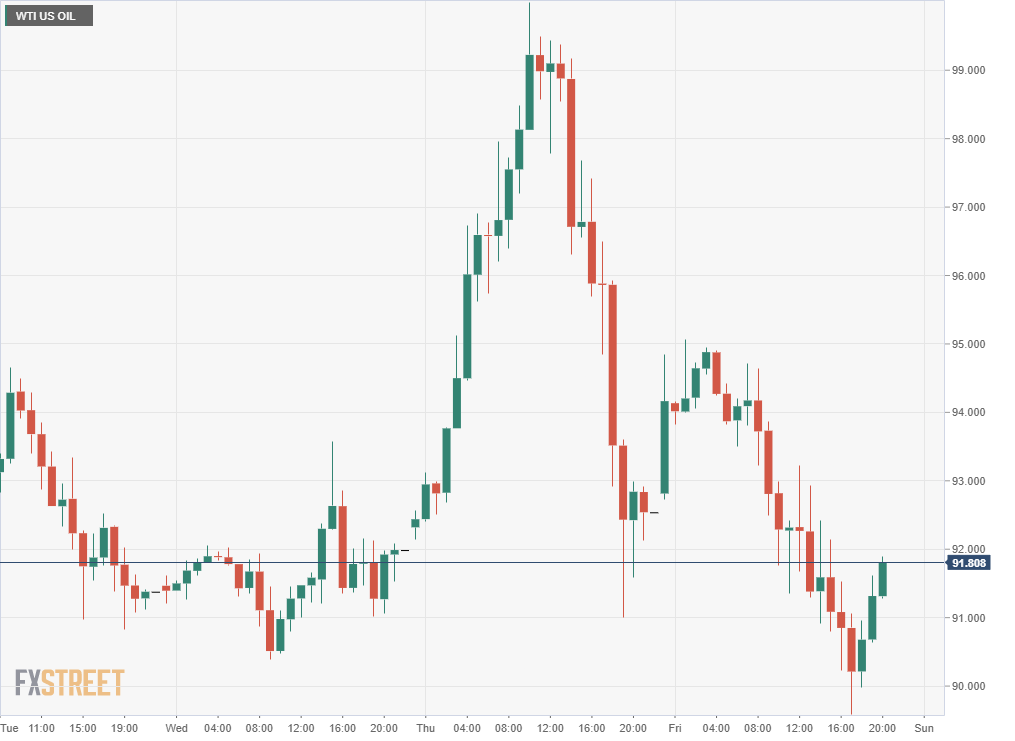
The USD/CAD closed the week at 1.2700, down 40 points from Monday’s open having surrendered all of its Thursday US dollar safety premium to 1.2878 in Friday’s general market recovery.
Thursday's run higher in the USD/CAD took place despite the almost 9% jump in the price of WTI. Normally, oil is a good proxy for the Canadian dollar, with the USD/CAD trading inversely to the price of WTI. In the shock of a full-scale invasion of Ukraine, fear of escalation and the vagaries of war, everything trended to the US dollar.
The violent revaluation of risk continued on Friday with the Dow climbing 834 points 2.15%, the S&P 500 adding 2.24% 95.95 points and the Nasdaq climbing 2.25%, 221.04 points.
Treasury yields were largely unchanged on Friday with the 10-yield at 1.97% and the 30-year off less than a point at 2.285%. The commercial benchmark 10-year rose 2 basis points to 1.57%.
North American crude dropped below $90 in afternoon trading on Friday, before recovering to finish at $91.81.
Markets and the Ukraine
The rapid recovery of global markets reflected the judgment on Friday that the Russia invasion, whatever its political outcome, would not cause great dislocation in the global economy.
That opinion had been fostered by the unwillingness of the US and its allies to deny Russia access to the SWIFT international payments system or the Society for Worldwide Interbank Financial Telecommunication, which facilitates financial transactions and bank funds transfers worldwide. Without SWIFT the Russian government and financial institutions would be isolated from most international business transactions, including payments from oil exports.
Germany and Hungary, which had been blocking the move to cut Moscow’s SWIFT access decided over the weekend, to remove selected Russian banks from the system, though the details and timing are not determined.
European and American sanctions have not targeted the Russian energy industry. Such an effort would be extremely costly to Russia which earns 40% of its revenue from energy resources.
Germany gets about one-third of its oil and natural gas from Russia which makes a cut-off nearly impossible. Sanctions on Russian energy firms would send global oil prices and consumer prices sky high.
Russian President Validimir Putin wants to avoid a drawn-out struggle for Ukraine or an occupation and would undoubtedly prefer a compliant but national government in Kyiv. The Ukrainian Defense Ministry said on Sunday that representatives of the two countries have agreed to meet on the Ukraine-Belarus border “with no conditions.” Meanwhile the Russian assault on Kyiv continued though the city remained in Ukrainian hands.
There were no data releases in Canada.
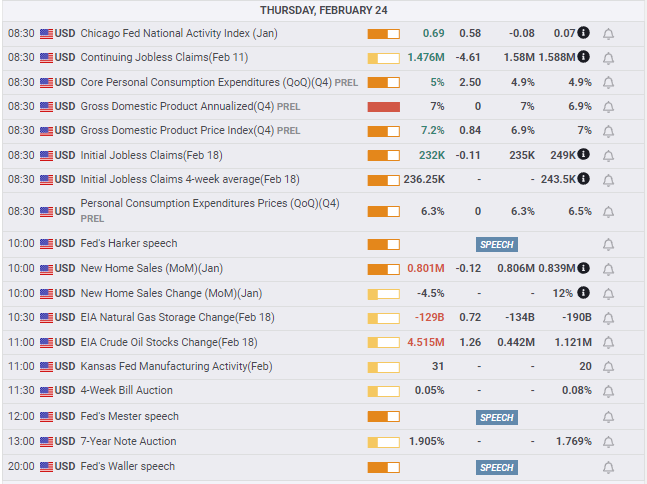
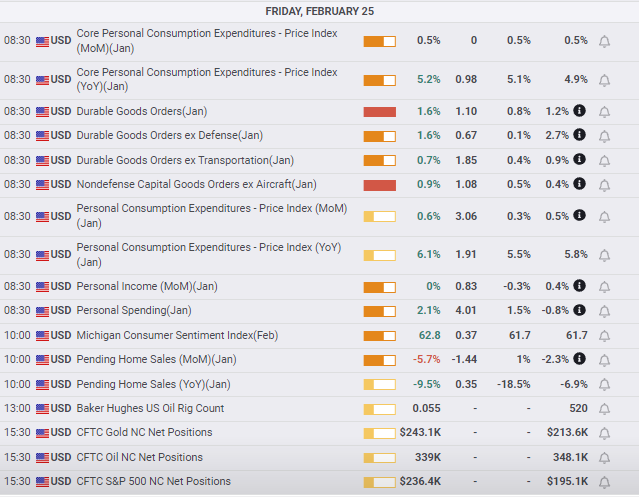
US information was generally better than anticipated. Fourth quarter GDP was revised to 7.2% from 6.9%. Markit’s manufacturing and services Purchasing Managers’ Indexes for February were slightly higher than expected. Durable Goods Orders for January, were, like Retail Sales, much more robust than forecast. The Personal Consumption Expenditure Price Index rose to a new record at 6.1% in January, far ahead of its 5.5% forecast and December’s 5.8% score. The core rate was 5.2%.
Curtailing Russian access to the SWIFT system seems designed to pressure Moscow to negotiate. Europe and the US are in a political and economic quandary. The most effective weapon against Russia, oil, would exact enormous damage on their own economies and come at a very high domestic political cost.
With Russian president Vladimir Putin having taken the enormous invasion gamble, it is hard to see him stopping short of the prime goal of taking Kyiv and forcing a government on Ukraine.
Ukraine will remain the market focus, with oil the barometer of risk. Sanctions on Russia’s energy industry is one obvious source of economic instability. Negotiations of any type between Russia and Ukraine will tend to restore market equanimity since once a cease fire is begun, a resumption of hostilities will be seen as unlikely.
USD/CAD outlook
The rush to dollar safety that was the first market response to the Russian invasion has reversed. Without an escalation of the conflict, it should not return. President Putin’s reported alert to Russia’s nuclear forces is probably more psychological than an actual tactical event but its impact on markets is unpredictable.
Nonetheless, wars are unpredictable. The US dollar and assets are the panic destination of choice, though a good portion of Thursday’s run to the greenback was from surprise. Further developments in the war are far less likely to provide a shock of that scale.
Absent that motivation, the potential for higher oil prices as the Ukrainian conflict drags on, should give the Canadian dollar an advantage.
Fed Chair Jerome Powell testifies in the House on Wednesday and the Senate on Thursday. He will be questioned on the risks of the Ukrainian conflict to the US and global economies.
Several regional Fed presidents have expressed their confidence that the bank will be able to execute its rate policy. Markets can expect the same opinion from Mr. Powell, with the necessary caveates for unexpected developments in Ukraine.
The US employment report for February on Friday should provide evidence that hiring continues apace. January’s PCE price will keep the Fed’s focus on inflation and only hurtling energy prices will distract the governors.
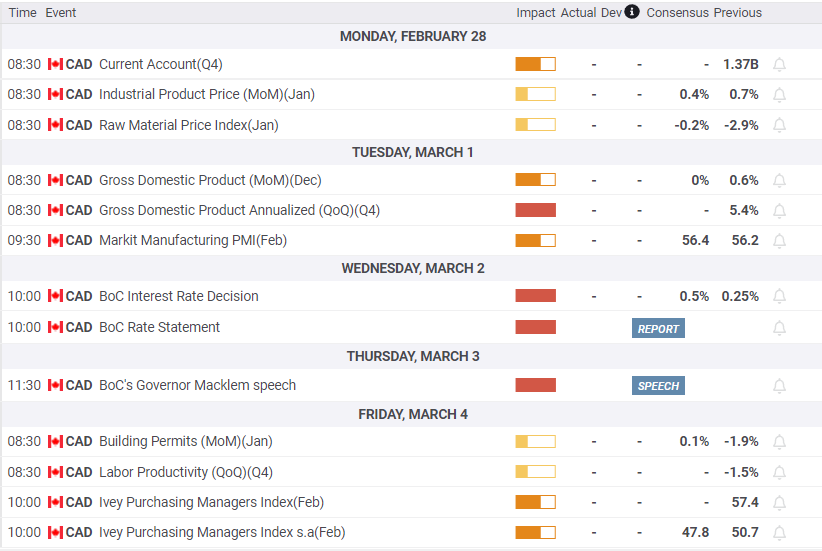
The Bank of Canada (BoC) meets on Wednesday. If Governor Tiff Macklem chooses a 0.5% increase, 0.25% is expected, the rate advantage shifts to the loonie. If the BoC stays conservative, the speculative prospects move to the Fed until the March 16 meeting. Chair Powell can abet the possibility for a 0.5% hike by dwelling on inflation in his Congressional appearances.
With the large warning of unexpected developments in Ukraine and the global energy markets which could reignite the US dollar safety trade, the outlook for the USD/CAD is lower.
Canada statistics February 21–February 25

US statistics February 21–February 25

FXStreet
Canada statistics February 28–March 4
FXStreet
US statistics February 28–March 4


USD/CAD technical outlook
Friday's close at 1.2700 is nearly at the middle of the three-month range, 1.2500 to 1.2950. The Relative Strength Index (RSI), not surprisingly, dropped to neutral after the back and forth on Thursday and Friday. The MACD (Moving Average Convergence Divergence) is close to the price line crossing the signal and headed lower. If the fundamental picture, primarily the possibility for higher oil prices, remains accurate, a cross would be considered a sell signal for the USD/CAD. The Average True Range (ATR) volatility rose sharply in the second half of the week and seems likely to remain elevated.
 tech 1-637815899824478993.png)
The 21-day moving average (MA) crossed over the 50-day MA on Monday heading higher. It had been below the longer average since January 18. Given that the USD/CAD is hostage to the dollar safety trade and that it ended the week at 1.2700, the trend signal from Monday can be ignored.
Technically, the USD/CAD is heavy having crossed the 21-dayMA and the 50-day MA in Friday's plunge.
 tech 2-637815910224206797.png)
Resistance: 1.2725 (21-day MA 1.2723), 1.2760, 1.2810, 1.2840, 1.2900
Support: 1.2700 (50-day MA 1.2700), 1.2670, 1.2650, 1.2620
FXStreet Forecast Poll
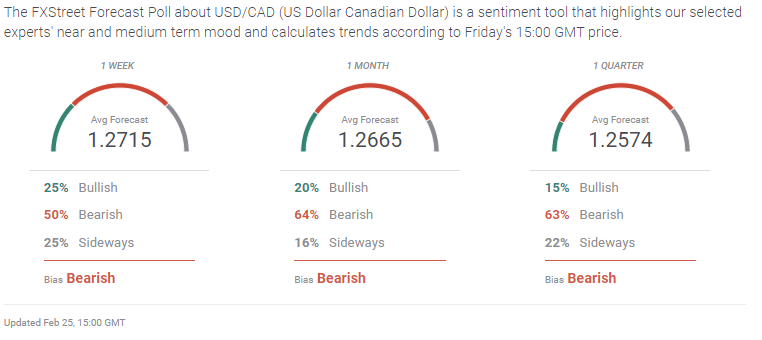
The FXStreet Sentiment Poll is negative out to one quarter with very weak bullish sentiment in all three time frames.
Author

Joseph Trevisani
FXStreet
Joseph Trevisani began his thirty-year career in the financial markets at Credit Suisse in New York and Singapore where he worked for 12 years as an interbank currency trader and trading desk manager.