USD/CAD Weekly Forecast: Energy jitters propel the Canadian dollar
- USD/CAD falls 1% on the week, 3.4% since May 12.
- WTI gains 3.4%, closes at a three-month high.
- BoC Deputy Governor Beaudry suggests larger rate hikes ahead.
- FXStreet Forecast Poll predicts a weak downside advantage then consolidation.

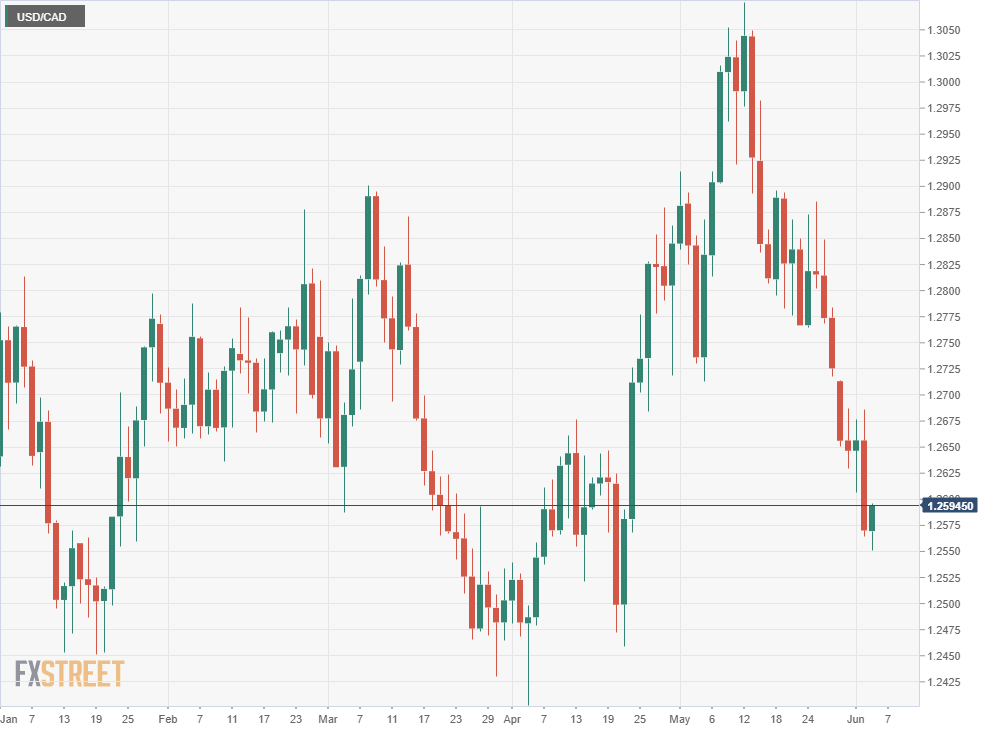
The US dollar managed a small recovery against the loonie on Friday backed by a strong US payroll report, but that barely altered the dismal record that has seen the USD/CAD drop 1% this week and 3.4% since May 12.
Rising oil prices have underpinned the Canadian dollar’s ascent. Since closing at $98.41 on May 10, West Texas Intermediate (WTI) has soared 20.7%, finishing at $118.77 on Friday, a three-month high. Except for the spike in WTI following the Russian invasion of Ukraine on February 24, crude prices are at levels not experienced since the collapse of the oil bubble just prior to the financial crisis of 2008 and early 2009.
-637899719558856988.png)
Energy prices dominated currency market views as USD/CAD fell despite a sharp and general rise in US Treasury yields. From last Friday’s close, the US 10-year yield added 20 basis points to 2.941% and the 2-year climbed 17 points to 2.657%.
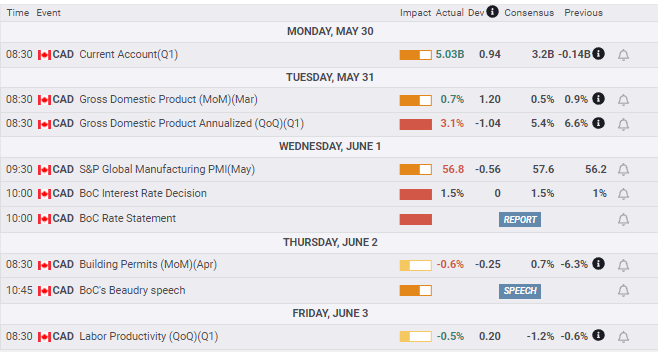
The Bank of Canada’s (BoC) half-point hike in the base rate on June 1 to 1.5% was incidental to the USD/CAD’s fall. The increase has been anticipated for many weeks and it will be duplicated by the Federal Reserve on June 15 to the identical end for the fed funds rate at 1.5%. The same can not be said for Deputy BoC Governor Paul Beaudry’s comment on Thursday that a 75 basis point hike was very possible at the July 14 meeting. He gave the loonie a nearly one figure boost for the day, noting that policy makers were wrong about transitory inflation and there was a real chance that price increases were becoming entrenched.
Canadian economic data was minor. The S&P Global Manufacturing PMI for May was a bit weaker than forecast though slightly better than April. Annualized GDP in the first quarter was just 3.1% rather than the 5.4% expectation and less than half the 6.6% pace in the final three months of last year.
Data releases on both sides of the border were headed by the US payroll report on Friday and its impact on Federal Reserve policy. US Nonfarm Payrolls: Just what the Fed ordered
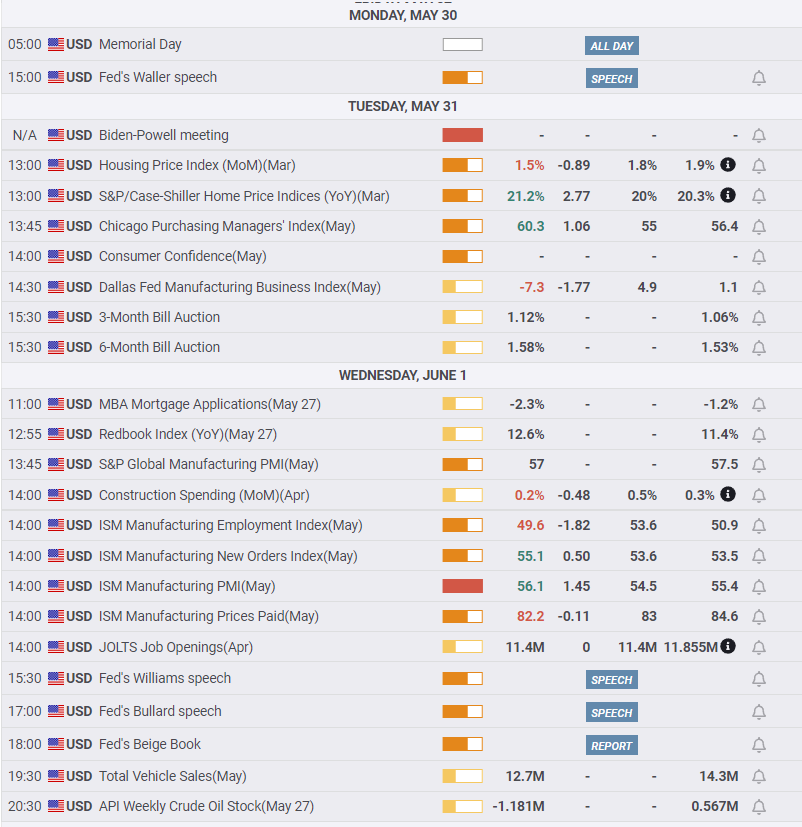
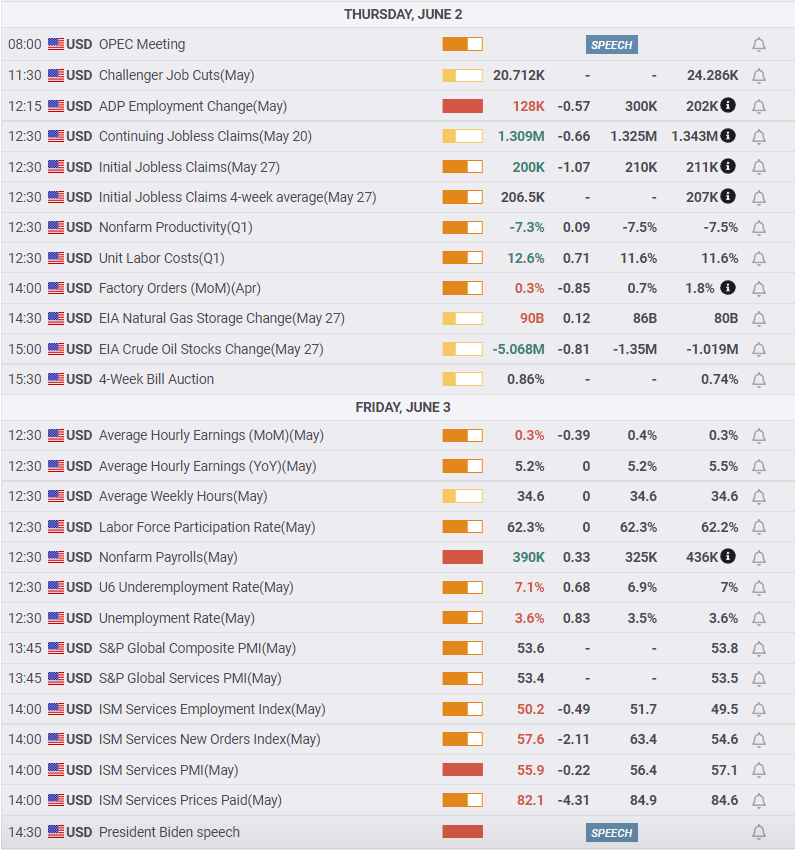
The US economy added 390,000 workers to the official job rolls in May, better than the 325,00 forecast and more than sufficient to keep Fed tightening policy in place. Wage increases for the year at 5.2% were lower than forecast and likely to speed the decline in consumer purchasing power when CPI is reported this coming Friday.
Purchasing managers’ indexes for May were mixed with all manufacturing gauges except employment better than predicted while the measures for the service sector were uniformly weaker.
Treasury futures have the odds for a 50 basis point increase at the June 15 meeting at 98.2% with 1.2% for a 75 point hike. For the July 27 meeting the odds are 88.6% for a 50 basis points move, 11.3% for 75 points and 0.3% for 100 points.
USD/CAD outlook
The combination of rising oil prices and a potentially more aggressive BoC should keep the Canadian dollar bid but the scope for further loonie improvement is controlled by the energy market.
In just three weeks the USD/CAD has fallen nearly the breadth of its six-month range, a distance that the pair has traversed three times to no conclusion since November. The decline in the USD/CAD has been paralleled by the rise in oil prices.
The Federal Reserve is next in the rate round robin but unless it springs a 0.75% surprise the June 15 increase will have little or no market impact. Since the Fed’s first intimation of a policy change last October, Chair Jerome Powell has been very careful to make its intentions known. With inflation slightly lower in the past two months there is no reason to expect the Fed to escalate its fight with a 0.75% increase on June 15.
This month’s start of the Fed's balance sheet reduction has not pushed Treasury rates above their early May highs and, like the fed funds rate, the current amount is fully priced into market values.
The general retreat of the US dollar over those weeks, prompted by reversing Treasury yields, has been true in all pairs except the USD/JPY.
Recession fears in the US, whether from an inflation-induced drop in consumer spending or from the cumulative impact of the Fed’s rate hikes have equity markets on the run but that has not generated a safety-trade enhancement of the US dollar. The dollar's recent ups and downs have been mediated by the credit markets.
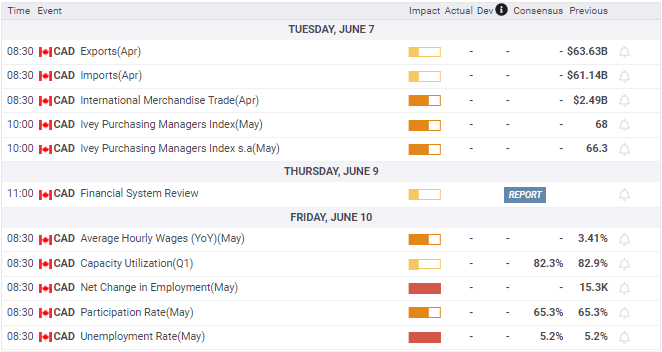
The Canadian employment report and the Ivey PMI for May out next week will be of informational value only.
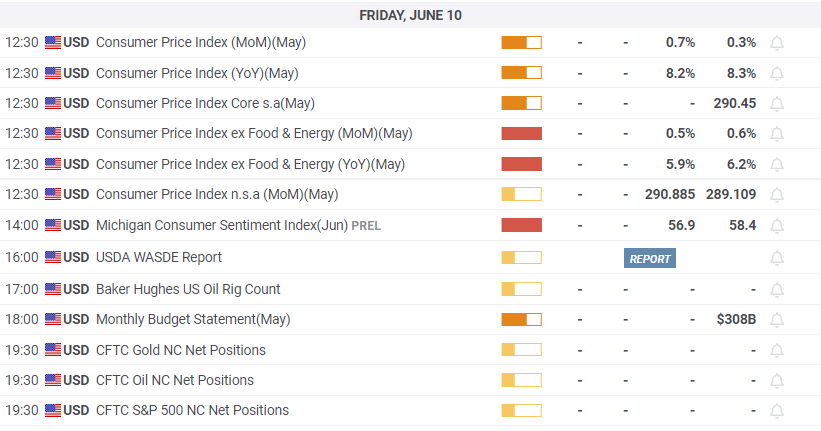
In the US, May CPI on Friday is the main data event. It is forecast to slip to 8.2% from 8.3%. For April the negative spread between CPI and annual Average Hourly Earnings (AHE) was 2.8% (8.3%- 5.5%). Earnings were 5.2% last month, every step of inflation above 8.0% increases the loss to consumer purchasing power and makes the Fed's anti-inflation campaign more imperative.
Inflation in the US is a linear function with Treasury rates and the dollar–higher CPI, higher yields and a rising dollar and the reverse.
The outlook for the USD/CAD is lower but contained within the range of the last six months.
Canada statistics May 30–June 3
FXStreet
US statistics May 30–June 3
FXStreet
Canada statistics June 6–June 10
FXStreet
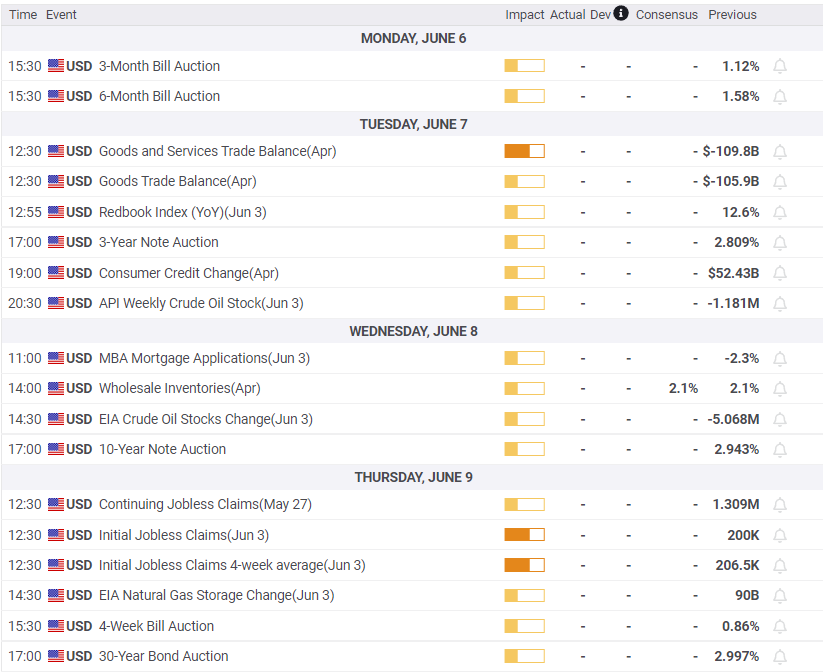
US statistics June 6–June 10
USD/CAD technical outlook
The MACD (Moving Average Convergence Divergence) remains in negative territory, its deepest penetration since early April but the spread between the signal and price lines has not widened. The urgency of the decline is slackening. The Relative Strength Index (RSI) showed a slight uptick from Thursday to Friday, another indication that selling energy may be waning. Average True Range (ATR) has been falling as the USD/CAD has descended with barely a rise for Thursday's figure long plunge. All three indicators suggest the USD/CAD decline has lost energy.
 tech2-637899743651563078.png)
The 200-day moving average at 1.2662 was significant support on Monday and effective resistance on Tuesday, Wednesday and Thursday.
 tech 2-637899755969363350.png)
Resistance: 1.2620, 1.2645, 1.2660, 1.2670, 1.2700
Support: 1.2570, 1.2550, 1.2525, 1.2500, 1.2475
Moving Averages: 21-day 1.2816, 50-day 1.2715, 100-day 1.2699, 200-day 1.2662
FXStreet Forecast Poll
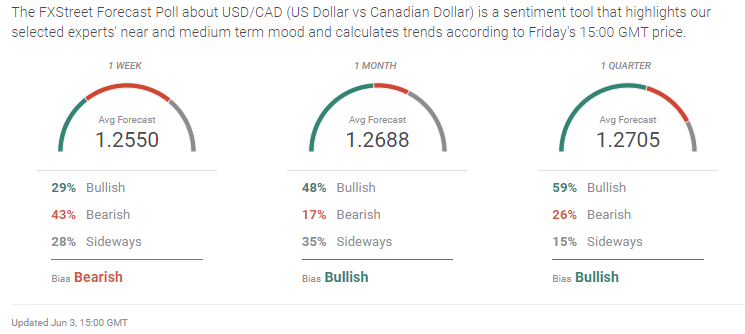
The FXStreet Forecast Poll suggests the USD/CAD decline has run its course.
Author

Joseph Trevisani
FXStreet
Joseph Trevisani began his thirty-year career in the financial markets at Credit Suisse in New York and Singapore where he worked for 12 years as an interbank currency trader and trading desk manager.