USD/CAD Price Forecast: Post-BoC breakdown below 1.3700 favors bearish traders
- USD/CAD struggles to register any recovery against a bearish fundamental backdrop.
- Hopes for a US-Canada trade deal and an uptick in Crude Oil prices underpin the Loonie.
- Fed rate cut bets and US fiscal concerns cap the USD and validate the negative outlook.


The USD/CAD pair extended its bearish consolidation phase through the early European session on Thursday and hangs near its lowest since October 2024 touched the previous day. The Canadian Dollar (CAD) continues to draw support from reports that a trade deal between the US and Canada could happen before the G7 Summit on June 15. Adding to this, the Bank of Canada's (BoC) decision to keep interest rates steady for the second time in a row, along with an uptick in Crude Oil prices, underpins the commodity-linked Loonie and acts as a headwind for the currency pair. However, a modest US Dollar (USD) bounce could help limit deeper losses ahead of key risks.
The BoC, as was widely expected, held its key benchmark rate at 2.75% at the end of the June monetary policy meeting but said that another cut might be necessary if the economy weakened in the face of tariffs. In the post-meeting press conference, BoC Governor Tiff Macklem said that the trade conflict remains the biggest headwind facing the Canadian economy. In fact, Trump's doubling of tariffs on steel and aluminum imports to 50% kicked in on Wednesday and is expected to hit Canada hard as it is the top exporter to the US. The negative factors, however, were offset by weaker-than-expected US economic releases, which lifted bets for further rate cuts by the Federal Reserve (Fed).
Automatic Data Processing (ADP) reported that US private sector employers added only 37K jobs in May, well below consensus estimates and marking the lowest level since March 2023. Adding to this, April's reading was revised to 60K from 62K reported originally, highlighting continued easing in the US labor market. Meanwhile, a survey from the Institute for Supply Management (ISM) showed that business activity in the US services sector unexpectedly contracted in May for the first time since June 2024. The US ISM Services PMI dropped to 49.9 last month from 51.6 in April. The data reaffirmed expectations that the Fed will lower borrowing costs further by the end of this year.
The resultant fall in the rate-sensitive two-year and the benchmark 10-year US Treasury yields to the lowest level since May 9 weighed heavily on the Greenback. Moreover, concerns that the US budget deficit could worsen at a faster pace than expected on the back of Trump’s flag-ship tax and spending bill cap a modest USD uptick on Thursday and suggest that the path of least resistance for the USD/CAD pair is to the downside. Traders now look forward to the release of the US Weekly Initial Jobless Claims, which, along with speeches from influential FOMC members, will drive the USD. The focus, however, remains on the monthly jobs reports from the US and Canada, due on Friday.
USD/CAD 4-hour chart
Technical Outlook
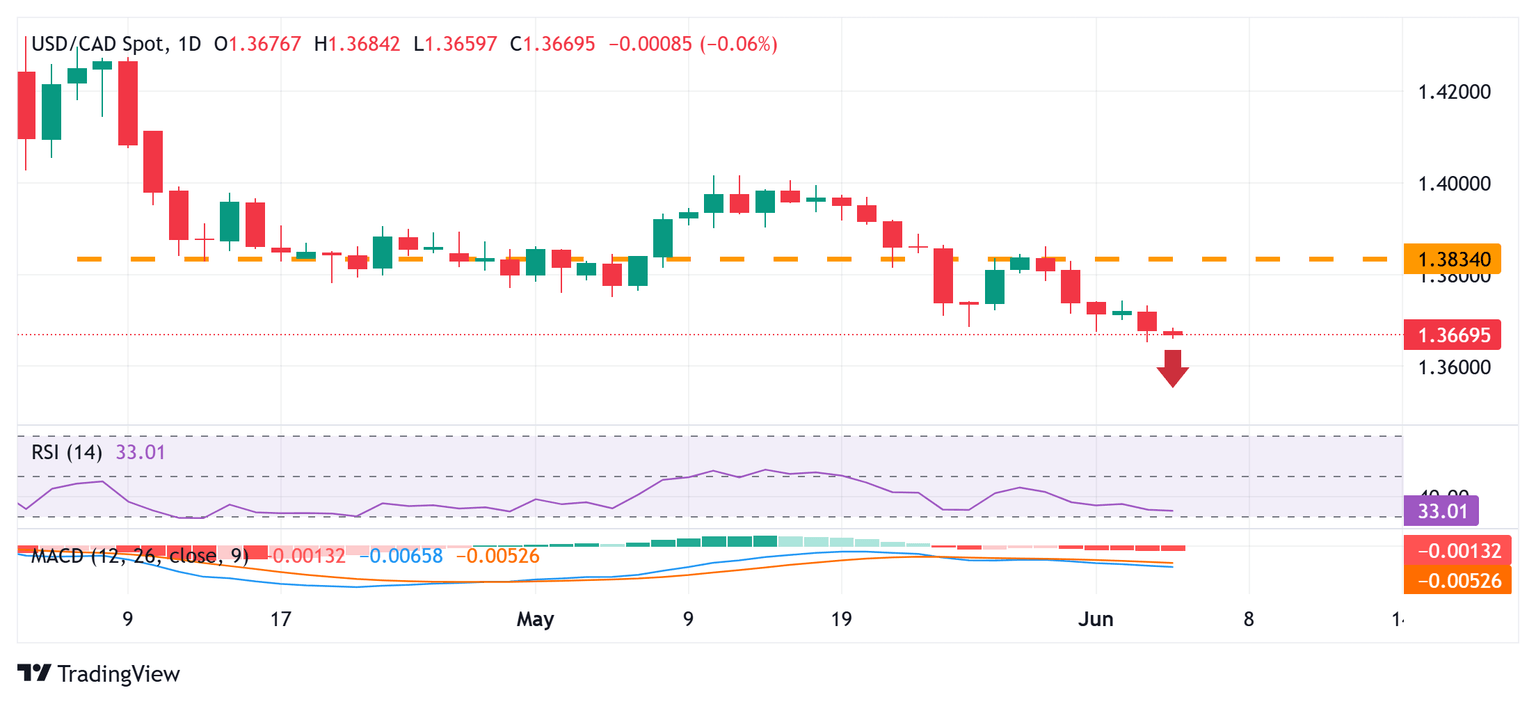
The overnight close below the 1.3700 round figure could be seen as a fresh trigger for bearish traders. Moreover, oscillators on the daily chart are holding deep in negative territory and are still away from being in the overbought zone. This suggests that the path of least resistance for the USD/CAD pair remains to the downside. Hence, some follow-through selling below the mid-1.3600s, or the year-to-date low touched on Wednesday, should pave the way for a fall toward the 1.3600 round figure en route to the 1.3545 region before spot prices eventually drop to the 1.3500 psychological mark.
On the flip side, any attempted recovery might now confront an immediate strong barrier near the 1.3700-1.3710 region. The next relevant hurdle is pegged near the 1.3735-1.3740 region, which if cleared might trigger a near-term short-covering rally. The USD/CAD pair might then accelerate the positive move toward the 1.3775 intermediate hurdle and reclaim the 1.3800 mark. The momentum could extend further towards the 1.3850-1.3860 heavy supply zone. A sustained strength beyond the latter will suggest that spot prices have bottomed out and pave the way for additional gains.
Premium
You have reached your limit of 3 free articles for this month.
Start your subscription and get access to all our original articles.
Author
Haresh Menghani
FXStreet
Haresh Menghani is a detail-oriented professional with 10+ years of extensive experience in analysing the global financial markets.