USD/CAD Outlook: The ongoing corrective decline could be seen as buying opportunity
- USD/CAD declines for the fourth straight day, though the downside potential seems limited.
- Reduced Fed rate cut bets continue to act as a tailwind for the USD and should lend support.
- Easing geopolitical tensions in the Middle East weighs on Oil prices, undermining the Loonie.

The USD/CAD pair extends last week's retracement slide from the vicinity of mid-1.3800s, or its highest level since November 10 and drifts lower for the fourth successive day on Monday. The downfall could be attributed to the consolidative US Dollar (USD) price action witnessed over the past week or so, though a combination of factors warrants some caution before placing aggressive bearish bets around the currency pair.
Investors seem convinced that the Federal Reserve (Fed) will keep interest rates higher for longer and have also scaled back their bets for the total number of rate cuts in 2024. Adding to this, the recent hawkish remarks by a slew of influential FOMC members suggested that the Fed is unlikely to begin its rate-cutting cycle before the September policy meeting. The outlook keeps the US Treasury bond yields elevated and favors the USD bulls. Apart from this, sliding Crude Oil prices could undermine the commodity-linked Loonie and contribute to limiting the downside for the USD/CAD pair.
Concerns about a further escalation of geopolitical tensions in the Middle East eased after Iran signaled that it has no plans to retaliate against the Israeli limited-scale missiles strike on Friday. Apart from this, rising US Crude stocks drags Oil prices away from over a four-month peak touched on April 5. This, along with expectations that the Bank of Canada (BoC) will cut interest rates in the summer amid declining inflation and slower economic growth, should cap any further gains for the Canadian Dollar (CAD) and act as a tailwind for the USD/CAD pair ahead of this week's key US macro data.
The Advance, or the first estimate of the US Q1 GDP growth is due for release on Thursday, which will be followed by the Personal Consumption Expenditures (PCE) Price Index on Friday. This will play a key role in influencing the near-term USD price dynamics and help determine the next leg of a directional move for the USD/CAD pair. Nevertheless, the aforementioned fundamental backdrop makes it prudent to wait for strong follow-through selling before confirming that spot prices have topped out in the near term and positioning for an extension of the ongoing corrective pullback.
Technical Outlook
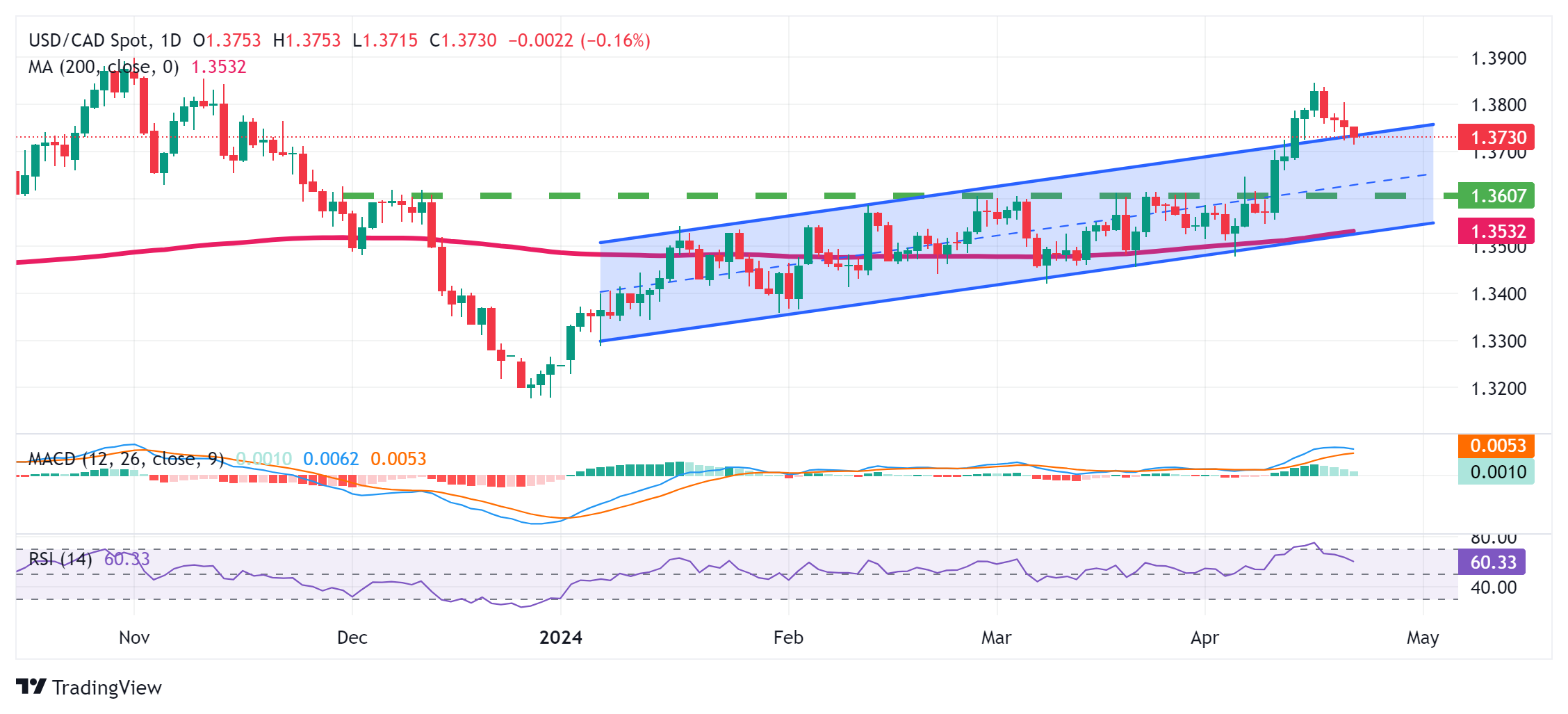
From a technical perspective, the recent breakout through the 1.3600-1.3610 supply zone and an ascending trend-channel barrier validate the near-term positive outlook for the USD/CAD pair. Moreover, oscillators on the daily chart are still holding in the positive territory, suggesting that the path of least resistance for spot prices remains to the upside. Hence, any subsequent slide might still be seen as a buying opportunity near the 1.3700 round figure. Some follow-through selling, however, might expose the 1.3610-1.3600 strong resistance breakpoint, now turned support, which should now act as a strong base for the pair.
On the flip side, Friday’s swing high, around the 1.3800 mark, now seems to offer some resistance, above which the USD/CAD pair could aim to challenge the YTD peak, around the 1.3845 region. A sustained strength beyond has the potential to lift spot prices to the November 2023 swing high, around the 1.3900 round figure. The latter should act as a key pivotal point, which if cleared decisively will be seen as a fresh trigger for bullish traders and pave the way for a further near-term appreciating move.
Premium
You have reached your limit of 3 free articles for this month.
Start your subscription and get access to all our original articles.
Author
Haresh Menghani
FXStreet
Haresh Menghani is a detail-oriented professional with 10+ years of extensive experience in analysing the global financial markets.

















