|

USD/CAD forms major bottoming pattern ahead of FOMC minutes
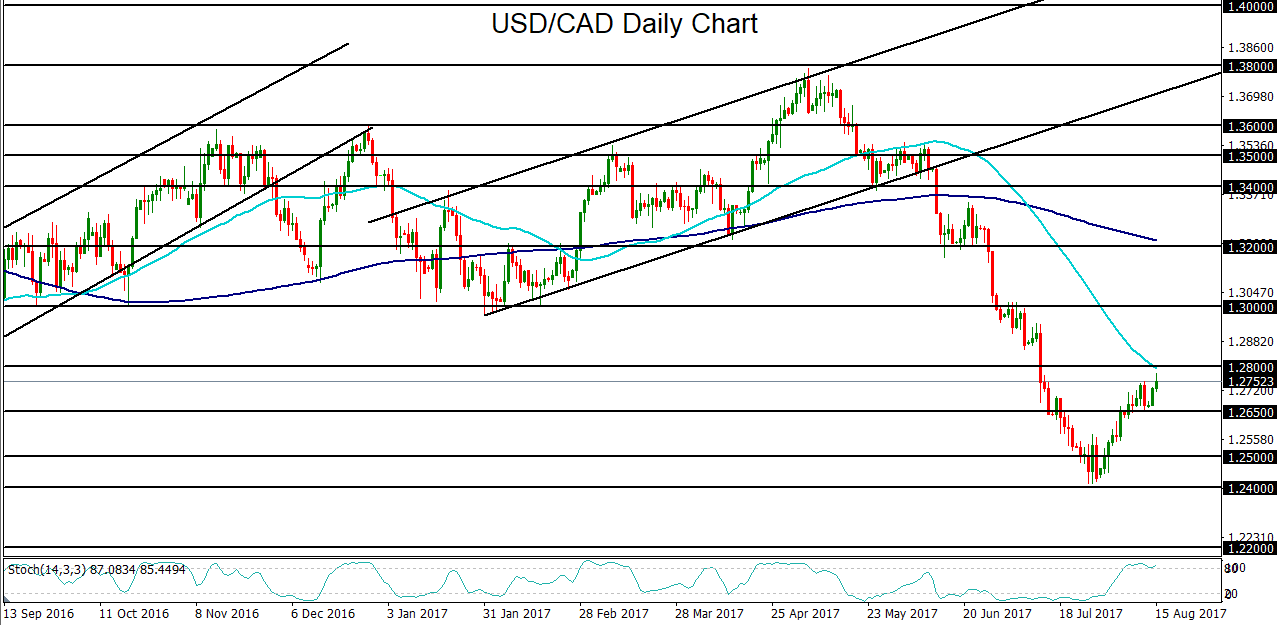
Since establishing a two-year low just above the 1.2400 handle in late July, USD/CAD has formed a clear reversal pattern – a V-bottom – characterized by a sharp bullish reversal resembling the letter, “V.” USD/CAD often tends to switch directions with this type of an abrupt reversal pattern, as the beginnings of trend changes in this currency pair can be relatively swift events. Currently, this reversal pattern has pushed USD/CAD up to approach the key 1.2800 level, which is also where the 50-day moving average currently resides.

This week, the short-term trajectory for the currency pair will depend to a large extent on how the markets interpret the Federal Reserve’s latest monetary policy stance when the minutes of the late-July FOMC meeting are released on Wednesday. Any hawkish nuances from the minutes could transform what was considered a relatively dovish meeting at the time into new-found fuel for the battered US dollar.

Also featured this week will be key inflation data from Canada in the form of July’s Consumer Price Index (CPI). Prices are expected to have remained steady after the previous month’s -0.1% drop. Another lower-than-expected CPI reading could weigh further on the Canadian dollar, boosting USD/CAD even more. Also potentially supportive of USD/CAD would be extended pressure on crude oil prices, which could continue to weigh on the energy-correlated Canadian dollar.

As noted, the recent rise of USD/CAD in the past two weeks has brought the currency pair up to approach key resistance around the 1.2800 handle and the 50-day moving average. If a continued rise for the pair amid this week’s critical economic events is able to overcome this resistance, it would confirm the strength of the current bullish reversal, potentially propelling USD/CAD back up to the key 1.3000 psychological level.
Author

James Chen, CMT

James Chen, CMT

Investopedia

James Chen, Chartered Market Technician (CMT), has been a financial market trader and analyst for nearly two decades.


More from James Chen, CMT
Share:

Editor's Picks

EUR/USD flirts with daily highs, retargets 1.1900

EUR/USD regains upside traction, returning to the 1.1880 zone and refocusing its attention to the key 1.1900 barrier. The pair’s slight gains comes against the backdrop of a humble decline in the US Dollar as investors continue to assess the latest US CPI readings and the potential Fed’s rate path.

GBP/USD remains well bid around 1.3650

GBP/USD maintains its upside momentum in place, hovering around daily highs near 1.3650 and setting aside part of the recent three-day drop. Cable’s improved sentiment comes on the back of the Greenback’s  irresolute price action, while recent hawkish comments from the BoE’s Pill also collaborate with the uptick.

Gold clings to gains just above $5,000/oz

Gold is reclaiming part of the ground lost on Wednesday’s marked decline, as bargain-hunters keep piling up and lifting prices past the key $5,000 per troy ounce. The precious metal’s move higher is also underpinned by the slight pullback in the US Dollar and declining US Treasury yields across the curve.

Crypto Today: Bitcoin, Ethereum, XRP in choppy price action, weighed down by falling institutional interest 

Bitcoin's upside remains largely constrained amid weak technicals and declining institutional interest. Ethereum trades sideways above $1,900 support with the upside capped below $2,000 amid ETF outflows.

Week ahead – Data blitz, Fed Minutes and RBNZ decision in the spotlight

US GDP and PCE inflation are main highlights, plus the Fed minutes. UK and Japan have busy calendars too with focus on CPI. Flash PMIs for February will also be doing the rounds. RBNZ meets, is unlikely to follow RBA’s hawkish path.

Ripple Price Forecast: XRP potential bottom could be in sight

Ripple edges up above the intraday low of $1.35 at the time of writing on Friday amid mixed price actions across the crypto market. The remittance token failed to hold support at $1.40 the previous day, reflecting risk-off sentiment amid a decline in retail and institutional sentiment.













