USD/CAD Canadian Dollar Higher on Strong Housing Starts and US Tax Reform Concerns

The Canadian dollar rose on Wednesday with positive housing data and us crude prices steady above $56. The trading week has brought little data so investors were happy to digest some positive news out of Canada. Housing starts rose to 222,771 on an annual bases in October. Building permits also rose by 3.8 percent in September. Condos are the main drivers of that growth that took forecasters by surprise given the slowdown in Canadian real estate after the changes to mortgage rules and foreign investment.
While most media has been busy covering NAFTA, the other trade agreement under review by Canada, the Trans Pacific Partnership (TPP) was having a moment as the 11 remaining members met in Vietnam. US President Trump took the States out of the agreement early in his presidency and Japan has assumed the leadership role seeking a commitment from members. Canada and Mexico will be looking at the TPP as an alternative if NAFTA trade talks go badly, but will not commit this early without knowing the fate of the trade deal with the United States.
The price of oil is struggling to remain bullish with a surprise buildup in US weekly inventories. The Organization of the Petroleum Exporting Countries (OPEC) production cut agreement with other major producers has been offset by higher levels of drilling by US shale producers. OPEC expects shale numbers to go higher, but be offset by higher demand.
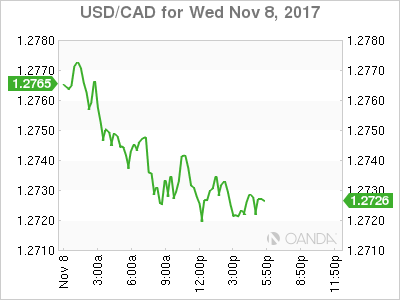
The USD/CAD lost 0.42 percent on Wednesday. The currency pair is trading at 1.2723 as the US tax reform’s path to becoming legislation is getting trickier. The backlash against the Republican establishment has started as the elections in Virginia went to the Democrats looking ahead to a very important primaries in 2018.
MarketPulse Analyst Kenny Fisher outlined the issues the US tax reform is facing:
US President Trump is off in Asia, but there is plenty of activity in Congress. After failing to pass a new healthcare act, President Trump has his sights set on tax reform, a key item in his domestic platform. Trump wants Congress to pass legislation overhauling the tax code before the end of the year, but that could prove to be too tight of a deadline. Most Democrats have come out against the proposal, and not all Republicans are on board. The bill would cut corporate taxes from 35% to 20%, but predictably, Democrat and Republican lawmakers are at odds as to whether the bill will lower taxes for the middle class. The bill is presently being debated in a congressional committee and is expected to move to the House floor next week. The Senate will present its version of the bill on Thursday, so we can expect plenty of activity in Congress in the next few weeks. Expectations that Trump will cut taxes has been the catalyst for a stock market rally over the past year, and if the bill does become law, the US dollar will likely gain ground.
The loonie advanced on US dollar struggles taking advantage of a higher price of oil after the events in Saudi Arabia over the weekend and the positive housing data released earlier today. The comments from Bank of Canada (BoC) Governor Stephen Poloz were neutral at best with inflation his main concern. Rate divergence with the US will remain if the U.S. Federal Reserve hikes a third time in December, but if inflation rises the BoC might have to match that move sooner rather than later, not allowing the gap to grow wider.
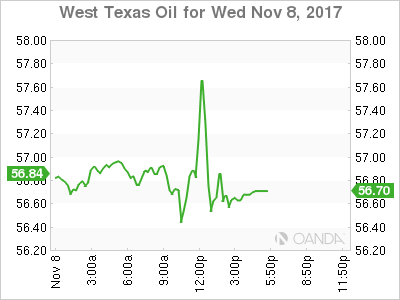
The price of oil dropped slightly on Wednesday. West Texas Intermediate is trading at $56.67 after the Energy Information Administration (EIA) released a surprise buildup in the weekly inventories. US crude stocks rose by 2.2 million barrels confounding forecasts of a 2.7 million drawdown.
The events over the weekend in Saudi Arabia triggered a rise in energy prices. Investors had already started getting out of long positions on Tuesday and the buildup in weekly inventories gave more strength to that move.
The arrests of prominent Saudi politicians and businessmen comes at a time when the kingdom is opening too many fronts. The embargo against Qatar, the military offensive in Yemen and the diplomatic/ideological fight with Iran have crown prince Mohammed Bin Salman in common as he is pushing for reform at home and abroad.
The Organization of the Petroleum Exporting Countries (OPEC) released its 2017 World Oil Outlook today and the group is forecasting a rise in shale production and growing demand in the following two years. OPEC and other major producers agreed to cut production to rebalance the energy markets after heavy falls and are now looking at extending for a second time the length of the agreement.
Market events to watch this week:
Thursday, November 9
9:30 am USD Unemployment Claims
8:30 pm AUD RBA Monetary Policy Statement
Friday, November 10
5:30am GBP Manufacturing Production m/m
*All times EDT
Author

Alfonso Esparza
MarketPulse
Alfonso Esparza specializes in macro forex strategies for North American and major currency pairs.