USD/CAD braces for volatility as Fed and BoC take center stage


As roughly one-fifth of the S&P 500 prepares to report earnings this week, investor focus is also shifting to the first monetary policy decisions of the year from both the Federal Reserve and the Bank of Canada—events that are likely to set the near-term direction for the USD/CAD currency pair.
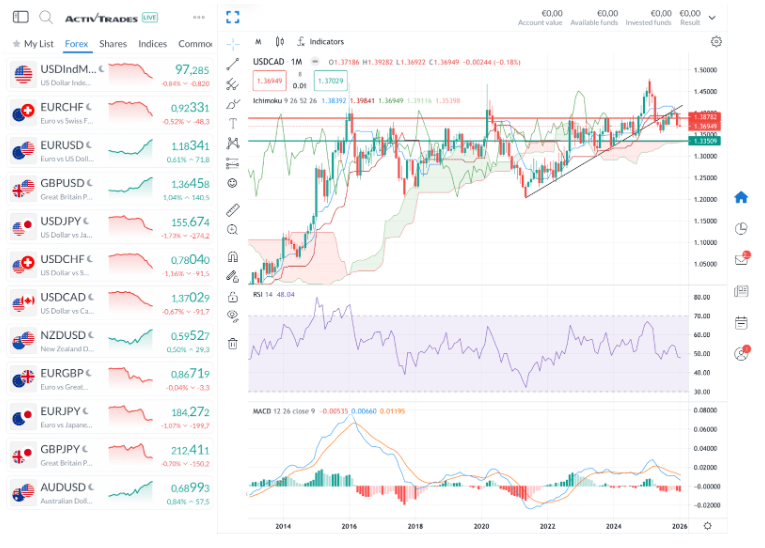
The USD/CAD is already under pressure. While it was trading within a broader uptrend structure that dates back to the 2021 lows, the Forex pair is down for a third consecutive month and trading below a key bullish trendline since April 2025, marking a potential shift in medium-term momentum.
Technically, the pair is now confined between well-defined levels, with support near 1.3350 and resistance around 1.3880, reflecting growing indecision in the market. Prices are still holding above the Ichimoku cloud, but the pullback from the 2024–2025 highs near 1.46, combined with a neutral RSI below the 50 threshold, points to fading upside momentum.
At this stage, the technical structure argues more for consolidation or a corrective phase than a confirmed trend reversal. With both the Fed and the BoC set to deliver policy signals this week, central bank guidance is likely to be the dominant catalyst in determining whether the USD/CAD stabilizes, resumes its longer-term uptrend, or extends its current correction.
The Bank of Canada is likely to keep rates unchanged at 2.25%
After delivering one of the most aggressive easing cycles among G10 central banks, the Bank of Canada (BoC) is widely expected to hold its overnight rate at 2.25% at its January 28 meeting. The central bank cut rates by a cumulative 275 basis points between June 2024 and October 2025, and policymakers have since signaled a preference for an extended pause as they assess how the economy is responding.
The policy rate now sits at the low end of the BoC’s estimated neutral range of 2.25%–3.25%, meaning monetary policy is no longer restrictive but not meaningfully stimulative either. This positioning allows the central bank to stay on hold without risking an inflation rebound. But while expectations a month ago leaned toward a smooth slowdown with inflation firmly under control and growth steadily improving, recent data have been more mixed.
Headline inflation remains slightly above target, with consumer prices rising 2.4% year-on-year in December. However, the measures that matter most for policymakers are moving in the right direction. The trimmed mean and weighted median slowed to an average of 2.6% in December, down from 2.85% in November.
Just as important, inflation expectations appear firmly anchored. The BoC’s latest quarterly business outlook survey recently published shows expectations remain within the 1%–3% target range, while a large number of companies planning significant price increases have fallen to some of the lowest levels in a decade. This gives policymakers confidence that inflation is unlikely to reaccelerate even with rates on hold.
On the growth side, the picture is far less reassuring. Canada’s economy is expected to have slowed sharply to just 0.3% annualized growth in the fourth quarter, down from 2.6% in Q3. Retail sales rose 1.3% in November, the strongest gain in five months, suggesting households were still spending late in the year. However, advance estimates point to a 0.5% decline in December, indicating more cautious behavior during the holiday period.
Trade relations also remains a key risk. Canada has so far shown resilience despite U.S. tariffs of 25% to 50% on sectors such as autos, lumber, steel, and aluminum, but economists warn that broader tariff escalation could significantly weaken growth and ultimately force the BoC back into easing mode.
This risk is heightened by the July review of the USMCA, a process that introduces significant uncertainty and has the potential to reshape North American trade relations, with lasting implications for the region’s economic outlook over the coming years. In response, Canadian policymakers are actively seeking to diversify trade relationships, including recent efforts to reduce tariffs with China and expand economic ties in the Middle East.
The Fed is expected to continue its pause in its easing cycle
The Federal Reserve (Fed) is widely expected to keep interest rates unchanged in the range of 3.5%–3.75% when it announces its policy decision on Wednesday, extending the pause that followed three quarter-point cuts in the second half of 2025. Market pricing still reflects expectations for at least one additional rate cut later this year, but the near-term case for further easing has weakened as the macroeconomic backdrop has proven more resilient than anticipated.
The U.S. economy expanded at a strong 4.3% annualized pace in the third quarter and is now expected to grow around 2.3% in 2026, up slightly from last year and above the Fed’s estimate of its long-run, non-inflationary growth rate of roughly 1.8%. Growth is also projected to average close to 2% through 2028. This level of momentum reduces the urgency for additional stimulus and supports the view that policy is already close to a neutral setting.
Inflation dynamics further reinforce the case for a pause. Headline inflation has moderated over the past year, easing from 2.9% in late 2024 to around 2.7% most recently, while core inflation has slowed more noticeably, falling from above 3% to roughly 2.6%. However, inflation remains above the Fed’s 2% target, and slower price growth does not equate to outright price declines. Consumers continue to feel the cumulative impact of past inflation, particularly in everyday expenses.
Labor market conditions also argue against immediate further easing. While job growth has cooled from earlier peaks, downside risks to employment have eased and there is still some slack in the labor market. With policy rates now near neutral, the Fed has greater flexibility to remain patient and assess how previous cuts feed through to the economy.
Beyond the economic data, the upcoming meeting is taking place against a more sensitive institutional backdrop. Questions around the Fed’s independence have moved into sharper focus following reports that Chair Jerome Powell faced legal pressure from the Trump administration. At the same time, President Donald Trump is weighing his choice of a potential successor to Powell, whose term as chair ends in May, adding another layer of uncertainty to the policy outlook.
History suggests that these issues matter. Decades of academic research show that central banks which operate independently from political influence tend to deliver better outcomes, including lower inflation and more stable growth. As a result, any perception that monetary policy decisions are being shaped by political pressure rather than economic fundamentals could unsettle markets. For now, however, the Fed appears set to stay on hold, using this meeting to reinforce its data-dependent stance and defend its credibility as inflation slowly converges toward target.
Stay up to date with what's moving and shaking on the world's markets and never miss another important headline again! Check ActivTrades daily news and analyses here.
Author
Carolane de Palmas
ActivTrades
Carolane graduated with a Masters in Corporate Finance & Financial Markets and got the AMF Certification (Financial Markets Regulator in France). Afterward, she became an independent trader, investing mostly in European and American stocks/indices.