US Dollar Weekly Forecast: The Dollar is on fire. Its positioning? Not so much
- The US Dollar climbs for the fourth week in a row to multi-month tops.
- Investors keep favouring extra tightening by the Fed, likely in December.
- Flash PMIs, Q3 GDP figures and PCE data will set the tone next week.

The week that was
The US Dollar (USD) maintained its march north well in place for the fourth consecutive week, sending the US Dollar Index (DXY) to the doorsteps of the key 104.00 hurdle for the first time since April 2025.
Once again, and in the current context of utter silence from the geopolitical landscape, either from the Middle East or the Russia-Ukraine multi-year conflict, the Greenback’s stronger bias was bolstered by rising speculation over extra tightening by the Federal Reserve (Fed), with the next rate raise expected at the December gathering.
On the latter, markets and some Fed officials seem to favour a 50-basis-point rate hike, adding extra fuel to the steep multi-week rally in the buck.
This week’s uptick in the index, curiously, came on the back of declining US Treasury yields across the curve and crude Oil prices, which further extended its post-midterm correction.
Fed officials turn more forceful as inflation broadens
Comments from Fed officials are the latest to suggest inflation is headed in the wrong direction and is growing too tough to dismiss as a transitory supply shock. Price pressures are extending beyond energy and tariffs as firms pass on more of their expenses and demand remains strong enough to keep the economy running hot. Some policymakers have cautioned that companies and consumers may be becoming used to inflation around 3%.
In services, the worry is especially evident: Christopher Waller said almost 70% of the core-services basket is growing by more than 3%, while Austan Goolsbee cited continuing services inflation and a big demand component. Investment in data centres and AI-related wealth effects are also adding to pricing pressures, increasing the risk that company spending may outstrip the economy’s capacity and create wider overheating.
That has tilted the policy discussion in a more hawkish way. Alberto Musalem said it may take multiple rate rises by spring, but Waller was pushing for a more aggressive pace, saying the Fed may need to hike by 50 basis points or use its communications to suggest harsher action. Lisa Cook said the existing position wasn’t restrictive enough, that September’s rise wasn’t adequate, and that delaying may enable inflation to get entrenched. “We are clearly falling short on the inflation side of our mandate,” Neel Kashkari said.
Yet there is a faction that would want a gradual change. Beth Hammack wants modest, incremental hikes so the economy has time to absorb them, while John Williams said the circumstances don't warrant a drastic shift. Anna Paulson also favoured a gradual approach, but she felt that greater tightening was required. Thomas Barkin and Michael Barr left the door open to further raises if the economy evolves as they forecast.
The unifying theme is that the Fed’s 2% objective is non-negotiable and inflation expectations remain widely anchored. But policymakers are now concerned that widespread price hikes could undermine confidence. The debate has shifted from whether inflation needs to come down to whether the Fed can move slowly enough to safeguard growth without allowing today’s high inflation to become tomorrow’s baseline.
FOMC Minutes reinforced a tighter stance
Minutes from the Fed’s last meeting on October 27-28 showed most officials backing a pause in rate rises but expecting future increases if inflation proves resistant.
The choice to halt was not simple. Some officials would have liked to raise rates by 25 basis points, and others said keeping rates unchanged was a tight decision. But almost all participants felt that further tightening would probably be justified, with some open to a bigger step in December if inflation readings were to worsen.
Policymakers highlighted that the halt did not undermine their resolve to bring inflation to the target. The Minutes also said there was a surge in AI investment and its consequences for productivity and financial stability. If price pressures do not diminish, the Fed appears to be using the pause to gather information before continuing its tightening campaign, with the economic outlook somewhat higher and inflation expectations largely unchanged.
Bullish momentum fades as positioning slips
USD bullish positioning softened in the week ending November 10, according to the Commodity Futures Trading Commission (CFTC) data. Non-commercial net longs fell by 377 contracts to around 13.8K contracts, or four-week lows, while the four-week change declined to +894 (from +2,179). That said, net longs remain higher than a month ago, but the bullish recovery has lost significant momentum.
Open interest increased to nearly 51.4K contracts, also the highest level in the past four weeks. With net positioning falling as overall participation rose, the move suggests a modest build-up of opposing positions and a less supportive balance of exposure for the Greenback.
Further data saw speculative exposure easing to 26.85% (from 28.91%), while its percentile declined to 48.2 (from 49). The Net Position Percentile also fell to 55.9 (from 57.4). Both measures remain close to neutral, indicating that USD positioning is neither crowded nor historically weak.
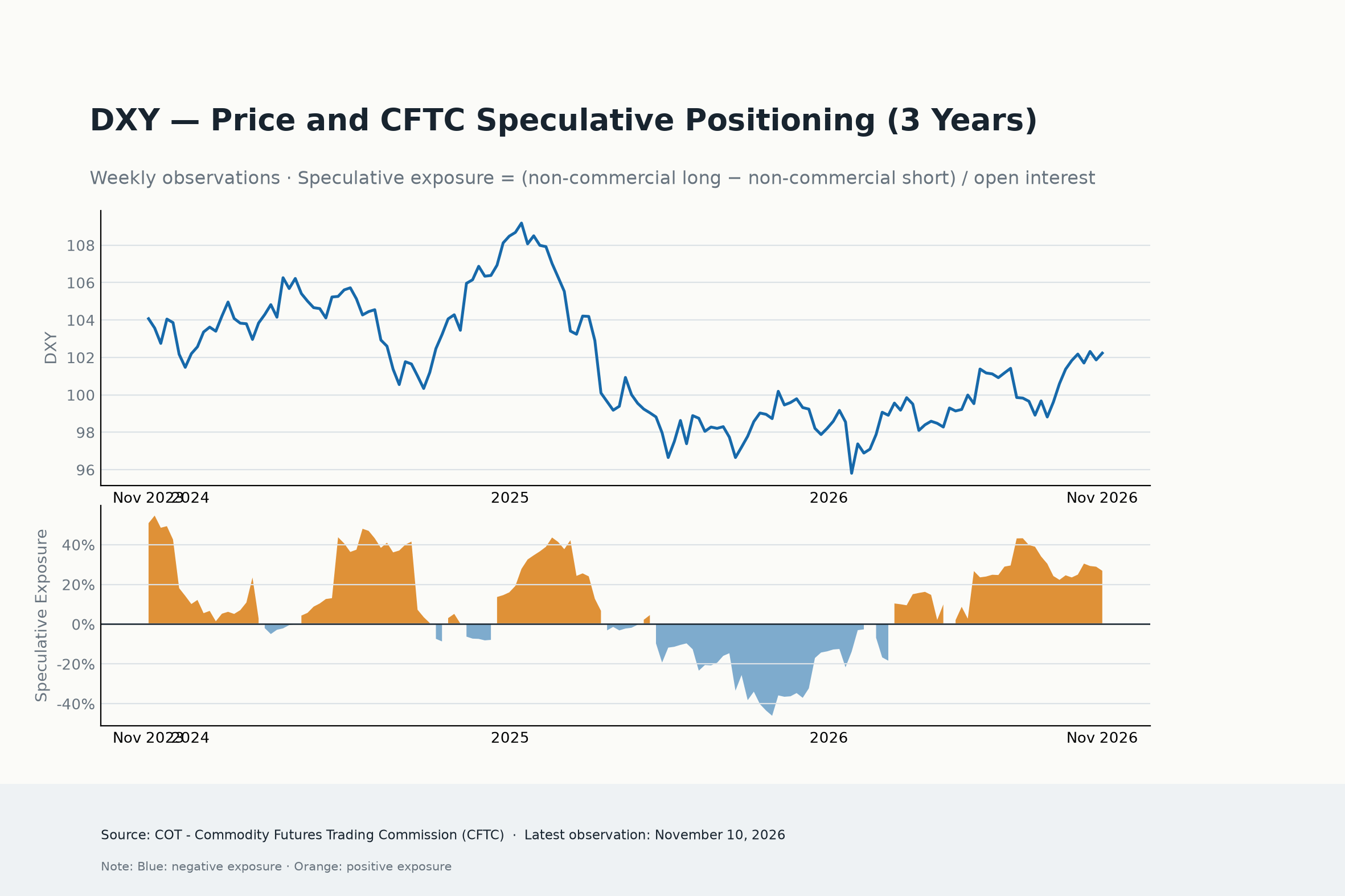
Overall, the US Dollar’s positioning backdrop remains mildly constructive, but the latest figures point to fading bullish conviction. Net longs are still positive and above their level four weeks earlier, yet the decline in weekly positioning, softer four-week change and higher open interest suggest that the recent recovery is losing momentum.
Next on tap for the US Dollar
Next week will focus once again on inflation, this time with the release of the Personal Consumption Expenditures (PCE) for October. In addition, the releases of the flash S&P Global Manufacturing and Services PMIs should gather attention alongside another estimate of the Q3 GDP Growth Rate.
Fedspeak-wise, the calendar looks very light, with Thursday’s Thanksgiving Day holiday and half session on Friday.
The bulls remain in charge, but cracks are starting to show
The US Dollar's rally is showing little appetite for a breather, and with the Fed increasingly entertaining the prospect of more aggressive tightening, the path of least resistance still points higher.
Yet there are some signs of weakness.
Treasury yields have failed to keep pace with the Greenback's advance, while speculative positioning suggests bullish conviction is beginning to lose steam. That hardly makes a compelling case for a reversal, particularly with inflation proving stubborn and a December rate hike firmly on the radar.
Still, with DXY approaching the 104.00 barrier, the next leg higher may demand more than hawkish rhetoric. October's PCE figures could provide just that, or expose a rally increasingly dependent on the Fed delivering on the market's lofty expectations.
The US Dollar remains firmly in the driver's seat, but the higher it climbs, the more it has to prove.
Author
Pablo Piovano
FXStreet
Born and bred in Argentina, Pablo has been carrying on with his passion for FX markets and trading since his first college years.

















