EUR/USD Weekly Forecast: The bears are winning, but something doesn't add up
- EUR/USD closed its fifth consecutive week in the red.
- The pair’s bearish price action has followed a firmer US Dollar.
- Next of note in Germany and the Euroland will be the flash PMIs.


The European currency has navigated another dreadful week, this time sending EUR/USD to the 1.0950 region for the first time since early April 2025.
The pair’s severe retracement has exclusively followed the dynamics of the US Dollar (USD), which have mostly come in the form of increasing bets for further interest rate hikes by the Federal Reserve (Fed).
On the latter, part of the market chatter appears to have been leaning toward the possibility of a larger rate raise of half a percentage point, which in turn has morphed into extra wings for the Greenback in the last couple of weeks.
No news is hardly good news
Geopolitical tensions remain stubbornly elevated. The familiar US-Iran standoff over the Strait of Hormuz shows little sign of resolution, while the ongoing Russia-Ukraine conflict adds another layer of uncertainty, keeping risk aversion alive and safe-haven demand supported.
While the Middle East conflict is per se an undoubted source of inflationary pressure via Crude Oil prices, Europe is expected to suffer most with the eventual increase of gas prices, exacerbated by its condition of being an “extreme” energy importer.
Energy prices put the ECB back on the defensive
The geopolitical fallout is increasingly visible in energy markets. Crude Oil prices continue to climb, European fuel costs are rising, and gas price forecasts face repeated upward revisions. For the energy-dependent Eurozone, this represents more than another squeeze on household budgets: it threatens to turn an external price shock into a more persistent inflation problem.
That is precisely where the European Central Bank faces its biggest challenge. Policymakers can look through a temporary jump in energy prices, but not if higher costs spread into wages, services and inflation expectations. With growth already vulnerable to expensive energy imports, the ECB risks having to tighten policy into a weakening economy simply to prevent inflation from becoming entrenched. The longer the energy shock persists, the stronger the case for additional tightening becomes. Markets are already pricing in around 18 basis points of further rate hikes by year-end.
Keep calm and… carry on?
The latest statements from ECB policymakers hint to a familiar problem: energy costs might drive inflation higher, but the essential issue is whether such pressures extend over the whole economy: Santos Pereira said the possibility of second-round impacts remained substantial, while Vujčić cautioned that reduced confidence and higher interest rates could assist in curbing excess inflation by reducing GDP.
Thus, the argument is less about the initial energy shock and more about its persistence. If rising fuel prices cluster, the bank may be able to see through some of the move. If they start flowing into salaries, services and broader price-setting behaviour, the argument for tighter policy would be considerably stronger.
Joachim Nagel’s evaluation implies policymakers are not there yet. “Inflation is too high,” he said, but added that monetary policy was already in a somewhat restrictive area and inflation expectations were firmly anchored.
For the moment, the ECB seems content to keep calm and observe whether the energy shock dissipates or starts to spread.
Bears are piling in, but options are not buying it
The Euro's (EUR) troubles are showing few signs of easing. EUR/USD has slipped below the 1.1000 threshold, extending a decline that has wiped nearly 6% off the currency's value over the past three months. The Greenback’s renewed strength has kept sellers firmly in charge, and there is little in the latest price action to suggest an imminent change of direction.
But beneath the surface, the picture is becoming rather more complicated.
Fresh futures exposure is entering the market as the pair moves lower. Speculative positioning, meanwhile, remains heavily skewed against the single currency. Yet the options market appears surprisingly reluctant to follow the sell-off, with demand for downside protection showing considerably less urgency than the decline in spot would normally warrant.
The question is whether the EUR is attracting another wave of bearish conviction or whether an increasingly crowded trade is beginning to show its limitations.
The futures market isn't standing still
The latest CME figures offer an interesting starting point.
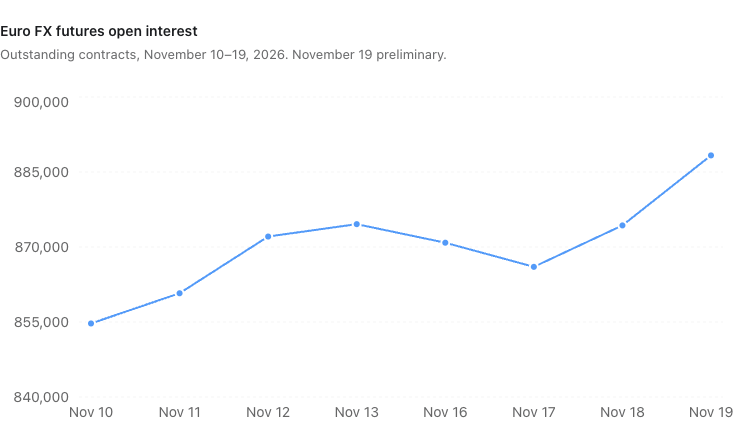
Between November 10 and November 19, Euro FX futures declined approximately 1.76%, while open interest increased roughly 4%.
That is hardly the footprint of a market experiencing a wholesale withdrawal of participation.
Indeed, the final two sessions were particularly revealing after open interest rose markedly on November 18 and on November 19, and trading volumes were also relatively elevated.
The combination of falling prices and expanding open interest suggests that traders are establishing new positions during the decline. This suggests that the Euro's weakness is attracting additional futures exposure rather than driving the liquidation of existing positions.
There is an important qualification, however. Open interest measures outstanding contracts, not the direction or identity of the traders initiating them. An increase cannot, by itself, establish that speculative funds are opening fresh short positions.
Nor has volume increased consistently throughout the period. Activity has been uneven, with the strongest readings concentrated in the latest sessions.
Still, the expansion in outstanding exposure deserves attention. The sell-off is not taking place in an increasingly empty futures market.
Speculators were already leaning heavily against the Euro
That brings us to the latest available Commodity Futures Trading Commission (CFTC) positioning figures.
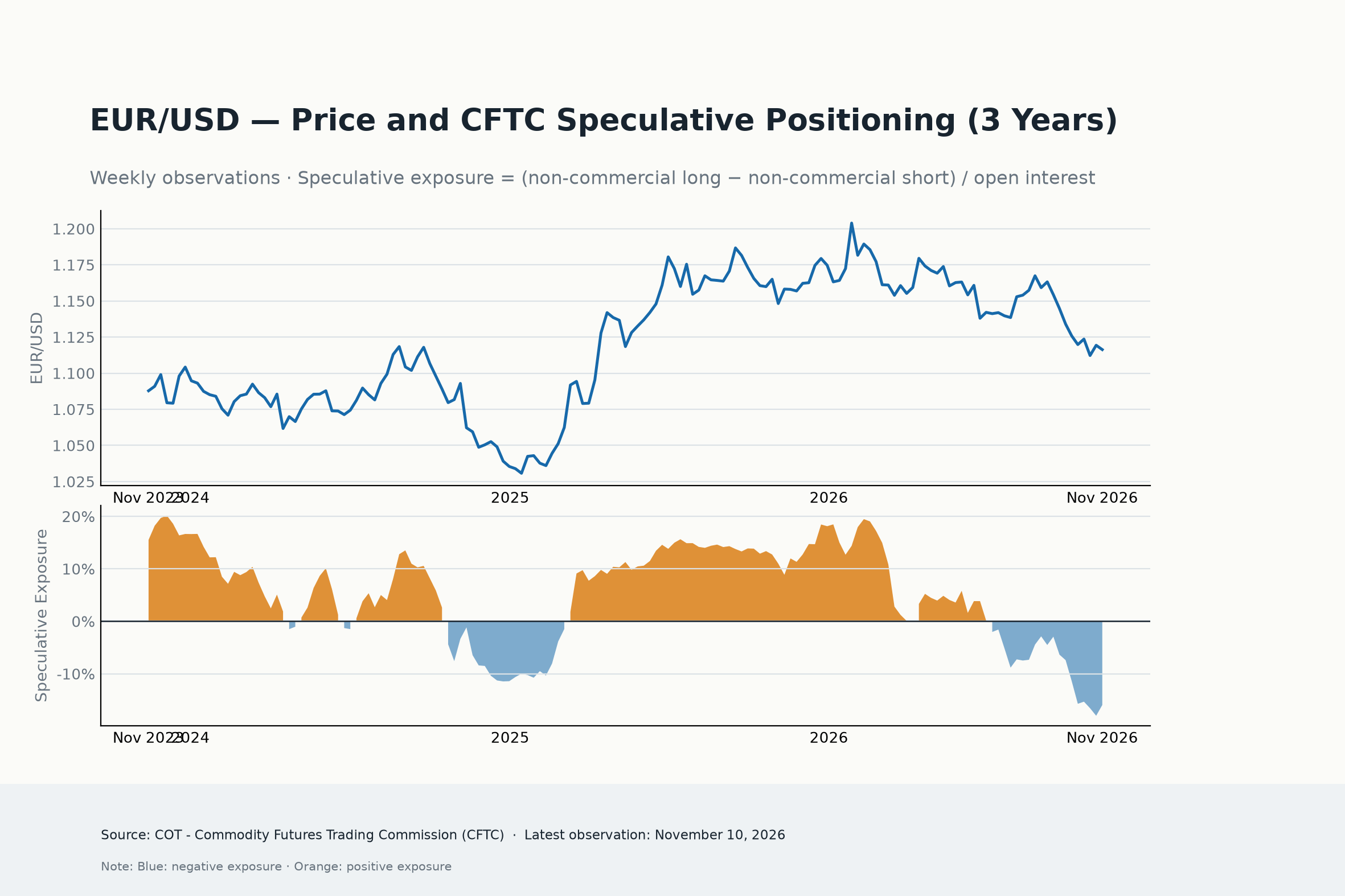
For the week ending November 10, non-commercial players held a net short position equivalent to approximately 16% of open interest.
More strikingly, net positioning stood at just the 1.5th percentile of its five-year distribution, with a z-score of -2.54.
In other words, bearish exposure was already exceptionally extended by historical standards.
Yet the weekly change tells a different story: net shorts declined during the reporting period, indicating a meaningful reduction in bearish speculative exposure rather than another round of net short accumulation.
The distinction matters.
The CFTC figures establish that speculative positioning was heavily bearish as of November 10, but they do not tell us how those traders behaved during the subsequent sessions.
The increase in CME open interest since that date could reflect renewed speculative selling, additional hedging activity or other changes in market participation. Without a more recent breakdown by trader category, attributing the increase to hedge funds or leveraged accounts, would be premature.
What we can say is that the single currency entered the latest leg of its decline with an unusually crowded bearish speculative base, while total futures exposure has subsequently expanded.
That is a potentially powerful combination, although not necessarily a comfortable one for traders arriving late to the move.
Options traders aren't chasing the decline
The options market introduces another complication.
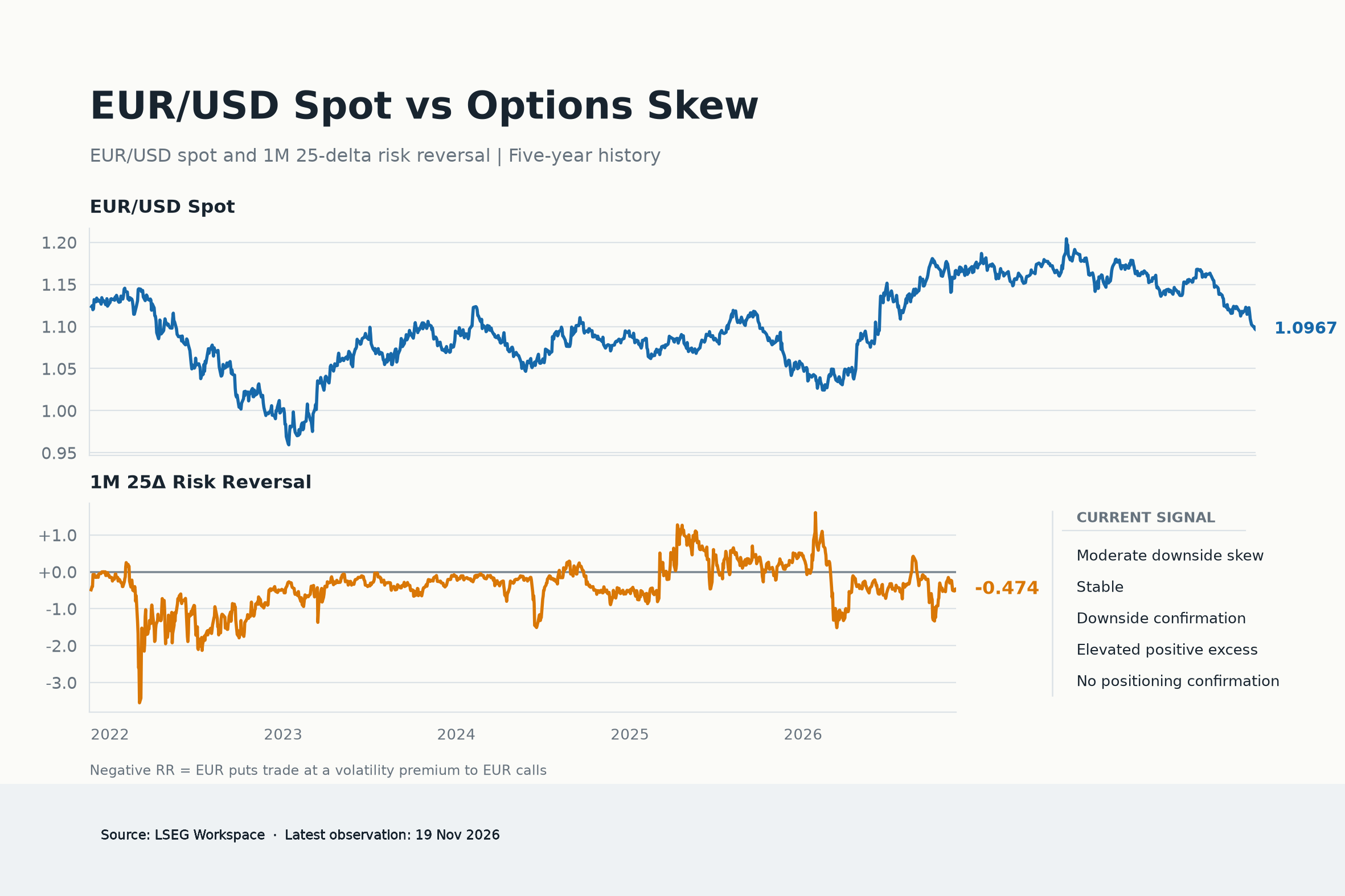
One-month 25-delta Risk Reversals stood at -0.474 volatility points on November 19, indicating that EUR puts continued to command a premium over equivalent calls.
The negative skew is consistent with a market still seeking protection against further EUR weakness.
However, the reading sits at the 36.4th percentile of its five-year distribution, hardly an extreme level of downside hedging demand.
More importantly, the latest changes in Risk Reversals have been remarkably restrained relative to the deterioration in EUR/USD.
Over the past month, spot declined 2.37%, while one-month Risk Reversals slipped by just 0.032 volatility points.
Instead, the actual decline was barely a tenth of that magnitude.
The resulting positive residual of 0.330 volatility points ranks at the 86.9th percentile of our rolling out-of-sample distribution.
In other words, options skew has held up considerably better than the EUR’s price action would ordinarily suggest.
The weekly figures reinforce that observation. EUR/USD lost 0.79% over the latest five-session window, yet Risk Reversals actually improved by 0.025 volatility points. The corresponding spot-adjusted residual reached +0.178, its 82.9th historical percentile.
This is not evidence that investors have suddenly turned bullish on the EUR. Downside protection remains more expensive than upside exposure, and three-month Risk Reversal momentum is still firmly negative.
Nevertheless, the relative resilience of options skew suggests that the latest selling pressure has not been accompanied by a proportionate increase in demand for bearish protection.
For a currency trading at fresh lows, that is worth paying attention to.
A bearish market, but not a unanimous one
Taken together, the three datasets paint a rather unusual picture.
EUR/USD continues to weaken, and futures open interest is expanding. Those developments suggest that the decline is attracting additional market participation.
At the same time, speculative positioning was already historically stretched at the latest CFTC reporting date, while options traders have shown little inclination to pay increasingly aggressive premiums for downside protection.
The signals are not necessarily contradictory. Futures participants and options traders operate with different objectives, time horizons and risk exposures.
Still, their behaviour raises an important question about the quality of the latest move.
Is the Euro attracting a fresh wave of speculative selling, or is the increase in futures exposure being driven by hedging and other activity while directional conviction becomes less pronounced?
For now, the available evidence cannot settle that question.
So far, EUR/USD is showing no positioning confirmation, reflecting the combination of bearish speculative exposure, recent net short covering and relatively resilient options skew.
The subsequent increase in CME open interest complicates that assessment but does not invalidate it. Total futures participation has expanded; the composition of that expansion remains unknown.
The next move could be telling
There is little reason to dismiss the Euro's downtrend simply because options traders have become less aggressive.
The currency remains under pressure, and the latest futures figures suggest that additional exposure is entering the market as prices decline.
A further increase in open interest, accompanied by continued EUR/USD weakness and a renewed deterioration in Risk Reversals, would strengthen the case that bearish conviction is broadening.
The alternative is more intriguing.
If EUR/USD continues to struggle while options skew remains resilient and futures open interest begins to contract, the possibility of position liquidation and a short-covering recovery would become harder to ignore.
That risk is particularly relevant when speculative positioning is already near the bearish extremes of its five-year history.
For the moment, sellers retain the advantage. But there is a difference between a currency falling because bearish conviction is strengthening across markets and one declining while important segments of the market become increasingly reluctant to follow.
The Euro is still falling. Whether the bears are becoming more committed to the trade is a different question altogether.
What’s in store for EUR/USD?
The coming week may be key for EUR/USD: preliminary S&P Global Manufacturing and Services PMIs in Germany and the Eurozone will provide fresh clues on how business activity in the bloc has evolved in recent weeks.
Across the Atlantic, the focus will also be on the preliminary gauges of business activity in combination with the release of the Fed’s preferred inflation measure, Personal Consumption Expenditures (PCE), as well as another estimate of the Q3 GDP Growth Rate. Will the US “exceptionalism” remain in place?
Author
Pablo Piovano
FXStreet
Born and bred in Argentina, Pablo has been carrying on with his passion for FX markets and trading since his first college years.

















