US Weekly Jobless Claims Preview: The trend is strong
- Weekly initial jobless claims expected to revert to trend
- Non-farm payrolls depict strong labor markets
- Previous week's spike related to government shutdown, now ended

The US Department of Labor will release initial weekly jobless claims at 8:30 am EST, 13:30 GMT on February 7th.
Forecast
Initial jobless claims are predicted to be 221,000 in the week ending February 1st down from 253,000 in the prior week. The four week moving average is 220,250 in the current week.
Jobless Claims and the Labor Economy
Initial filings for unemployment claims are one of the earliest and most reliable indicators for the labor market.
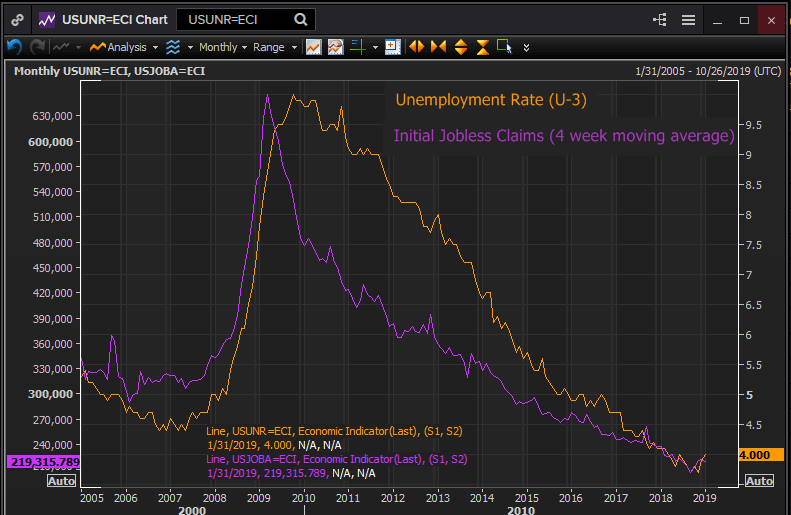
In 2006 initial claims shot up from 289, 000 (4 week moving average) in January to 327,000 in May and stayed elevated until September 2007. In the same period the unemployment rate (U-3) declined from 4.8% to 4.4%. From June on they moved in tandem. Claims had climbed to 345,000 by year end and the unemployment rate to 5%.
It wasn’t until May 2008 that indications of serious trouble began. Claims soared over the next ten months from 366,000 to their peak at 655,000 in March 2009 and the unemployment rate jumped from 5.4% in May 2008 to 10% in October 2009.
Reuters
Initial Claims in History
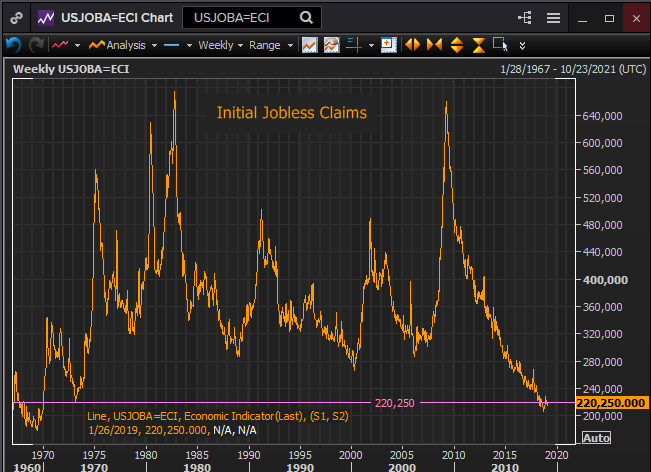
Initial jobless claims are one of the longest running economic series beginning in January 1967. This turns out to be a necessity when comparing the historical averages. The current four week moving average of 220,250 is a level that the US has not reached in 46 years, since January 1973. It is more impressive when one considers that claims are an absolute number not an index or percentage and that the US population has increased 55% since disco was the rage. In 1973 the population was 211 million. It is now 328 million.
Reuters
Coincident Indicators
Most secondary employment statistics remains at levels congruent with strong employment and by implication low jobless claims.
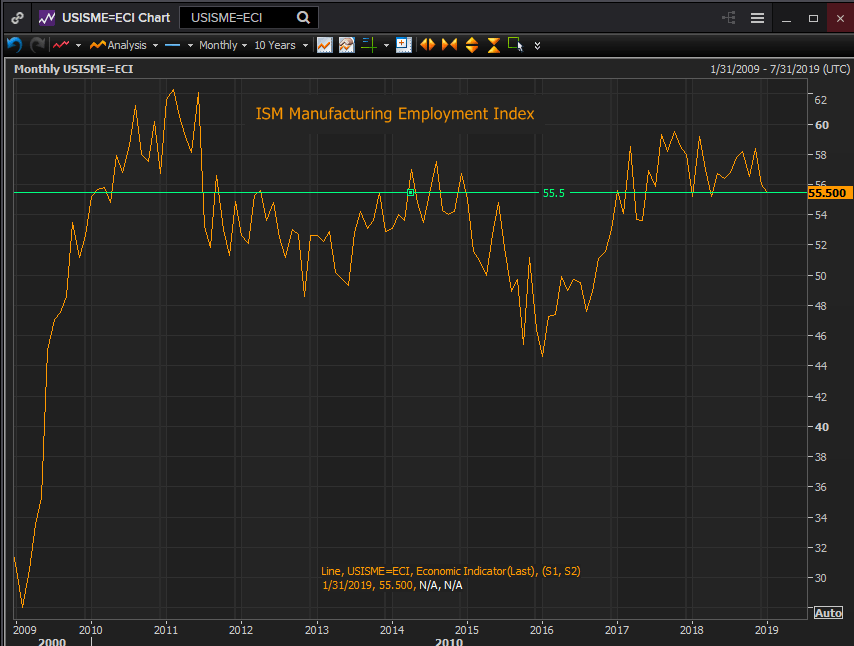
The manufacturing employment index from the Institute for Supply Management for January came in at 55.5 off slightly from 56.0 in December and 58.4 in November. This is at the low end of the range for the past two years but securely in the expansion bracket which divides at 50 between growth and contraction.
Reuters
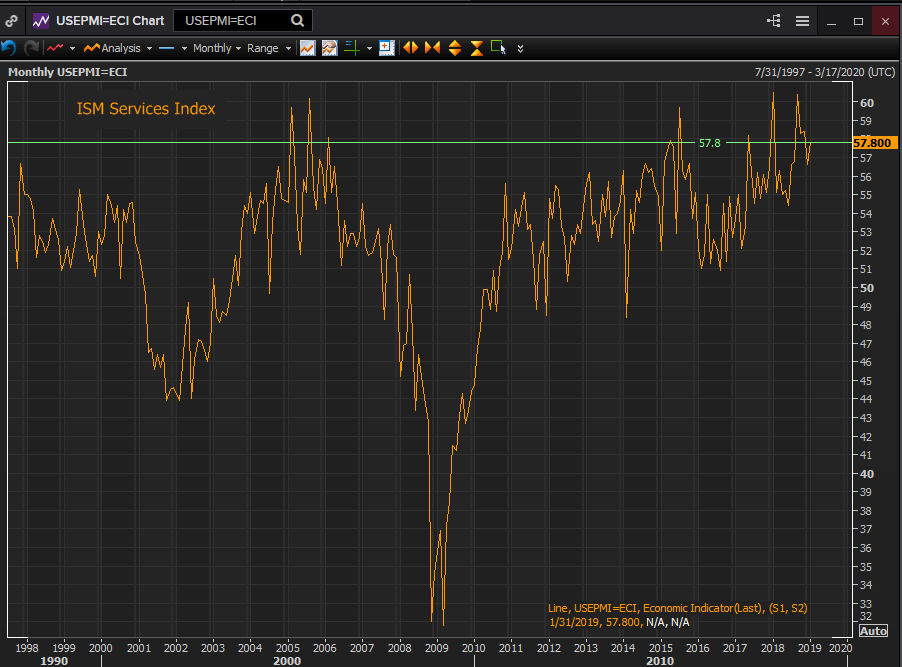
Likewise the ISM services employment index was 57.8 in January up from 56.6 the prior month. September’s 60.4 score was the second highest in the history of the series which extends to July 1997.
Reuters
The Conference Board Consumer Confidence Survey charts labor market outlook among the general population. In January the proportion expecting more jobs in the months ahead dropped to 14.7% from 16.6% in December. Those anticipating fewer openings increased to 16.5% from 14.6%. These slight changes are not indicative of a worsening trend.
Because jobless claims are a weekly number, individual weeks bring little information, it is the trend and the average that are important. Last weeks burst of 253,000 claims is an attribute of the partial government shutdown. The trend remains wholly positive for the labor market.
Author

Joseph Trevisani
FXStreet
Joseph Trevisani began his thirty-year career in the financial markets at Credit Suisse in New York and Singapore where he worked for 12 years as an interbank currency trader and trading desk manager.
















