US trade still front and centre – RBNZ holds ground on rates


US President Donald Trump has recently announced another extension to the trade tariff deadline, pushing it out to 1 August. When asked if the deadline was set in stone, he responded, ‘I would say it’s firm, but not 100% firm’. Adding to the confusion, he posted the following on his Truth Social platform yesterday:
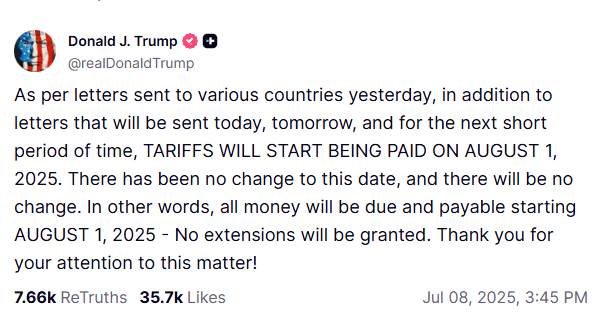
We’ve already seen two trade deadlines move, one shortly after ‘Liberation Day’ tariffs (2 April) were imposed on 9 April, and again this week. The question is whether we will get future deadline extensions, and, importantly, does the market even care at this point. Despite Trump’s current stance, I believe additional extensions will be forthcoming, as trade negotiations can take months to conclude – or even years in some cases, as I noted yesterday.
Price action across major US equity indices has been lacklustre so far this week, with the S&P 500 and the Nasdaq tiptoeing around all-time highs. While tariffs remain an unknown, the market’s message is currently one of complacency, and the response to the headlines and the tariffs is incomparable to what we observed in the recent past – just look back at the market’s reaction on 2 April.
As long as the market remains in this state, Stocks are likely to continue trending higher from here. However, if the recently touted tariff rates come into effect, it could be a different story and Equities could pull lower. This would be a particularly emphasised if hard data begins to show cracks, particularly on inflation and jobs.
You will recall that the Fed is expecting some ‘tariff-induced’ inflation and, coupled with growth also anticipated to take a hit, this could prove to be a difficult path for the Fed to navigate later in the year.
In terms of the US dollar (USD), we have been modestly higher in recent trading, with US Treasury yields on track to trade higher for a sixth consecutive session. The USD is stretched to the downside according to the COT data (Commitment of Traders), having had the worst start to the year since the early 1970s. While the recent rebound could be a bout of profit-taking, and while selling USD rallies has been the theme this year, a USD long at this stage may tempt some investors given the high risk/reward, particularly if USD short positioning begins unwinding.
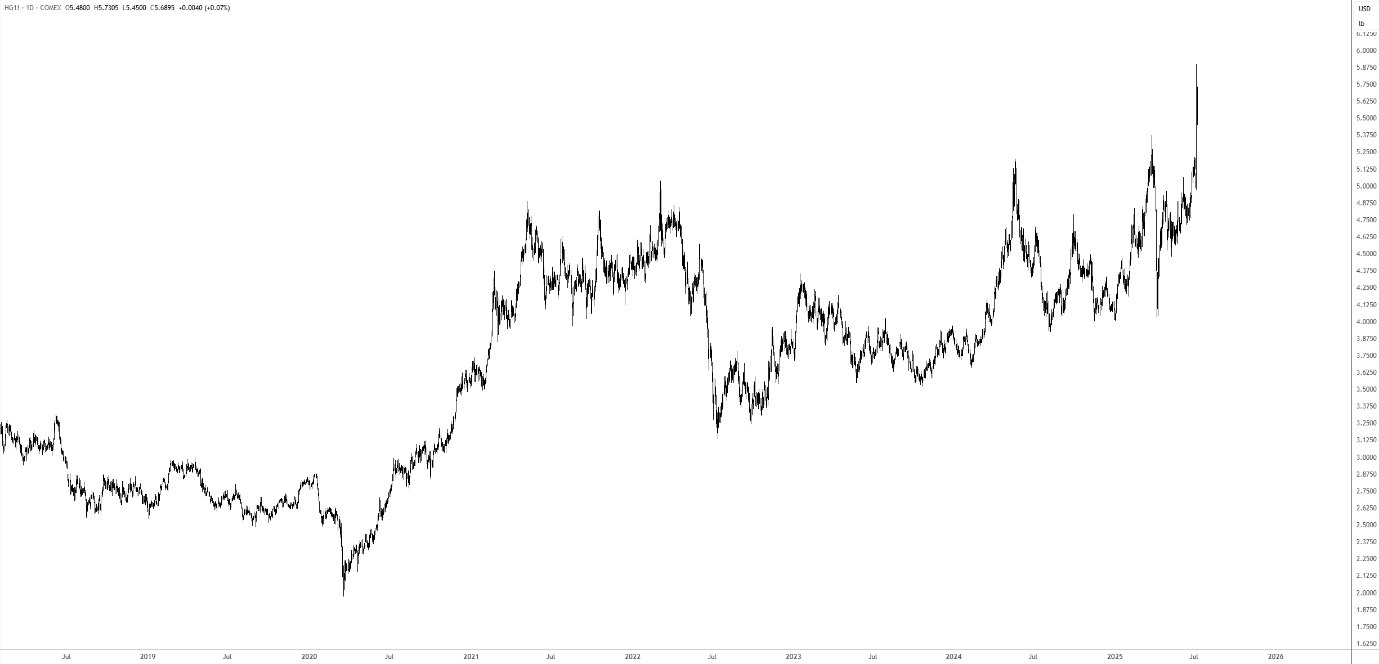
‘Dr Copper’ was also thrown in the spotlight yesterday, following Trump threatening 50% tariff threats on imported copper. This has seen copper futures hit record highs of US$5.89 per pound. According to the US Commerce Secretary, Howard Lutnick, copper tariffs are expected to come into effect early August.
The copper futures chart below says it all.
RBNZ held rates steady
As widely expected, the Reserve Bank of New Zealand (RBNZ) opted to hold the official cash rate at 3.25%, despite discussing the possibility of reducing the rate by 25 basis points (bps). The rate decision was largely based on current economic uncertainty and the need for more data on inflation and economic recovery before making further adjustments.
The rate statement noted that ‘If medium-term inflation pressures continue to ease as projected, the Committee expects to lower the official cash rate further’. Markets are still expecting one more rate cut this year, with -30 bps of easing priced in. August’s meeting is a coin toss at this point, with October almost fully priced in for a 25 bp cut (-23 bps).
The RBNZ is navigating a multifaceted economic landscape, with recent data suggesting a slowdown in the June quarter, although some signs of recovery are emerging in interest-rate sensitive sectors. On the domestic front, inflation is expected to briefly rise towards the top of the 1% - 3% target band in the September quarter, before falling back to the midpoint by early 2026. On a global scale, the RBNZ views the US trade war as a disinflationary force for New Zealand, potentially slowing economic growth.
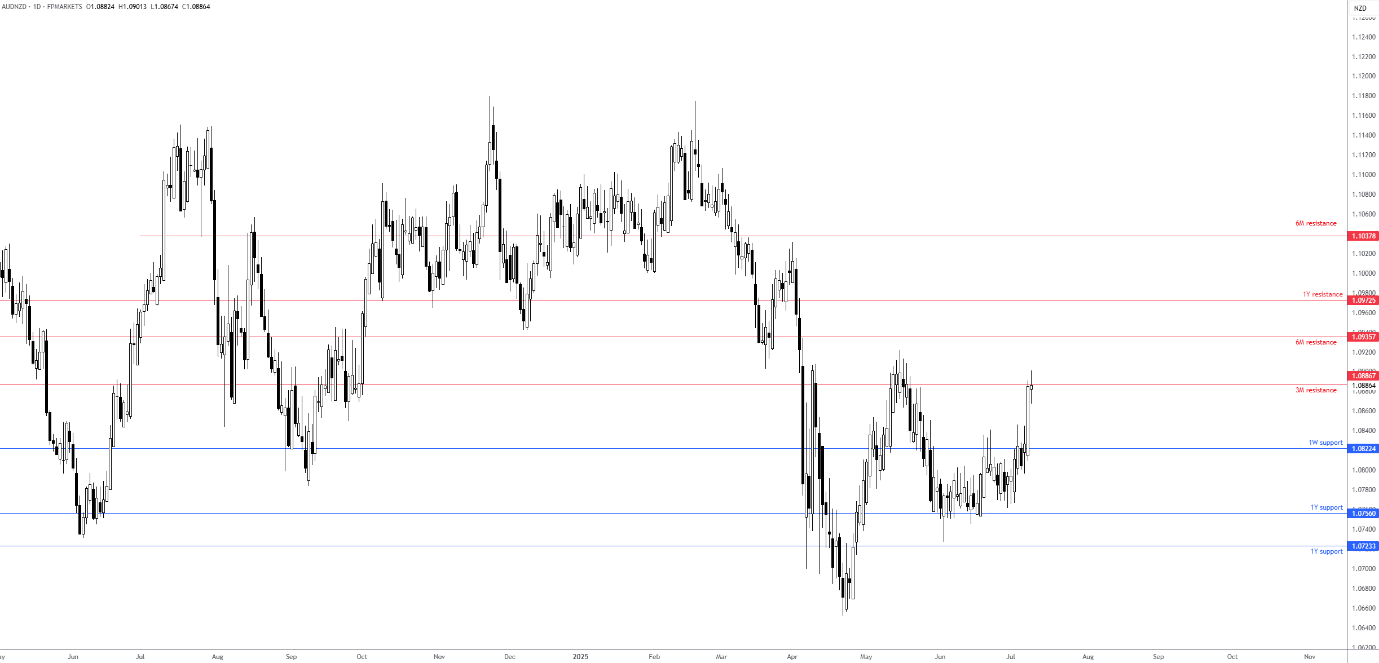
Markets were muted following the announcement. As shown below on the daily chart of the AUD/NZD cross (Australian dollar versus the US dollar) below, the pair is seen shaking hands with key resistance at NZ$1.0887. Were this level engulfed, 6M resistance calls for attention at NS$1.0936.
Author
Aaron Hill
FP Markets
After completing his Bachelor’s degree in English and Creative Writing in the UK, and subsequently spending a handful of years teaching English as a foreign language teacher around Asia, Aaron was introduced to financial trading,

















