US trade deficit widens in July, but balance normalizing on trend

Summary
The U.S. trade deficit widened after upward revisions to past data leave the balance narrower in recent months. Trade flows continue to normalize, and the early read on Q3 GDP is that net exports will provide a modest boost to headline growth.
Trade flows are slowing
U.S. trade flows continue to come back to earth after pandemic-related disruptions. The overall trade balance widened by $1.3 billion to -$65.0 billion in July, but that comes after large upward revisions leave the balance narrower over the past few months. Revisions help bring the monthly data in line with quarterly net exports in the GDP accounts, which previously suggested a larger drag from trade in Q2.
Despite the overall narrowing, the trade balance is now about 37% smaller than at its widest point in March 2022. That said, even as flows are normalizing, as seen in the nearby chart, the deficit remains wider than it was pre-pandemic.
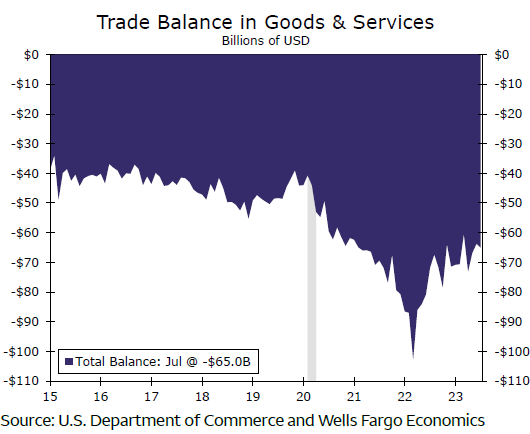
After the reopening of the global economy helped spur export growth throughout 2021 and most of 2022, exports have been more lackluster since late last year as growth has downshifted. Domestic U.S. demand has been a bit more rocky as well as households shift more of their wallets toward services and businesses have pulled back on new capital expenditures amid higher financing costs and increased economic uncertainty.
Trade flows bounced in July, but imports outpaced exports leading to the widening in the deficit. Imports rose by $5.2 billion, led higher by a rebound in consumer goods specifically. Capital goods were also higher, up 3.2%, and autos remained a bright spot for the fourth consecutive month (+1.9%) as the sector continues to unwind from a knotted supply chain. But there are indications of weakness. Industrial supplies have now fallen in 11 of the past 13 months, and on a year-to-date basis, industrial imports are running about $89 billion below their run rate last year. Consumer goods imports are also behind, about $65 billion below last year's year-to-date levels, demonstrating a pullback in domestic demand.
Exports rose by a still-strong but more muted $3.9 billion during the month, though growth here was concentrated in autos. In fact, motor vehicles & parts comprised more than 60% of the increase in July goods exports, rising by the most in nearly two years (+11.3%). Exports of industrial supplies also bounced after three consecutive months of decline, though here too industrial exports are more than $60 billion lower than their year-to-date 2022 pace through July.
Given monthly volatility in trade flows, it is still early yet to back into a precise read on Q3 trade. In real terms, exports rose 1.1%, while imports were up 1.8%. But coming off of a modest drag in Q2 and having fairly neutral assumptions in the remaining months of the quarter suggests net exports will provide a modest boost to Q3 headline GDP growth.
Author
Wells Fargo Research Team
Wells Fargo

















