|

US stocks fall on renewed global growth concerns

Dollar slips as home sales decline

US stock market snapped 4-session winning streak on negative implications of slower China’s growth data to global growth outlook. The S&P 500 fell 1.4% to 2632.90. Dow Jones lost 1.2% to 24404.48. The Nasdaq dropped 1.9% to 7020.36. The dollar weakening continued as data showed existing home sales declined in December. The live dollar index data show the ICE US Dollar index, a measure of the dollar’s strength against a basket of six rival currencies, slipped 0.01% to 96.287 but is higher currently. Futures on three main US stock indices point to mixed openings.
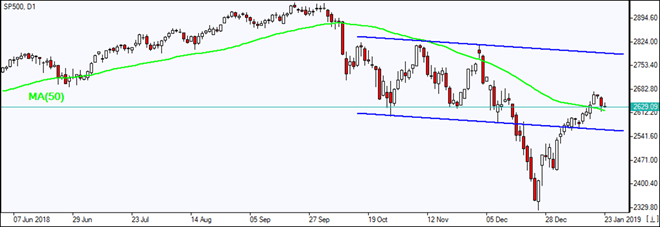
SP500

FTSE 100 underperforms other European indexes

European stocks extended losses on Tuesday on persisting global growth worries after China reported slower growth for 2018. The EUR/USD turned lower while GBP/USD rose with both pairs higher currently. The Stoxx Europe 600 lost 0.4%. The German DAX 30 fell 0.4% to 11090.11, France’s CAC 40 slid 0.4% and UK’s FTSE 100dropped 1.0% to 6901.39.

Chinese stocks rise while Asian indices slip

Asian stock indices are mixed today after President Xi Jinping told high-level Communist Party officials to be alert over “black swan” and “gray rhino” financial events in face of an economic slowdown at a meeting after China posted its slowest annual growth since 1990 - 6.6%. Nikkei slipped 0.1% to 20593.72 while yen resumed its slide against the dollar as Japan reported weak export data. Chinese stocks are higher supported by Beijing pledge to step up fiscal spending this year to support its economy: the Shanghai Composite Index is up 0.1%, and Hong Kong’s Hang Seng index is 0.1% higher. Australia’s All Ordinaries Index extended losses 0.3% as the Australian dollar resumed climbing against the greenback.

Brent up

Brent futures prices are recovering today. Prices ended lower yesterday: March Brent fell 2% to $61.50 a barrel on Tuesday.


Want to get more free analytics? Open Demo Account now to get daily news and analytical materials.


Want to get more free analytics? Open Demo Account now to get daily news and analytical materials.

Author

Dmitry  Lukashov

Dmitry Lukashov

IFC Markets

Dimtry Lukashov is the senior analyst of IFC Markets. He started his professional career in the financial market as a trader interested in stocks and obligations.


More from Dmitry Lukashov
Share:

Editor's Picks

AUD/USD flirts with 0.7000, lowest since early August amid bullish USD

AUD/USD hits a fresh low since early August during the Asian session on Friday and looks vulnerable near 0.7000 after breaking below the 200-day SMA overnight. Against the backdrop of the hawkish Fed, a two-day rally in oil prices revives inflation fears and continues to push US bond yields to multi-year highs. Adding to this, geopolitical risks lift the US Dollar to a two-month high, overshadowing RBA rate hike bets and weighing on the pair.

USD/JPY pulls back from three-week high after failing near 159.00

USD/JPY edges lower during the Asian session on Friday, stalling its recent strong move to a three-week high of 159.00 as Japanese Yen bears turn cautious amid intervention fears. Meanwhile, the US Dollar retains a strong bullish undertone as the Fed's hawkish outlook and oil-driven inflation fears continue to push US bond yields to multi-year peaks. Furthermore, the BoJ's dovish rate hike last week might cap JPY and support spot prices.

Gold treads water below $4,300

Gold grabs some buying attention and advances marginally at the end of the week, partially retracing the weekly decline, although it is still navigating below the key $4,300 mark per troy ounce. The fresh selling bias on the Greenback and the modest decline in US Treasury yields appear to support the humble advance in the precious metal.

Crypto Today: Bitcoin and Ethereum edge lower, XRP extends recovery as macro headwinds weigh

The broader cryptocurrency market is consolidating on Friday, with Bitcoin paring losses slightly above $84,000. Ethereum declines in tandem with BTC. Ripple (XRP), meanwhile, paints a different picture.


Fed vs BoJ: Both hiked. The market only believes one of them – and the chart shows which
The Federal Reserve (Fed) and the Bank of Japan (BoJ) have just done something remarkably similar. Both central banks raised interest rates by 25 basis points (bps) last week, both are confronting inflation risks, and both signal that future decisions will depend on incoming economic data.
Fed vs BoJ: Both hiked. The market only believes one of them – and the chart shows which

The Fed and the BoJ have just done something remarkably similar. Both central banks raised interest rates by 25 bps last week, both are confronting inflation risks, and both signal that future decisions will depend on incoming economic data.













