US Retail Sales May Preview: Deferred consumption or cancellation?
- Sales expected to rebound from April historic loss.
- Reopening economy and businesses should support rising consumption.
- Market and dollar impact will depend on the degree of sales recovery.

American consumption should recover from its historic collapse as the US economy shuddered to a halt under the mandated public health measure of the coronavirus pandemic but the amount of the return matters most for many partially reopened businesses.
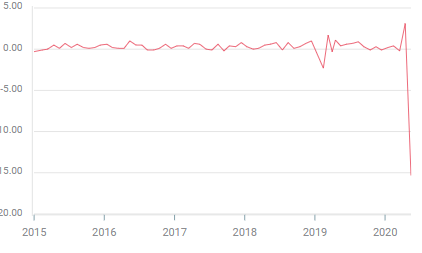
Retail sales are forecast to rise 8% in May following the record 16.4% drop in April. The control group category that inform the Bureau of Economic analysis’ GDP calculation, is predicted to climb 3.8% after its -15.3% plunge in April.
Retail sales control group
Non-farm payrolls and initial claims
Non-farm payrolls in lost 20 million jobs in April and only a small portion, 2.5 million, were rehired in May. Even so those returnees were completely unexpected as the consensus estimate for May NFP had been for another 8 million loss.
Initial jobless claims have seen a steady decline in new filings but the latest week still had 1.5 million applicants and 20 million continuing claims far in excess of any previous reading and an objective measure of the labor market catastrophe that has overtaken the US economy.
For the majority of the population that is still employed, their spending decisions in May and June will go a long way to determining the speed and success of the recovery.
Business and retail sales
The majority of retail businesses in the US were ordered closed in March and though internet shopping and delivery rose dramatically during the shutdown the bulk of normal consumption did not take place once the closures and sheltering orders went out.
Some of those purchases were simply deferred and some cancelled as families and individuals who lost employment cut back to essential buying.
The proportion between deferred consumption, which will likely return in May, and the vanished spending of the unemployed will mean survival or extinction for many small businesses.
A large though unknown segment of the retail stores are likely near their financial extremity after being closed and without cash flow for nearly three months.
If sales return in reasonable amount, reasonable being differently defined for each business, the revenue provided might be enough to sustain operation and perhaps rehire. As that take place the circle of employment leading to spending and more consumptions may power the economy to a rapid recovery. That at least is the theory.
However, it starts with retail sales, with consumers in stores, malls and on sidewalks.
Conclusion: market reaction and the dollar
The consensus forecast for an 8% gain in overall sales, about half the April loss and for a 3.8% rise in the control group, about one-fourth the prior decline, will not be enough to convince markets that the economy is going to outperform expectations.
May payrolls set the comparison and perhaps the underlying market hopes. If the sales figures improve markedly on the forecasts, equities and the dollar will benefit. The greater the surprise the better the market result.
If sales are as predicted they will be a market wash and if worse equites and the dollar will suffer.
In a consumption based economy there is no substitute for the consumer.
Author

Joseph Trevisani
FXStreet
Joseph Trevisani began his thirty-year career in the financial markets at Credit Suisse in New York and Singapore where he worked for 12 years as an interbank currency trader and trading desk manager.
















