US Retail Sales January Preview: Jobs and consumption are the core of the US economy
- Retail sales forecast to be unchanged in January.
- Control group and ex-automobiles categories to moderate.
- Labor market and consumer sentiment remain strong backers.

The US Census Bureau will release the advance report on Monthly Sales for Retail and Food Services for January on Friday, February 14th at 13:30 GMT, 8:30 EST.
Forecast
Retail sales are predicted to rise 0.3% in January as in December. The retail sales control group, the Bureau of Economic Analysis’ (BEA) GDP component, is expected to slip to 0.3% from 0.5% in December. Sales ex-autos are projected to increase 0.3% following Decembers 0.7% gain.
Wages and the labor market
It’s a truism that if the US consumers have income they will spend it. The US economy has provide plentiful proof over the last three years that this remains accurate.
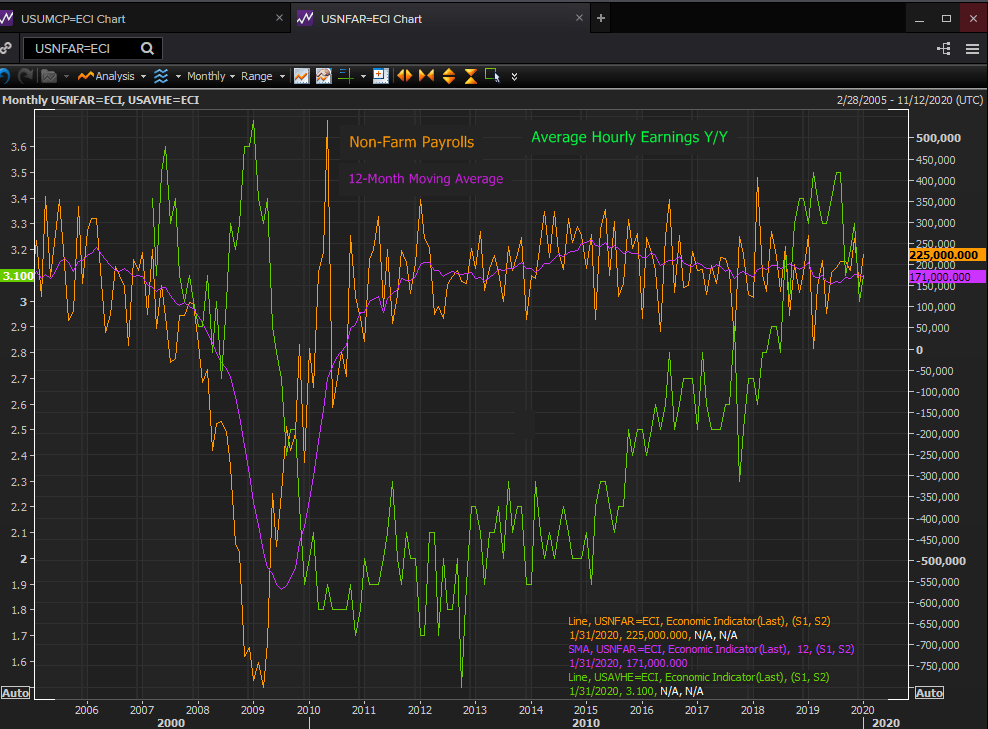
Annual average wage increase have been at 3% or higher for 18 months through January.
Non-farm payrolls averaged 175,000 new jobs each month in the year to December. If this was a decline from 235,000 in at the start of 2019 it is more than enough to supply the natural labor force expansion of 125,000-150,000 new workers each month with positions.
This surplus of employment is the main reason that wage gains are stable near their best levels of the decade despite the unexploited labor pool represented by the improved but historically low 63.4% participation rate.
Reuters
Personal income
This measure of income from the Bureau of Economic Analysis counts almost all sources of incoming funds including wages, salaries, interest payments, dividends, workmen's compensation, pensions , social security and other transfer payments. It rose 0.2% in December.
The 12-month moving average has tailed off this year to 0.317% in December from 0.375% in January and from 2018’s four year high of 0.508% in July and August, but it remains a constant addition to family and individual income.
Consumer sentiment
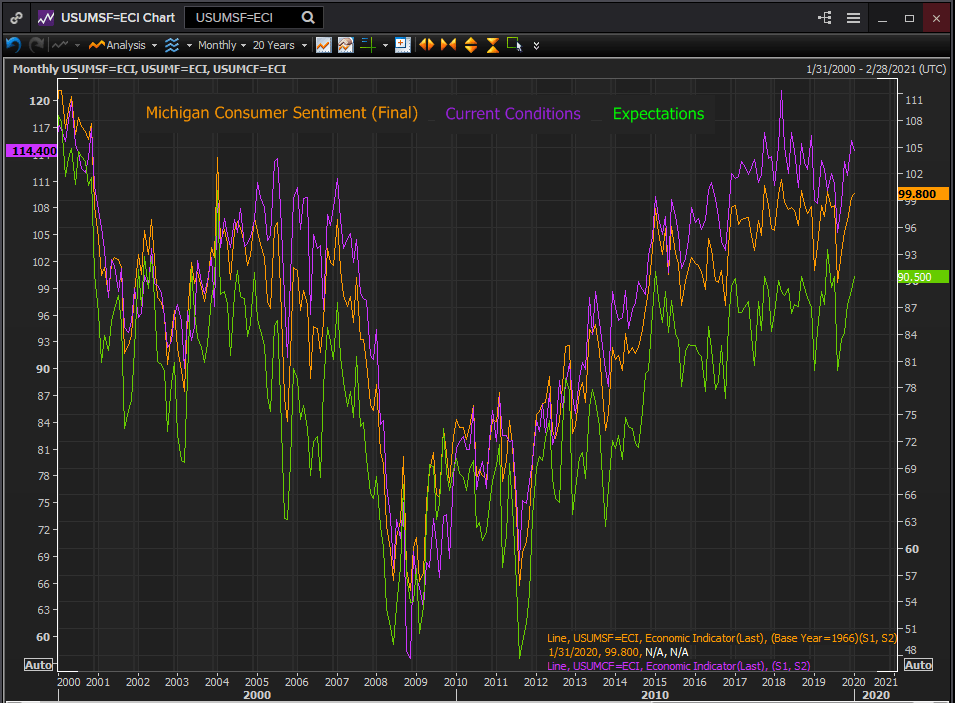
Michigan consumer sentiment has made a complete recovery from its August 2019 plunge. At 99.8 in the overall index, 90.5 in the expectations index and 114.4 in the current conditions score in January, the outlook of the US consumer is near the top of the past three years which places among the highest reading of the past two decades.
Reuters
The preliminary figures for February due on the 14th are expected to remain buoyant at 99.5 overall, 115 for current conditions and 90.3 in expectations.
Whatever is going on in Washington, China and the rest of the world, close to home America is remarkably sanguine.
Retail sales
Consumption over the past year, aside from the anomalous reading of -2% in December 2019 and 1.4% in January 2019 that were due to reporting problems around the government shutdown in January, has been stable.
The 11-month moving average for retail sales in December (excluding the above mentioned months) was 0.4%, a bit higher than where it was in November 2018. The same average in the ex-autos category was 0.364% in December, almost equal to the November 2018 score of 0.373%. Finally the retail control group that informs the BEA’s GDP calculation for consumption was 0.327% in December and 0.368% in December 2018.
Despite all the political wrangling and bitterness in DC, the US-China trade dispute, the recession in manufacturing and assorted international and now health crises, US consumers has stayed close to their happy employment roots.
Conclusion and the dollar
The main factors enabling retail sales, employment, wages and consumer sentiment have remained strong through the second half of the year and into January.
The pickup in hiring in the New Year may owe something to the China trade deal and the next few months may show lower numbers due to the mainland health crisis, but the trend is stable and is the biggest consideration in expanding consumption.
Wages continue to outpace inflation and provide higher amounts of disposable income. Consumer sentiment reflects these conditions and suggests a willingness to spend the profits of employment. There is no reason for this to change in January.
The dollar has gained 3% against the euro since the beginning of the year. Initially a product of the positive ramifications for the US economy of the China trade deal, the move since early February is a safety reaction to the corona virus crisis in China. The much weaker improvement versus the yen, less than 1%, is likely due to the Japanese currency’s safe-haven status in Asian markets.
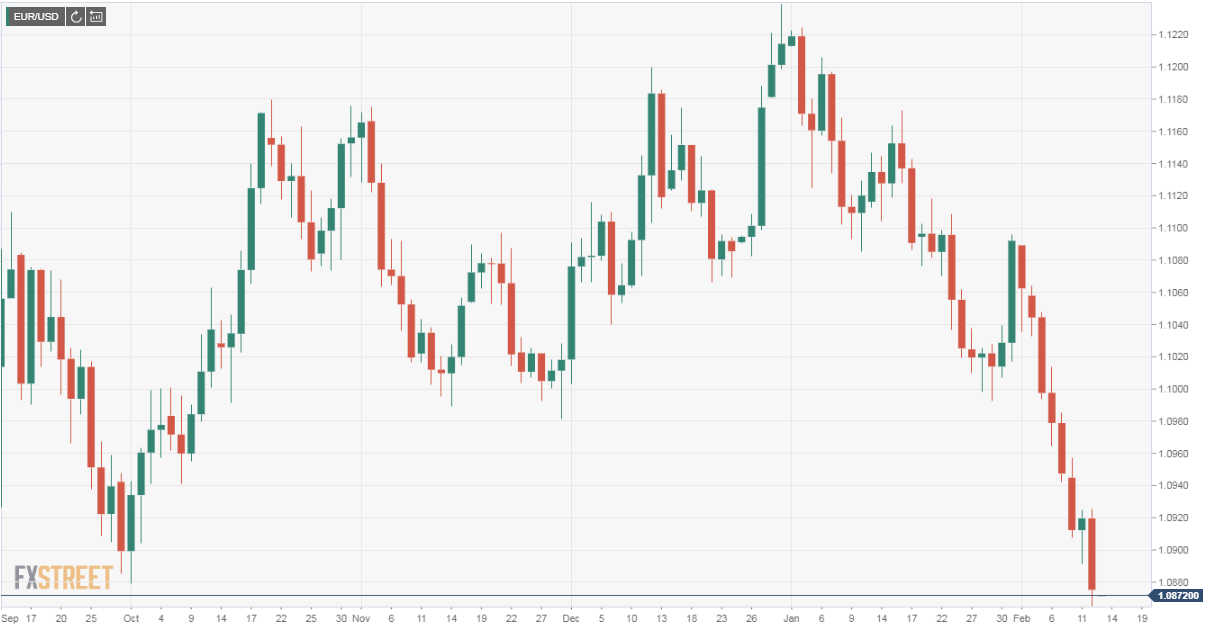
A good retail sales result for January will reinforce the notion that the US economy is still the most successful of the major industrial nations. The dollar can only benefit.
Author

Joseph Trevisani
FXStreet
Joseph Trevisani began his thirty-year career in the financial markets at Credit Suisse in New York and Singapore where he worked for 12 years as an interbank currency trader and trading desk manager.