US recession: With consumers showing fatigue, what is left to hold up the economy?
- A consumer sentiment survey is showing signs of weakness.
- Consumption has held up the economy up while investment dragged it down.
- The chances of a recession are rising and that may weigh on the dollar.

The University of Michigan's final Consumer Sentiment Index for August has been surprisingly downgraded from 92.1 to 89.8 points. The initial publication was already significantly below expectations and the current figure is the lowest since October 2016 – nearly three years.
The updated Gross Domestic report for the second quarter has shown a healthy growth rate of 2% annualized. However, there was a considerable gap between consumer spending at 4.7% – and contraction in investment – both in business and household spending.
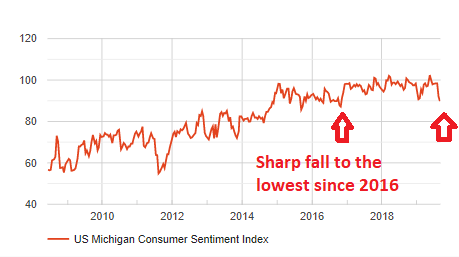
We noted that this has implications for the medium term – that the Fed is targeting – and there impacts the US dollar.
Strong consumption played a role in the second quarter that ended in June. The shopping spree extended into July with upbeat consumer sentiment – and upbeat retail sales.
The picture for August is already murkier. While lower consumer confidence may not immediately translate into reduced spending in August – it as an ominous sign.
If consumption fizzles out, what is left to prevent a recession?
A recession – foreseen also by the inversion of the yield curve – make time to materialize. However, the prospects for 2020 are looking bleaker by the day.
If such downbeat data continue to pile, talk about a recession may grow – turning into a self-fulfilling prophecy and adding fuel to the fire.
A recession and the dollar
The greenback is set for gains first and foremost against the Australian dollar – suffering from the trade wars. Next in line is the pound – which struggles with Brexit uncertainty. The robust Canadian economy may give a temporary fight against the dollar.
The euro may be a winner against the American currency – despite an imminent German recession – as the euro may see some repatriation after the immense QE programs. The clearest winner is the Japanese yen – the safest of safe havens.
For more about the trade wars and currency implications, see Powell powerless against Trump's trade wars – US set to move
Author

Yohay Elam
FXStreet
Yohay is in Forex since 2008 when he founded Forex Crunch, a blog crafted in his free time that turned into a fully-fledged currency website later sold to Finixio.

















