US Personal Income and Spending May Preview: Markets look ahead and behind
- The April-May reversal moves to personal spending.
- Personal income to drop in May as CARES stimulus fades.
- Annual core PCE price to continue lower after record fall in April.
- Market, dollar and currencies remain focused on the pandemic threat to economic growth.

Personal spending in the US will follow retail sales higher in May as the end of most restrictions in US states permitted a burst of deferred consumption. Income will take the opposite route as the boost from the CARES Act in April fades and annual PCE prices will continue to drift lower.
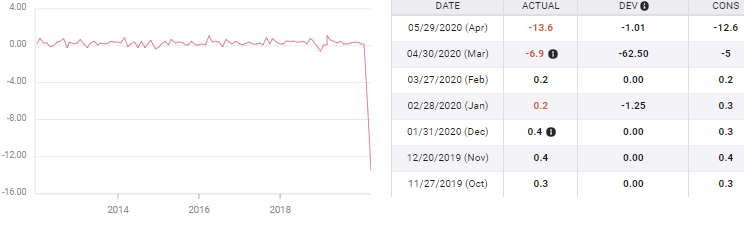
This spending measure from the Bureau of Economic Analysis (BEA) which tracks purchases at the household level is forecast to rise 9% in May following declines of 13.6% in April and 6.9% in March.
Personal spending
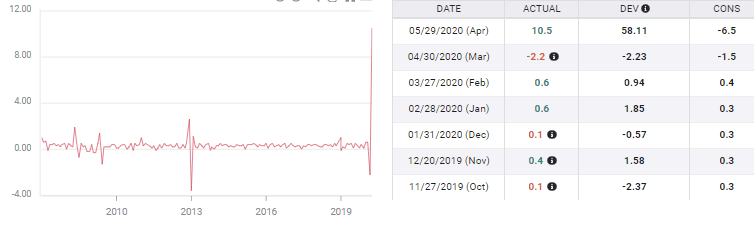
Personal income, also from the BEA, is expected to fall 6% after soaring 10.5% in April, largely on the receipt of stipend checks from the coronavirus relief act. Income fell 2.2% in March as the first of the layoffs took place.
Personal income
The core personal consumption price index, the Federal Reserves preferred gauge, is forecast to be flat in May after falling 0.4% in April and the annual rate is predicted to be 0.9% after falling to 1.0% in April from 1.7% in March.
Personal income and average annual earnings
The personal income statistic is a much broader measure of household funding than the average annual earnings number that is part of the non-farm payrolls report from the Labor Department.
Personal income attempts to covers all sources of money coming into a household, including wages and salaries, interest and dividends, rent, workmen’s compensation and transfer payments, the last detailing unemployment benefits and awards from the CARES Act.
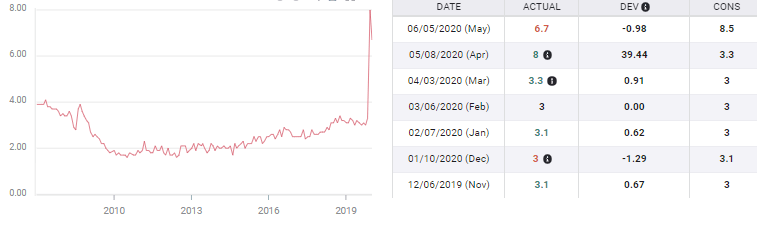
In comparison the average annual earnings figures for April and May rose 8% and 6.7%, because many of the workers laid off in those months were among the lowest paid hourly workers, making it appear that the remaining employees received large increases which they did not.
Average annual earnings
Personal spending and retail sales
The two figures look at consumption from different ends of the transaction.
Retail sales measure from his store point of view, tracking the reported rise and fall of receipts at America’s commercial establishments. Personal spending looks at consumption from the consumer viewpoint, measuring purchases by households. In the BEA definition personal spending, strictly personal consumption expenditures, is, “the value of goods and services purchased by or on the behalf of US residents."
The US consumer was far more energetic than anticipated in May. Retail sales soared 17.7%, easily besting the 8% prediction. Sales ex-autos rose 12.4% against a 5.5% estimate and the control group, which enters the government’s GDP calculation, climbed 11%, more than doubling the 4.7% prediction. The May increases for all were the largest on record as were the April declines.
Most important for the economy sales more than reversed the April collapse of 14.7% providing businesses with immediate cash flow after weeks of empty cash registers. Though the ex-autos and control group numbers did not quite reverse their April declines of 15.2% and 12.4% respectively, the overall report was so much better than expected it revived hopes for a rapid and even v-shaped recovery.
Conclusion: Markets look ahead and behind
The apparent return of the coronavirus in the early opening states of Texas and Florida, even though fatalities remain low hospitalizations have risen, unnerved markets on Wednesday. Texas Governor Greg Abbott warned of a “massive outbreak” and that the state’s ability to remain open depends on people following social distancing guidelines.
The Dow, S&P 500 and Nasdaq all fell more than 2%, in order 2.72%, 2.59% and 2.19%. Treasury yields fell to their lowest in two weeks with the 10-year shedding four points to 0.676% and the 2-year losing one point to 0.186%.
The dollar saw a modest return to risk aversion with the greenback gaining against all the majors and the Swiss franc and New Zealand dollar.
While it is likely that the personal spending figures for May will confirm the strong showing for the US consumer evident in the retail sales figures that may matter less to markets and the dollar than the evolving pandemic picture in the United States.
The economic recovery that the equities and the risk-on dollar have been banking on depends on a fully opened American economy.
Markets can only look in one direction at a time. If they are watching their virus back they are not watching the economic future.
Author

Joseph Trevisani
FXStreet
Joseph Trevisani began his thirty-year career in the financial markets at Credit Suisse in New York and Singapore where he worked for 12 years as an interbank currency trader and trading desk manager.
















