|

US Natural gas futures price analysis

Natural Gas prices continued its’ chiseling price action lower yesterday and held to slide on Tuesday but held the line in the sand at 2.650 moving one-tick lower but saving itself from price annihilation. Demand is clearly under pressure as the weather forecast into the holidays is expected to be warmer than normal for most of the United States especially in the traditionally colder belts of the mid-west at least for the next 2-weeks. Hurricane Iota was downgraded to a tropical storm causing sustainable damage in regions of  Nicaragua and there is no real expectation of disrupting any US Natural gas infrastructure  including the southern regions. Demand over the near-term horizon therefore has fallen, driven by lower building consumption.

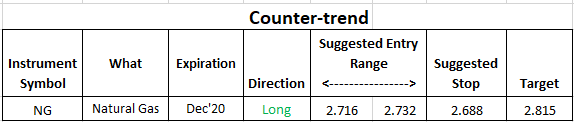
Natural Gas futures are still trading the December-20 expiration contract unlike WTI Crude which has seen brokerages roll to the first front-month of the upcoming year [Jan-21].Ironically, the price has a nice long setup leading into the extended timeframe short which we present below in an easy to read and trade tabular format. At TradeGuidance, we try to give our readers actionable trade ideas that they can run with during the intraday trading hours and not have to sweat the small stuff by carrying positions into the overnight timeframe when a whole lot of information becomes unpredictable from global events at least in the short term. Trade with stops and always learn to only risk what you can afford to lose.

Trade ideas

Counter-trend long setup
fxsoriginal

Trending short setup

Chart

Author

Murali Sarma

Murali Sarma

Trade Guidance, LLC

Murali Sarma is a private investor and trader, dealing in currencies, commodities (grains, energies, metals, bonds, indices) and stocks.


More from Murali Sarma
Share:

Editor's Picks

GBP/USD holds near Feb. 11 highs as bulls await breakout above 1.3660

The GBP/USD pair trades with a positive bias around mid-1.3600s at the start of a new week and remains well within striking distance of its highest level since February 11, touched on Friday. Moreover, the fundamental backdrop favors bullish traders and backs the case for an extension of a nearly one-month-old uptrend.

EUR/USD holds steady amid US debt strategy

EUR/USD remains stronger for the fourth successive trading day, hovering around 1.1680 during the Asian hours. The currency pair holds its ground as the US Dollar struggles under pressure from newly announced United States fiscal moves. The Treasury Department surprised financial markets by pledging to at least double its buybacks of longer-dated government debt in an attempt to rein in rising bond yields.

Gold keeps rallying toward $4,700, fresh three-month highs

Gold extends its last week's stellar performance into Asian trading on Monday, refreshing three-month highs beyond $4,600. The precious metal capitalizes on persistent US Dollar weakness, following the US Treasury's buyback plan amid fresh US-Canada trade tensions.

Here's what I learned trading meme coins
I’ve been trading cryptocurrencies for the past seven years, with meme coins becoming one of the most exciting and implacable parts of my experience. I love them because they represent internet culture and community sentiment, and, let’s be honest, extreme speculation. Newly launched meme coins were especially tempting: get in early enough, I thought, and a small bet could turn into a huge return.
The week ahead: Jackson Hole and Nvidia results to take focus away from Trump
We start the week with the focus squarely on the US. Rising Treasury yields, the Jackson Hole Symposium, inflation and GDP data, along with tariff risks, will dominate market action in the coming days.
$20 billion offered, $2 billion taken: Why Treasury doubled its buyback cap

The US Treasury moved off its own calendar on Wednesday, and that is the part worth sitting with. At 12:32 GMT, the department said it would at least double the size of liquidity support buyback operations in the 10-year to 20-year and 20-year to 30-year sectors, lifting the maximum from $2 billion per operation to at least $4 billion, effective September 9 and running to November 4.