US Initial Jobless Claims Preview: If higher claims are evidence of an economic slowdown are lower a sign of an acceleration?
- Initial jobless claims expected to edge down from pandemic low.
- New orders index for the service sector at record high in July.
- Dollar has stabilized after falling for three weeks and will respond to better or worse claims.

When initial jobless claims jumped 10% in the middle of July speculation connected the increase with the Covid prompted economic rollbacks in several Southern and Western states.
After the surprise, and much larger 17% drop in unemployment claims last week, who will ask if this is a signal that the recovery is accelerating?
Initial jobless claims in the week of August 7 are forecast to fall to 1.140 million continuing the improvement that began with the prior week’s drop to 1.186 million, the lowest since the pandemic began in March, from 1.435 million.
Continuing claims are predicted to decrease to 15.898 million from 16.107 million the previous week, also the pandemic low and from 16.951 million on July 17.
Non-farm payrolls
American firms hired 1.763 million workers in July, 10% more than the consensus estimate but two-thirds less than June’s 4.8 million. The survey week for NFP was July 17, the first of the two weekly increases in initial claims (July 17, 1.422 million, July, 1.435 million) from the low of 1.307 million on July 10.
Payrolls have recovered 42%, 9.253 million, of the 22.26 million jobs shed in March and April.
Manufacturing PMI and employment
Purchasing managers’ indexes for July present a conundrum. The overall indexes for manufacturing and services were much stronger than anticipated and the new orders gauges were even better but employment measures remained mired in contraction.
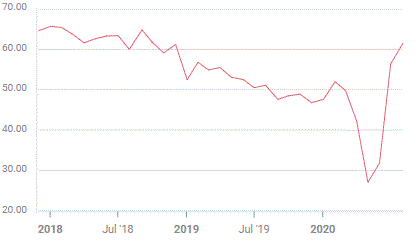
Manufacturing rose to 54.2 beating the 53.6 estimate and June’s 52.6 score. It was the highest reading since 54.6 in March 2019. The new orders index, a reliable measure of future business, climbed to 61.5, far ahead of the projected and likely Covid inspired forecast of 46.8 and June’s 56.4.
Manufacturing new orders index
The employment index, however, at 44.3 missed its forecast of 48.3 and was but a minor improvement over June’s 42.1. Despite the sharp gain in new orders, the employment index remained below 50 deep in contraction.
Services PMI and employment
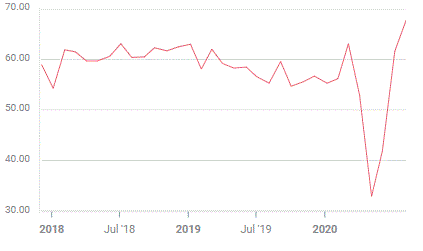
Services exhibited the same pattern. The overall index climbed to 58.1, outstripping the 55 forecast and June 57.1 for the best score 17 months. The new order gauge soared to 67.7 an all-time record from 61.6. Employment lagged badly falling to 42.1 from 43.1 and missing the 51.1 prediction.
Services new orders index
PMI, new orders and employment
The obvious question is that if managers are seeing these high volumes of incoming orders why would their employment outlook remain pessimistic.
Perhaps the Covid case reporting had its impact here. Small and medium sized business were the hardest hit by the economic closures and many remain under some form of restraint. Their logic is simple. Even if business is good, let’s wait and see how the second wave transpires. There is little point in rehiring if managers would be forced to lay off the new workers in a few weeks.
Conclusion and the dollar
The prospect of a second wave economic shutdown in the US was responsible for the dollar sell-off of the last three weeks and the primary economic signal was initial claims.
Covid cases, hospitalizations and fatalities are in decline in almost all of the states. Manufacturing businesses are fielding the highest levels of new orders in a year-and-a-half. The service sector which comprises about 85% of US economic activity had a record level of incoming orders in July.
A logical response to such business conditions would be to rehire workers. The risk to the claims number especially after the unexpected improvement last week to is to the downside.
If initial claims begin to fall the dollar and US economic prospects will surely rise.
Author

Joseph Trevisani
FXStreet
Joseph Trevisani began his thirty-year career in the financial markets at Credit Suisse in New York and Singapore where he worked for 12 years as an interbank currency trader and trading desk manager.
















