US GDP beats forecast but markets unimpressed

The US economy continued its strong run into the third quarter propelled by rising consumer and government expenditures while business investment took a breather from 18 months of expansion and inflation retreated
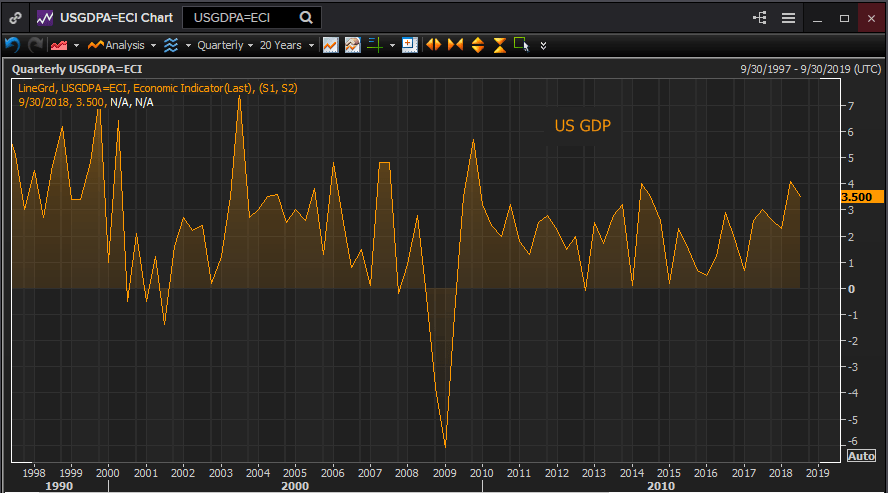
Gross domestic product grew at a 3.5% annual rate, according to the Commerce Department on Friday, slightly more than the 3.3% median forecast, a bit lower than the 4.2% pace in the second quarter and better than the 2.2% pace in the first.
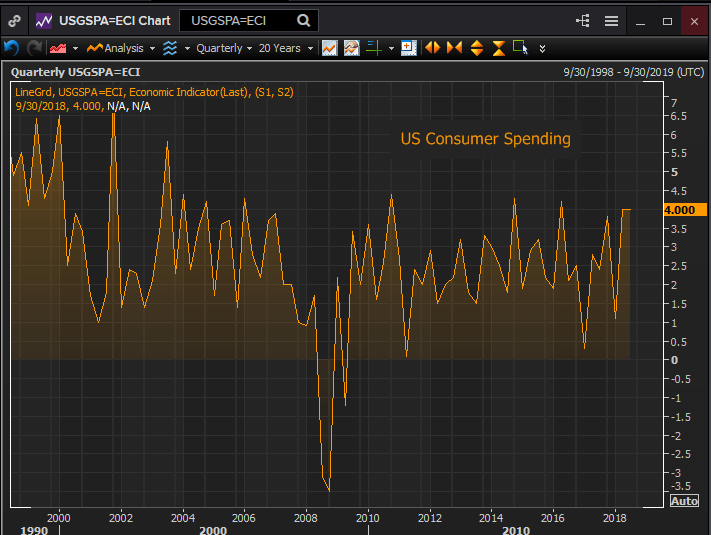
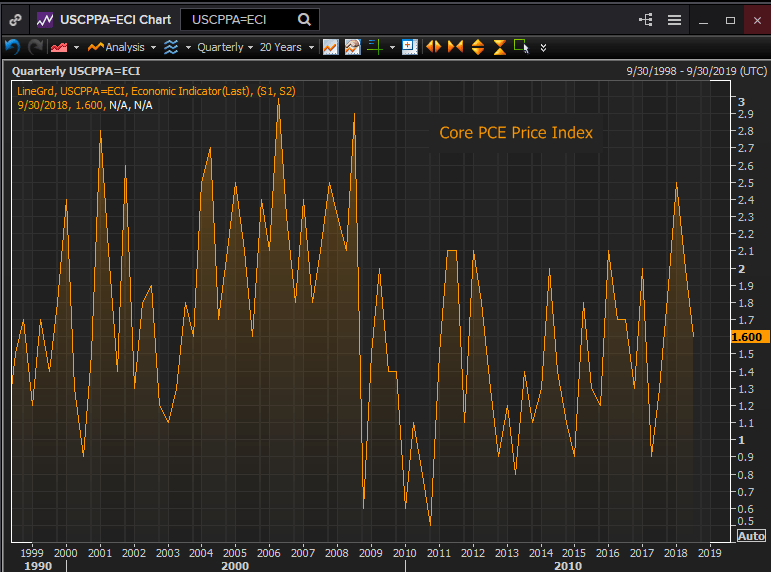
Consumer spending, the perennial two/thirds of economic activity, rose 4 % in the third quarter, the best since the final three months of 2014. Government expenditures jumped 3.3% at the Federal level and 3.2% for state and local governments. Both helped offset a 7.9% decline in business spending, the biggest drop since the first quarter of 2016. Inflation in the third quarter in the PCE price index fell to 1.6% from 2.2 %.
Low unemployment, 3.7% in September, robust job creation and benefits from the $1.5 trillion 2017 tax overall bill have supported consumer spending.
The dollar was initially higher with the euro dropping as low as 1.1335 after the release at 8:30 am EDT, the sterling to 1.2227 and the yen falling to 112.19, but those gains were quickly reversed and by noon the yen was back above 112.00, the sterling above 1.2800 and the euro beyond 1.1400.
Equities saw another sharp sell off the Dow was down over 300 points at mid-day, but by early afternoon the equity index had cut its losses to 77 points.
Though third quarter GDP was good by any objective standard, it had been expected and was largely priced into the currency and equity markets.
The October stock swoon has not been about US economic growth which has been excellent, but about concerns that the Fed's higher interest rate program, trade tensions with China and slowing growth in Europe will cut into the US expansion.
The Fed’s economic projections anticipate a drop in US GDP to 2.5% next year and 2.0% in 2020.
Business investment rose just 0.8% in the third quarter after climbing at an 8.7% rate in the second quarter and 11.5% in the first. Those quarters capped the strongest year and a half for businesses since 2011. It may be that the drop in investment is a pause for reassessment and to determine whether consumption will continue to improve in line with the strong labor market, or if the recent surge in consumer spending is a product of the temporary stimulus of the tax cut.
Credit prices improved with the 10-Year Treasury yield losing 3 basis points to 3.09% (1:08 pm EDT) even though the GDP number works to reinforce the case for the Fed's four rate hikes to the end of 2019.
Inventory expansion added 2.07% to third quarter GDP, the opposite of the prior quarter which saw a net drawdown and the lagest quarterly build since the beginning of 2015.
Businesses stockpile goods in anticipation of future sales. If those purchases materialize the economy moves ahead, if not, companies and retailers discount those goods to move them off the shelves hurting profits and decreasing new orders to manufacturing. Holiday shopping in the next two months will determine whether firms have made the correct choice in building inventories.
Exports fell at a 3.5% annual rate last quarter, amid political and trade problems, while imports rose at a 9.1 percent annual clip, indicative of a healthy consumer economy.
Real final sales of domestic product, the GDP number minus net trade, inventories and government spending came in at a 1.4% annual rate.
Charts: Reuters
Author

Joseph Trevisani
FXStreet
Joseph Trevisani began his thirty-year career in the financial markets at Credit Suisse in New York and Singapore where he worked for 12 years as an interbank currency trader and trading desk manager.