US First Quarter GDP Preview, Second Release, First Revision: Economic archeology
- Annualized growth forecast to be unchanged at -4.8%.
- Revisions to components and international trade balance due for inclusion.
- Retail sales control group for March stronger on adjustment.
- Market impact minimal as far worse GDP expected in the second quarter.


American economic growth in the first quarter was smashed by the extensive business closures and the massive layoffs that dominated the second half of March. Large portions of the retail, restaurant, travel and hospitality sectors and many thousands of small businesses were ordered shut by state governors from New York to California.
The blow was large enough to drop annualized economic growth GDP from 2.7% in the Atlanta Fed GDPNow model before the pandemic to -4.8% on delivery from the Bureau of Economic Analysis (BEA) on April 29.
Unincorporated March economic statistics
The economic record for the final month of the first quarter was largely complete by the release of the initial version of first quarter GDP on April 29.
National account procedures followed by the BEA include four categories of economic activity for GDP: consumption, business spending, government expenditures and net international trade.
The BEA calls the first version of GDP preliminary, the second or first revision, advanced and the last version and second revision, final.
The initial March retail sales figures were released on April 15 and the durable goods orders on April 24 in time for the initial GDP estimate from the BEA. However the revisions to both numbers came after the April 29 release and will be included in this May 28 advanced GDP release.
Retail sales control group
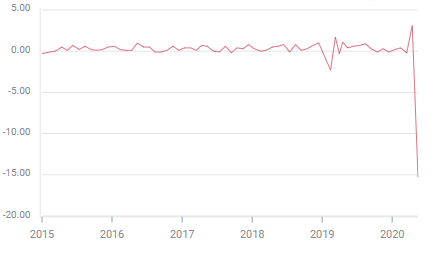
Retail sales’ control group category is the consumption component of the BEA’s GDP calculation. The initial 1.7% gain was revised to 3.1% and released with the April retail sales numbers on May 15.
The durable goods category non-defense capital goods ex-aircraft, while not an actual BEA inclusion is considered a good proxy for the business spending component of government’s GDP accounting. Its March result was revised from 0.1% to -0.8%.
These two revisions counter each other, consumption improved and business investment declined. Even though the consumption contribution to economic activity is considerably larger than that of business investment the partially offsetting changes are probably not sufficient to affect the overall rate of first quarter growth.
There is one other BEA category, net international trade that has new information since the original GDP release.
The international trade balance for March and the revision to February’s numbers were released on May 5. The March deficit was slightly larger than the -$44 billion forecast at -$44.4 billion and the February deficit was revised to -$39.9 billion from -$39.8 billion, neither discrepancy is large enough to impact the overall annualized first quarter GDP number.
Conclusion: markets and the dollar
First quarter GDP was old news when it was first reported on April 29, it is practically archeology now.
Markets and traders are expecting the second quarter GDP numbers to be the nadir of the pandemic economic collapse. The latest GDPNow projections from the Atlanta Fed envision a 41.9% decline in growth.
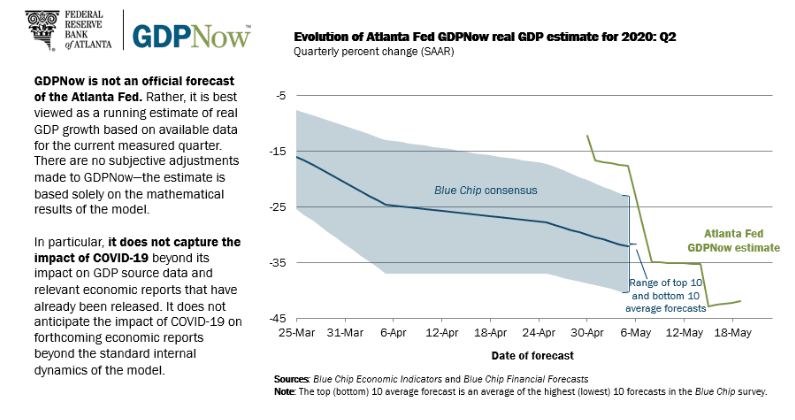
Bureau of Economic Analysis figures for the second quarter are more than two months away on July 30 and indeed the final month June lies directly before us.
By the time the BEA growth numbers for April, May and June are available much of the important economic information for May and June will already be known.
If the US economic low point does turn out to be May, with the recovery accelerating in June and July, equity, credit and currency markets in late July will be firmly fixed on the future and the second quarter numbers will seem as dusty as a Pharaoh’s tomb.
Author
Joseph Trevisani
FXStreet
Joseph Trevisani began his thirty-year career in the financial markets at Credit Suisse in New York and Singapore where he worked for 12 years as an interbank currency trader and trading desk manager.

















