US economy held back by a lack of willing workers

Headline US jobs numbers were weak, but the details paint a more positive picture. Nonetheless, labour supply simply isn't returning quickly enough and for companies desperate to hire this is a huge problem. The implication is that it constrains growth and pay is bid higher, with those cost increases likely passed onto consumers.
Payrolls bad
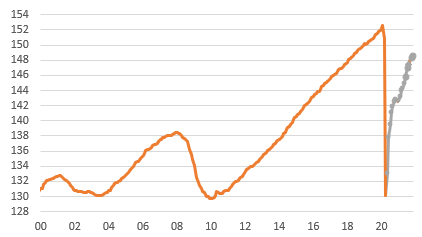
US non-farm payrolls rose at a much slower pace than expected in November. 210,000 jobs were added last month – less than half of the 550k consensus. 82k upward revisions don't really change anything. Goods producing jobs rose a solid 60,000, but there was a major slowdown in the service sector with just 175,000 private service sector jobs added. Leisure and hospitality is simply not rebounding as we would have liked to see (+23,000) while government employment fell for the fourth month in a row. Retail also saw a 20,000 fall. This means that US employment is still 3.9mn below pre-Covid levels.
US Nonfarm Payrolls (millions of jobs)
Source: Macrobond, ING
Household survey good
However, this is not the full picture. The unemployment rate fell to 4.2% from 4.6% with household employment rising 1.1mn so there is a clear discrepancy between what employers are saying (establishment survey) and what individuals are saying (the household survey). There are often divergencies, but this is a big difference and it is difficult to reconcile. Effectively you can defend any position by picking out the bits of the report that suits your view.
Demand outstrips supply
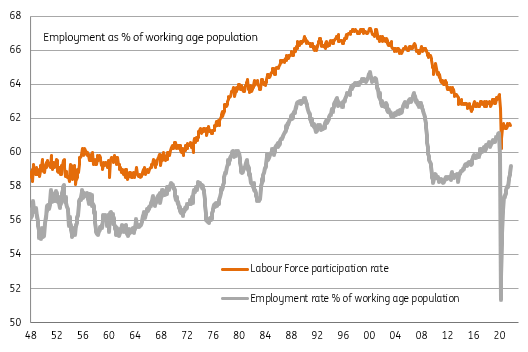
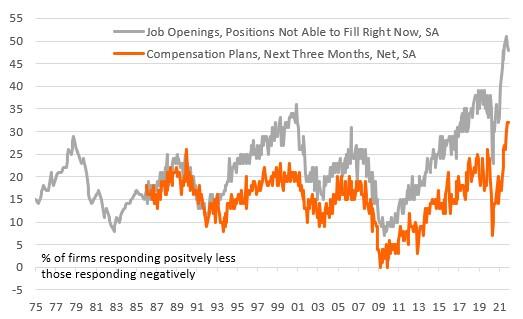
In our view the key problem for the economy, as indicated by today’s payrolls number, is that demand for workers continues to outstrip supply by a wide margin. There are more than 10 million job vacancies in the US with the National Federation of Independent Businesses (NFIB) yesterday reporting that a net +48% of small businesses have job openings they can’t fill. There is absolutely no problem with demand. The issue is the lack of workers to hire with the labour participation rate remaining woefully low at 61.8%.
Labour force participation rate and employment ratio (% of working age population)
Source: Macrobond, ING
Nearly 40% of people of working age are not engaged in the labour market in any meaningful way and with companies desperate to hire the jobs figures could be so much better if workers were available. This in turn is holding back the productive capacity of the US economy so growth is not as good as it should be while it boosts inflation pressures as companies compete for staff and bid wages higher. Today’s environment of decent corporate pricing power then means that these higher costs can be passed onto customers, which shows up in CPI.
In this regard, the NFIB reported a net +44% having raised worker compensation in the past three months to try and attract staff. A net +32% expect to have to raise pay further in the coming three months. Both of these are at all-time highs for a report that started in 1975!
NFIB survey – proportion of companies with vacancies they can't fill and the proportion of companies expecting to raise worker pay (1975-2021)
Source: Macrobond, ING
Where are the workers?
The return of in person schooling, the effective Covid vaccine and the ending of extended and uprated unemployment benefits was supposed to see potential workers come flooding back.
One reason may be that with household wealth having increased by $26tn between end 2019 and June 2021 – equivalent to $78,000 for every American – there isn’t the urgency to go and find work with many people choosing to take early retirement. Those gains will not have been spread evenly over the income spectrum, but there is the likelihood that many individuals have built up a financial buffer so don’t need to go out and immediately get a job they may not especially like doing.
Fed to move sooner rather than later
Comments this week from Federal Reserve officials suggest a clear appetite to normalize policy more quickly. The dropping of the “transitory” description of inflation and the likes of Jerome Powell, Mary Daly, Randy Quarles and Raphael Bostic all extolling the virtues of accelerating the taper is a clear and also somewhat surprising shift given the emergence of the Omicron variant. With inflation set to push close to 7% next week we have to be looking for a $30bn monthly reduction is QE asset purchases from January and the realistic prospect of three rate hikes in 2022 – Omicron permitting…
Read the original analysis: US economy held back by a lack of willing workers
Author

James Knightley
ING Economic and Financial Analysis
James Knightley is the Chief International Economist in London. He joined the firm in 1998 and has been covering G7 and Western European economies. He studied economics at Durham University, UK.
















