US: Economic resilience despite higher rates – Part one


In the US, in an environment of aggressive monetary tightening, the resilience of companies has contributed to the resilience of the economy in general through various channels -staffing levels, investments, growth of profits and dividends, etc. Companies’ resilience has been underpinned by different financial factors: company profitability, cash levels accumulated during the Covid-19 pandemic, the ease of capital markets-based funding, low long-term rates that had been locked in during the pandemic. Finally, the growing role of intangible investments also plays a role because they are less sensitive to interest rates, thereby weakening monetary transmission.
Despite significant and swift increases in official interest rates, judging by e.g., real GDP growth and the labour market, the US economy has been remarkably resilient during this monetary policy cycle.
After analysing the role of household finances in last week’s EcoWeek, we now turn to companies. Through various channels -staffing levels, investments, growth of profits and dividends, etc.- they have contributed directly or indirectly to the resilience of the US economy in general.
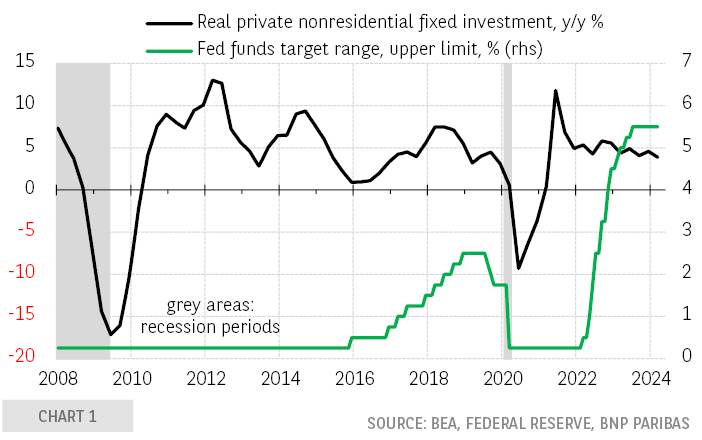
After the rebound following the collapse during the pandemic, company investments have been growing in recent years at about 5% y/y, a pace that was maintained despite the huge increase in official interest rates.
Author
BNP Paribas Team
BNP Paribas
BNP Paribas Economic Research Department is a worldwide function, part of Corporate and Investment Banking, at the service of both the Bank and its customers.