US Dollar Weekly Forecast: Fedspeak and US shutdown on top of the agenda
- The US Dollar could not sustain fresh tops north of the 100.00 barrier.
- Expectation of a December rate cut by the Fed is losing momentum.
- The US federal government shutdown extends to historic levels.

The week that was
Despite a promising start to the week, the upside impulse in the US Dollar (USD) fizzled out in the second half of the week, leaving it with modest losses when looking at the weekly chart.
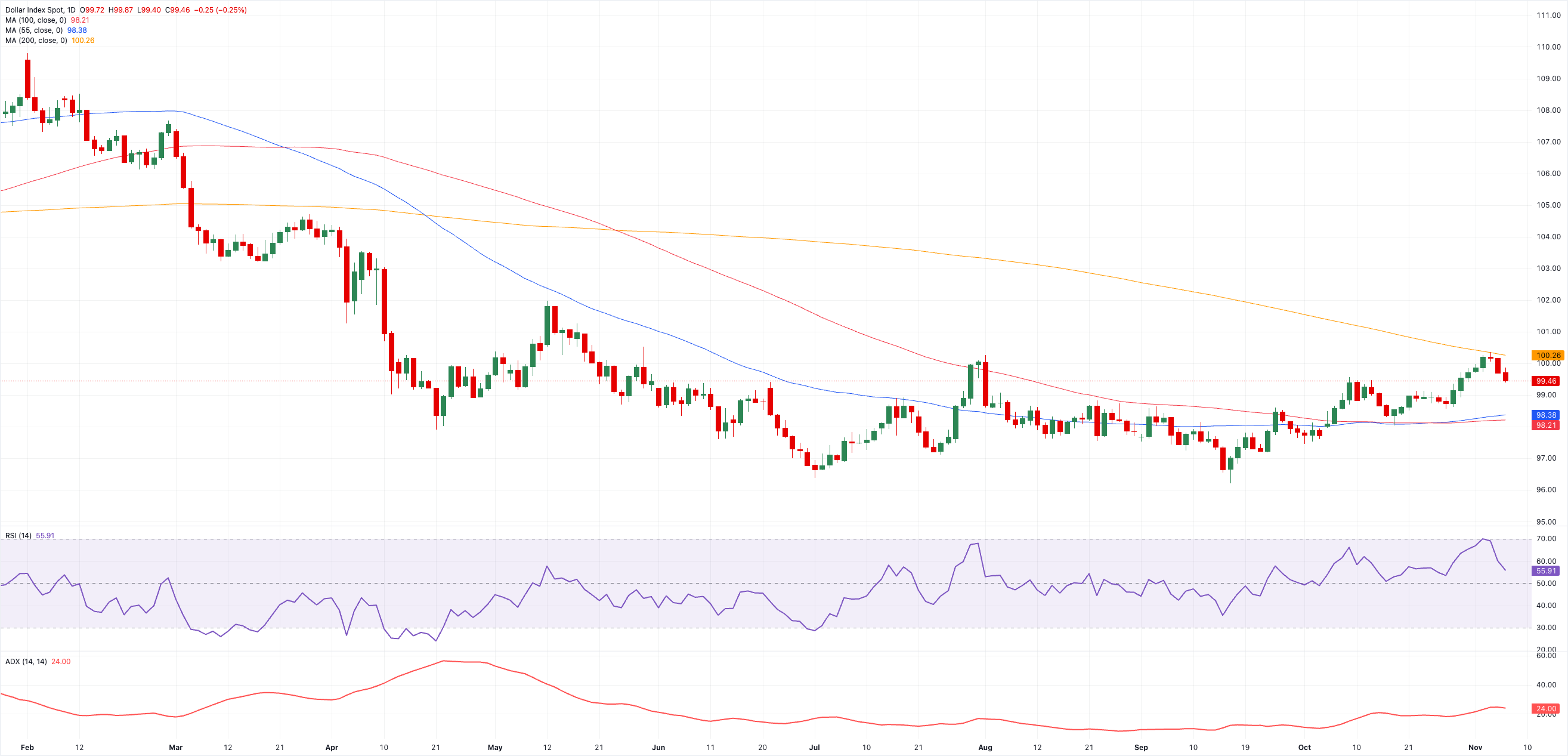
Indeed, the US Dollar Index (DXY) failed to sustain a move to levels last seen in May, north of the psychological 100.00 barrier, a region also coinciding with its critical 200-day Simple Moving Average (SMA).
As a result, the index returned to the negative territory, although chances of another attempt to break above the key 200-day SMA are expected to remain in the pipeline for now.
This week, investors remained mostly focused on developments (or lack thereof) around the US federal government shutdown, which, at 38 days and running, has become the longest in history.
In addition, the Federal Reserve's (Fed) further repricing of extra easing in the following months remained a key focus, as market participants continued to evaluate the hawkish message from Chief Jerome Powell at the latest FOMC event.
On another note, there was no further news on the trade front following the Trump-Xi-sponsored extension of the trade truce between the two largest economies of the world, while the geopolitical landscape did not offer any breakthrough either.
In the US bond market, US Treasury yields have navigated a generalised downward trend across various maturity periods.
The Fed sticks to its prudent stance
The Fed lowered interest rates by a quarter point on October 29, a move supported by most, but not all, policymakers. The 10–2 vote brought the benchmark rate down to 3.75%–4.00%, matching what most markets had expected.
Alongside the rate cut, the Fed announced it would restart small-scale Treasury purchases to ease recent strains in money markets, an indication that liquidity has tightened more than officials would like.
Speaking at his usual press conference, Chair Jerome Powell acknowledged that the Fed remains split on what comes next and warned investors not to assume another cut in December. His comments highlighted just how much uncertainty still surrounds the FOMC’s path forward.
In futures markets, traders are now pricing in roughly 18 basis points of additional easing by year-end and about 87 basis points by the end of 2026, slightly more than they were expecting a week ago.
Further easing remains far from a done deal
Federal Reserve officials struck a cautious tone this week, offering a mix of views on what comes next for interest rates. Some said it’s too soon to think about another cut with inflation still running high, while others warned that keeping policy too tight could do more harm than good. The ongoing government shutdown and the lack of fresh data it’s causing added another layer of uncertainty to the debate.
- Chicago Fed President Austan Goolsbee said he’s in no rush to cut rates again, pointing out that inflation remains too high for comfort. Later in the week, he noted that the shutdown’s disruption to key economic data only makes him more hesitant to move quickly.
- Fed Governor Lisa Cook described December’s meeting as “live,” meaning a rate cut is still on the table, but said she’ll base her decision on whatever information is available between now and then, even if official data are delayed.
- Governor Stephen Miran repeated his argument that rates are already too restrictive, saying policy is weighing on the economy despite the strength seen in stock and credit markets.
- San Francisco Fed President Mary Daly said she backed last week’s rate cut but wants to see how the data evolves before deciding if another move in December makes sense.
- Cleveland Fed President Beth Hammack took a more hawkish view, warning that inflation is still too high and that current policy settings aren’t doing much to bring it down.
- St Louis Fed President Alberto Musalem said the recent cuts were appropriate to help keep the job market resilient but added that the Fed must still lean against above-target inflation.
- And Fed Vice Chair Philip Jefferson wrapped up the week by urging patience, saying the Fed should “proceed slowly” with any further cuts as policy moves closer to a neutral stance.
Shutdown hits a sad record
The government shutdown has now dragged into its 38th day, the longest in US history, and with no sign of a breakthrough. The Senate is set to vote again on Friday on a Republican plan to restart funding, but Democrats are standing firm on their demand to extend healthcare subsidies.
In Washington, the blame game is in full swing. Despite their continued finger-pointing, neither party appears to be any closer to reopening the government.
The fallout is spreading fast. More than a million federal employees are still working without pay, while another 600,000 have been furloughed. A 2019 law technically guarantees they’ll receive back pay, but recent comments from President Trump have raised doubts about whether that promise will hold.
The shutdown’s ripple effects are growing, with flight operations and energy aid for low-income households now at risk of disruption.
Meanwhile, President Trump is urging Senate Republicans to break the impasse by scrapping the filibuster and pushing through a short-term spending bill, an idea party leaders have so far resisted.
Trade tensions ease, but uncertainty remains
After weeks of rising tension, Presidents Donald Trump and Xi Jinping wrapped up a closely watched meeting in South Korea with the outcome most investors had expected: a temporary truce in the trade war.
Following nearly two hours of talks, Trump said he had reached an understanding with Xi: the US would ease some tariffs on Chinese goods, while Beijing would resume purchases of American soybeans, keep rare earth exports flowing, and step up efforts to curb fentanyl trafficking.
China’s commerce ministry later confirmed that both sides agreed to extend the truce for another year, building on progress made during last week’s talks between senior economic officials in Malaysia.
Still, questions remain. Tariffs can deliver short-term political wins, but the longer they stay in place, the greater the risk they pose to inflation and growth. Some in Trump’s camp appear comfortable with a weaker US Dollar to give US exporters a competitive edge, but bringing manufacturing back home is neither quick nor cheap, and tariffs alone won’t get it done.
What’s in store for the US Dollar
The ongoing government shutdown is further clouding the economic outlook. With key data releases on hold, investors are flying with limited visibility, making next week’s comments from Fed officials the main source of guidance.
Traders will be watching those remarks closely for any hints as to how the central bank is balancing sticky inflation against a cooling labour market and, crucially, what that might mean for the next rate move.
Technical views
The US Dollar has advanced just over 3% since its yearly lows reached in mid-September. More sustainable gains, however, require the DXY to surpass its key 200-day simple moving average (SMA) of approximately 100.30 in quite a convincing fashion.
If DXY clears the November high at 100.36 (November 5), it could then set sail to the weekly top at 100.54 (May 29), which comes ahead of the May ceiling at 101.97 (May 12).
In the opposite direction, provisional support is found at the 55-day and 100-day SMAs at 98.36 and 98.20, respectively, with the next support located at the weekly trough of 98.03 (October 17). A deeper pullback could bring the test of the 2025 bottom at 96.21 (September 17) into consideration, seconded by the February 2022 valley at 95.13 (February 4) and potentially the 2022 floor at 94.62 (January 14).
Momentum indicators keep leaning bullish: The Relative Strength Index (RSI) eases to around 56, suggesting that further gains are still on the cards, while the Average Directional Index (ADX) above 23 indicates a strengthening trend.
Bottom line
The short-term outlook for the US Dollar appears to have improved slightly in the last few weeks. The recent hawkish stance by the Fed has given the Greenback a fresh impulse, but there is still a significant amount of work ahead.
Despite US fundamentals appearing to be aligned, the record-long shutdown continues to cast a shadow over economic activity, exposing an exaggerated absence of common ground in the US political arena.
Although the Fed is now focusing primarily on the labour market, the persistence of stubbornly elevated inflation could prompt Fed officials to rapidly shift their attention to consumer prices again in no time, which should, in turn, morph into a more cautious Fed, whether President Trump likes it or not.
US Dollar FAQs
The US Dollar (USD) is the official currency of the United States of America, and the ‘de facto’ currency of a significant number of other countries where it is found in circulation alongside local notes. It is the most heavily traded currency in the world, accounting for over 88% of all global foreign exchange turnover, or an average of $6.6 trillion in transactions per day, according to data from 2022. Following the second world war, the USD took over from the British Pound as the world’s reserve currency. For most of its history, the US Dollar was backed by Gold, until the Bretton Woods Agreement in 1971 when the Gold Standard went away.
The most important single factor impacting on the value of the US Dollar is monetary policy, which is shaped by the Federal Reserve (Fed). The Fed has two mandates: to achieve price stability (control inflation) and foster full employment. Its primary tool to achieve these two goals is by adjusting interest rates. When prices are rising too quickly and inflation is above the Fed’s 2% target, the Fed will raise rates, which helps the USD value. When inflation falls below 2% or the Unemployment Rate is too high, the Fed may lower interest rates, which weighs on the Greenback.
In extreme situations, the Federal Reserve can also print more Dollars and enact quantitative easing (QE). QE is the process by which the Fed substantially increases the flow of credit in a stuck financial system. It is a non-standard policy measure used when credit has dried up because banks will not lend to each other (out of the fear of counterparty default). It is a last resort when simply lowering interest rates is unlikely to achieve the necessary result. It was the Fed’s weapon of choice to combat the credit crunch that occurred during the Great Financial Crisis in 2008. It involves the Fed printing more Dollars and using them to buy US government bonds predominantly from financial institutions. QE usually leads to a weaker US Dollar.
Quantitative tightening (QT) is the reverse process whereby the Federal Reserve stops buying bonds from financial institutions and does not reinvest the principal from the bonds it holds maturing in new purchases. It is usually positive for the US Dollar.
Author

Pablo Piovano
FXStreet
Born and bred in Argentina, Pablo has been carrying on with his passion for FX markets and trading since his first college years.

















