US Dollar Weekly Forecast: Markets’ focus remains on the US real economy
- The US Dollar advanced for the third straight week.
- US inflation figures reinforced the case for further interest rate cuts.
- More US data and the Fed’s independence issue remain in centre stage.

The week that was
It was another constructive week for the US Dollar (USD), with the US Dollar Index (DXY) extending its steady climb and remaining firmly on the front foot so far this year. Indeed, the DXY pushed decisively back above the 99.00 mark, doing so with a fair degree of conviction.
Beyond the broader recovery, the index also managed to reclaim its key 200-day Simple Moving Average (SMA) around 98.70, a technical development that could open the door to further gains in the near term.
On the policy side, commentary from Federal Reserve (Fed) officials once again reveals a divided Committee on the path ahead for interest rates. That said, renewed concerns about the Fed’s independence helped temper enthusiasm for the Greenback, maybe preventing an even stronger rally.
The move higher in the USD was mirrored by a solid rebound in US 2-year yields. Elsewhere along the curve, the belly remained largely in consolidation mode, while the long end managed a modest recovery in the latter part of the week.
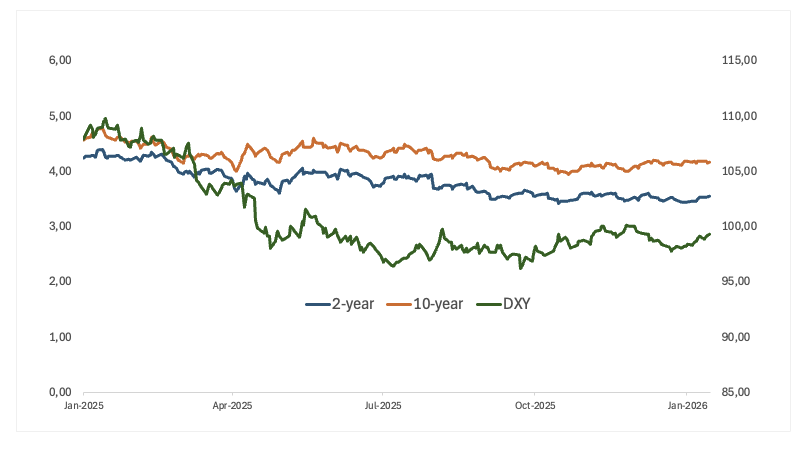
Fed officials strike a cautious balance as policy debate widens
Recent remarks from Fed rate setters underline a growing divergence within the Committee over the appropriate timing of rate cuts, even as most policymakers agree that inflation is easing only gradually and policy must remain restrictive for now. While some officials are increasingly open to easing later this year if forecasts play out, others remain firmly focused on the risk that inflation proves more persistent than expected.
On the more dovish side, Anna Paulson (Philadelphia, voter) argued that further rate cuts later this year would be appropriate if the outlook evolves as anticipated. She expressed cautious optimism on inflation, which she expects to be close to 2% by year-end, and described current policy as only slightly restrictive. Paulson sees US growth around 2% this year, albeit uneven, with inflation moderating further and the labour market stabilising into 2026, an economy that is “bending but not breaking”.
Similarly, Austan Goolsbee (Chicago, non-voter) said the Fed should remain focused on bringing inflation down, while pointing to continued resilience in the labour market. His comments kept the door open to rate cuts later this year, provided disinflation continues and labour-market conditions remain solid.
FOMC Governor Michelle Bowman (permanent voter) sent a more nuanced message. She said that the Fed should be ready to cut rates again if the labour market weakens quickly, which it could. Bowman, on the other hand, stressed that her base case is still positive: steady growth and a return to near-full employment as policy becomes less strict over time. She also pointed out that the risks of inflation are going down, especially as the effects of trade tariffs wear off.
On the other hand, some officials spoke in a very hawkish way. Neel Kashkari (Minneapolis, voter) said that rates should stay the same for now because the economy is strong enough to show that policy is not too tight. He said that cutting too soon could be a bad idea because inflation is still high and trade tariffs could keep prices high for longer, potentially keeping inflation above target for two to three more years.
Raphael Bostic (Atlanta, non-voter) echoed this concern, stating that the fight against inflation is "not over yet" and that policy should remain restrictive. Bostic also warned that fiscal tailwinds, including tax cuts introduced last year, could support growth into 2026 and sustain demand-driven inflation pressures.
The most hawkish remarks came from Jeff Schmid (Kansas City, voter), who argued forcefully against rate cuts, describing inflation as still “too hot.” Schmid warned that policy and fiscal dynamics risk adding further momentum to demand that already exceeds supply, and reiterated his view that recent labour market cooling is structural rather than cyclical, something that easier monetary policy would not fix.
Bottom line: While a gradual shift towards rate cuts later this year remains possible, particularly if inflation continues to edge lower, the overall message from Fed officials suggests no urgency to ease. The Committee remains divided, with inflation risks and the durability of disinflation still central to the policy debate.
So far, implied rates point to no more than around 45 basis points of easing this year, while a rate cut at the January 28 gathering is practically ruled out.
Falling US inflation: A mirage?
The latest US inflation data showed both the headline Consumer Price Index (CPI) and the core print advancing by 2.7% and 2.6%, respectively, in the year to December, both prints matching their previous month’s advance.
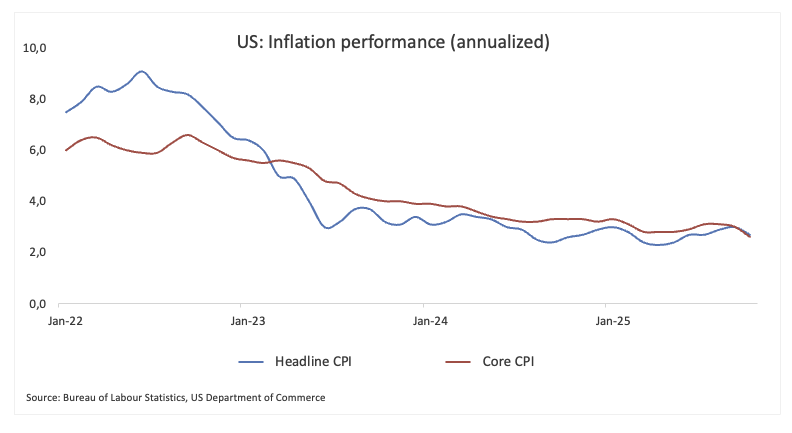
Investors saw this set of data releases as a confirmation of further interest rate cuts in the upcoming months, despite the impact of US tariffs on the cost of living of Americans still remaining far from clear, and several Fed officials still warning that inflation does remain elevated and quite above the bank’s 2.0% goal.
Threats to the Fed's independence weigh on the buck
Earlier in the week, the Greenback suffered another bout of weakness following reports that the Justice Department could seek to indict Chair Jerome Powell over remarks he made to Congress about cost overruns tied to a renovation project at the Federal Reserve headquarters.
On this, Powell pushed back, describing the move as a pretext aimed at gaining leverage over interest-rate decisions, something President Trump has openly advocated.
Adding to the uncertainty, Trump said that potential candidates to succeed Powell could be named in the coming weeks.
What’s in store for the US Dollar
The spotlight next week will be firmly on US PCE inflation, alongside the flash PMI readings, which should offer an early snapshot of how business activity is shaping up at the start of the year.
There will be no fresh signals from the Fed, however, as officials have now entered the customary blackout period ahead of the late-January policy meeting.
Technical landscape
After bottoming out around 97.70 on December 24, the US Dollar Index (DXY) has staged a solid rebound. The recovery has seen the DXY not only regain the 99.00 handle, but also push decisively back above its key 200-day Simple Moving Average (SMA) near 98.70.
That break higher keeps the technical bias constructive and opens the door to a potential retest of the November 2025 peak at 100.39. A clear move through that level would shift attention towards the May 2025 high at 101.97.
Looking south, the first level of support is at the December low of 97.74. If there is a bigger sell-off, the index could go back to the 2025 bottom at 96.21 (September 17). If it breaks through that level, it will meet deeper support at the February 2022 floor at 95.13, and then at the 2022 valley at 94.62.
The Relative Strength Index (RSI) is still close to 63, and the Average Directional Index (ADX) is close to 19, which means that the current trend still has some strength.
-1768588752546-1768588752550.png)
Bottom line
The US Dollar has found a second wind over the past couple of weeks, with momentum clearly tilting back in its favour, at least for now. Part of that support comes from a cluster of Fed officials who continue to lean hawkish, helping to anchor the greenback in the near term.
Policymakers appear especially focused on the labour market, watching closely for any signs of material weakness. But inflation remains very much part of the equation. Price pressures are still running hotter than the Fed would like, and if progress on disinflation stalls, expectations for early or aggressive rate cuts could quickly be pushed further down the road.
That would point to a more cautious Fed and a firmer Greenback, regardless of the political backdrop.
Fed FAQs
Monetary policy in the US is shaped by the Federal Reserve (Fed). The Fed has two mandates: to achieve price stability and foster full employment. Its primary tool to achieve these goals is by adjusting interest rates. When prices are rising too quickly and inflation is above the Fed’s 2% target, it raises interest rates, increasing borrowing costs throughout the economy. This results in a stronger US Dollar (USD) as it makes the US a more attractive place for international investors to park their money. When inflation falls below 2% or the Unemployment Rate is too high, the Fed may lower interest rates to encourage borrowing, which weighs on the Greenback.
The Federal Reserve (Fed) holds eight policy meetings a year, where the Federal Open Market Committee (FOMC) assesses economic conditions and makes monetary policy decisions. The FOMC is attended by twelve Fed officials – the seven members of the Board of Governors, the president of the Federal Reserve Bank of New York, and four of the remaining eleven regional Reserve Bank presidents, who serve one-year terms on a rotating basis.
In extreme situations, the Federal Reserve may resort to a policy named Quantitative Easing (QE). QE is the process by which the Fed substantially increases the flow of credit in a stuck financial system. It is a non-standard policy measure used during crises or when inflation is extremely low. It was the Fed’s weapon of choice during the Great Financial Crisis in 2008. It involves the Fed printing more Dollars and using them to buy high grade bonds from financial institutions. QE usually weakens the US Dollar.
Quantitative tightening (QT) is the reverse process of QE, whereby the Federal Reserve stops buying bonds from financial institutions and does not reinvest the principal from the bonds it holds maturing, to purchase new bonds. It is usually positive for the value of the US Dollar.
Author

Pablo Piovano
FXStreet
Born and bred in Argentina, Pablo has been carrying on with his passion for FX markets and trading since his first college years.

















