US Dollar Weekly Forecast: Will tariffs finally turn up in inflation data?
- The US Dollar traded on the back foot, resuming its weekly downtrend.
- The Federal Reserve is expected to trim its interest rate this month.
- Markets’ attention now gyrates to the release of US CPI data.

The week that was
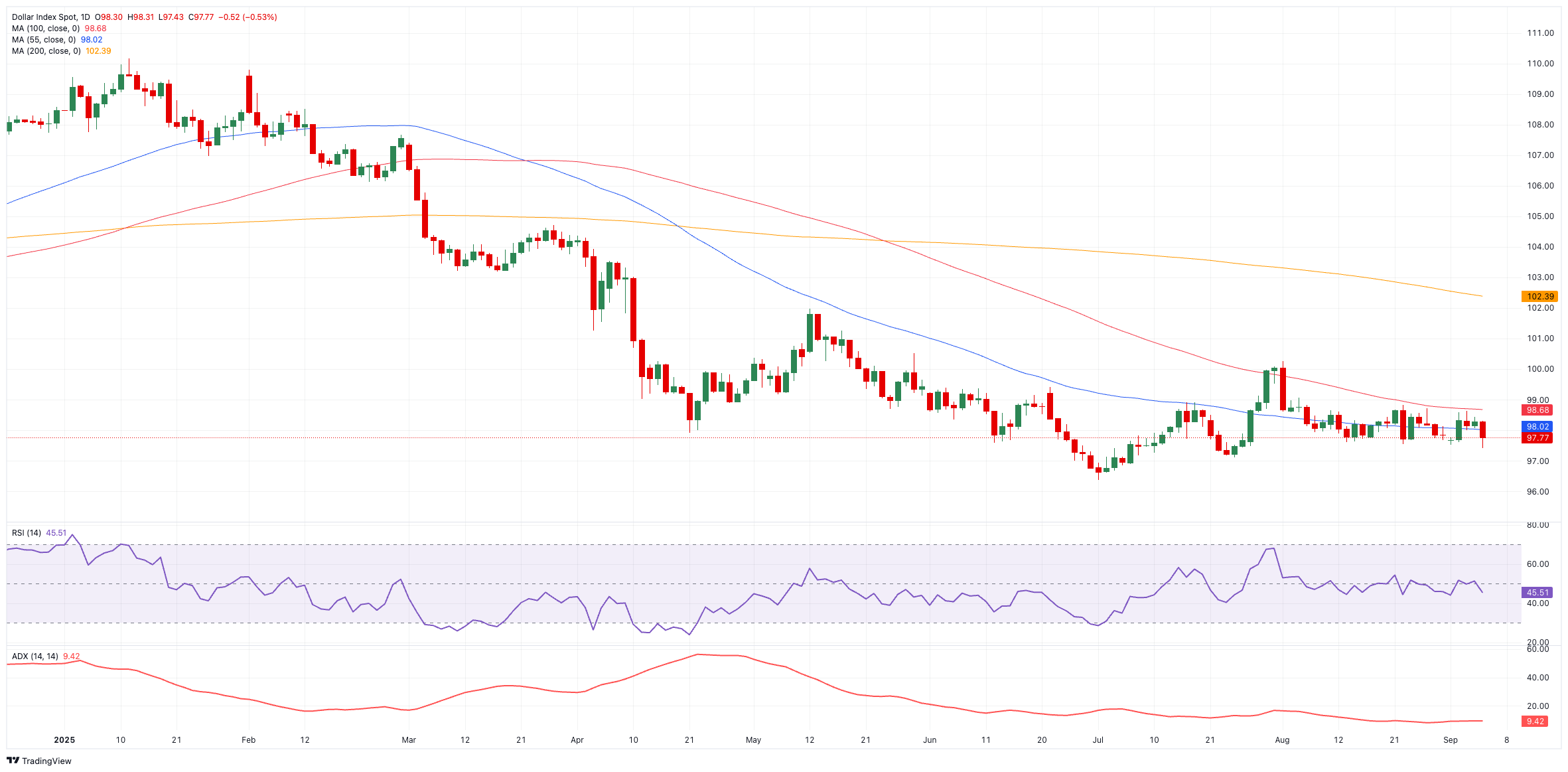
The US Dollar (USD) couldn’t find its footing last week, dragging the US Dollar Index (DXY) down to the lower end of its monthly range near 97.40. On a longer view, the picture doesn’t look much brighter: the index has only managed gains in two months this year (January and July) and remains stuck below 98.
Treasury yields told the same story, with a sharp correction across the curve. Short and mid-dated maturities slipped back to levels last seen in early April, while the long end tested fresh multi-week lows.
Politics looms over the Fed
Markets are also nervous about the Fed’s independence. US President Trump has been ratcheting up pressure, firing the Bureau of Labor Statistics commissioner, accusing the agency of “rigging” jobs data, and pushing allies like Stephen Miran into key roles. Governor Christopher Waller has even emerged as Trump’s preferred candidate to replace Fed Chair Jerome Powell down the line.
That backdrop keeps alive the risk of a more politicised Fed, one that could be more willing to deliver the cuts Trump wants.
Markets bet on September cut
Speculation over a September rate cut has only grown since July’s weak Nonfarm Payrolls (NFP) report, which showed just 79K jobs added. The August release reinforced the case, with payrolls up a meagre 22K and the Unemployment Rate ticking up to 4.3%.
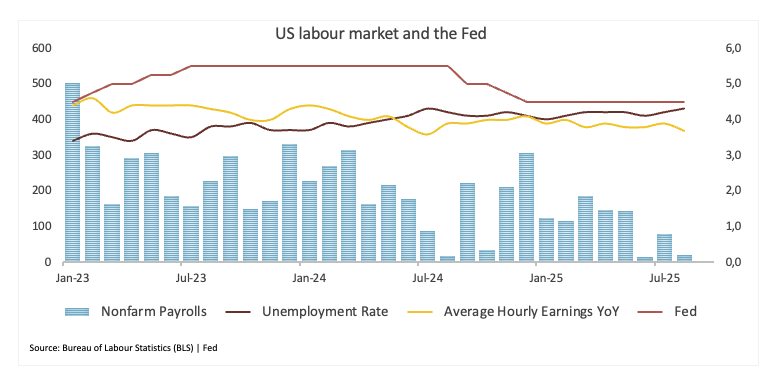
Powell himself shifted the emphasis at Jackson Hole on August 22, saying that the Fed’s focus is tilting more toward the health of the labour market. Inflation still matters, but it’s no longer the only guidepost. Traders have taken the hint: markets are now almost fully pricing in a cut at the September 16–17 meeting, with about 151 basis points of easing priced in through the end of 2026.
Tariffs may hurt more than they help
Tariffs remain a wild card. They may deliver short-term political wins, but the longer they stay in place the more they risk driving up household costs and dragging on growth. Some in Trump’s circle appear relaxed about a weaker US Dollar to help exports, but reshoring manufacturing is a long, expensive process that tariffs alone won’t fix.
Fed holds its line, for now
At its July 30 meeting, the Fed kept rates unchanged at 4.25%–4.50% for a fifth straight time. Powell described the labour market as “effectively at full employment” but said tariffs and sticky inflation justified keeping policy “modestly restrictive”. Still, he left the door open for a cut in September if jobs data continued to weaken.
Fed officials weigh in
Officials echoed that mixed message. Waller doubled down on his call for a September cut, saying the labour market was clearly softening. Musalem said hiring trends worried him more than inflation at this stage. Bostic flagged inflation as the Fed’s main risk but still backed one quarter-point cut this year. Kashkari admitted policy was getting harder to calibrate. Williams said gradual easing could make sense if his forecast of a mild rise in unemployment and softer inflation holds, while Goolsbee said he wasn’t sure a September cut was right given tariff uncertainties.
Together, the comments suggest the Fed is leaning toward a September move, but it remains deeply divided over what happens next.
What’s next for the Dollar?
This week’s focus turns squarely to US inflation data, with both CPI and PPI on deck. Weekly Jobless Claims will also add colour. Fed officials, meanwhile, will stay quiet as the blackout period begins ahead of the September meeting.
Technical outlook: bears still in control
The technical setup doesn’t look friendly for the Dollar. If the DXY breaks below its 2025 valley at 96.37 (July 1), the next checkpoints sit at the February 2022 base of 95.13 (February 4) and the 2022 bottom at 94.62 (January 14).
On the topside, the August high at 100.26 (August 1) is the first big hurdle. Clearing it would put the May weekly peak at 100.54 (May 29) and the May ceiling at 101.97 (May 12) back in play.
For now, the index remains capped below both the 200-day SMA (102.39) and the 200-week SMA (103.19), keeping the broader bias tilted lower. Momentum indicators echo that view: the RSI has cooled to around 45, showing fading bullish energy, while the ADX near 11 signals a market without a strong trend.
US Dollar Index (DXY) daily chart
Bottom line
The Dollar’s weakness reflects more than just weak data. Political pressure on the Fed, tariff risks, and swelling government debt are all clouding sentiment. Even when the Greenback rallies, those gains don’t stick for long. Most strategists still see more downside ahead, though with net shorts already built up, a lot of the bearish story may already be priced in, limiting how far the slide can extend.
Author

Pablo Piovano
FXStreet
Born and bred in Argentina, Pablo has been carrying on with his passion for FX markets and trading since his first college years.

















