US Dollar Weekly Forecast: It’s all about the labour market now
- The US Dollar snapped a three-week negative streak.
- Trump’s attacks on the Fed’s independence remained unabated.
- Markets’ focus now shifts to the upcoming labour market report.

The week the US Dollar tried to bounce
The US Dollar clawed back some ground this week after three straight weekly losses. Still, it’s stuck near the bottom of its yearly range, with the Dollar Index (DXY) holding below 98. On a monthly view, the pullback remains steep, only briefly interrupted by July’s rebound.
Trump vs. the Fed
Trade headlines were quiet, apart from tariff threats on India. Instead, the focus was back on Washington. President Trump tried to oust Federal Reserve (Fed) Governor Lisa Cook, who is now suing to keep her seat, and is pushing to install more dovish allies at the central bank. Short-term yields fell as markets priced in easier policy ahead.
Powell’s position looks safe for now, as his term runs until 2026, but the bigger fight over Fed independence is clearly heating up.
A more political central bank?
Trump’s latest moves have raised fears about a politicised Fed. He fired the Bureau of Labor Statistics commissioner after accusing the agency of “rigging” jobs data, and he continues to clash with Powell. He’s also nominating loyalists like Stephen Miran to key roles, while Christopher Waller has emerged as his preferred candidate to eventually replace Powell. The risk: a central bank more open to delivering the rate cuts Trump wants.
Tariffs: Short-term gain, long-term pain
Tariffs may score political points, but the economic cost could mount. So far, consumers haven’t felt a major hit, but if levies persist, groceries and essentials will get pricier, household budgets will tighten, and growth could suffer. Some in Trump’s team even seem comfortable with a weaker Dollar to boost exports — but reshoring US manufacturing will take years, heavy investment, and more than just tariffs.
Fed holds steady
At its July 30 meeting, the Fed kept rates unchanged at 4.25%–4.50% for the fifth straight time. Powell said the labour market is “effectively at full employment”, but with inflation still sticky — and tariffs muddying the picture — policy needs to stay “modestly restrictive”.
At Jackson Hole on August 22, Powell hinted at the possibility of a September cut if the jobs data deteriorates but emphasised that no decision has been made. Upcoming releases of Nonfarm Payrolls (September 5) and fresh inflation data the following week will be crucial.
Mixed messages from Fed officials
- John Williams (New York) said rates may fall eventually, but the Fed needs more data before moving.
- Tom Barkin (Richmond) expects only a modest adjustment, given steady growth.
- Lorie Logan (Dallas) urged better communication on the policy outlook.
Markets are leaning toward at least one September cut, but officials keep stressing “data dependence”.
With core inflation still around 3% and a tariff shock in train, a September cut risks looking premature unless the next data round weakens decisively. Powell’s messaging leaves space to move if needed, but the bias is to wait for confirmation, not to pre-commit.
Translation: the bar for a September cut is higher than pricing implies
What’s next for the Dollar?
Next week, all eyes will be focused on the US labour market, particularly on Nonfarm Payrolls. The ISM surveys for manufacturing and services will also be closely watched.
Technical picture
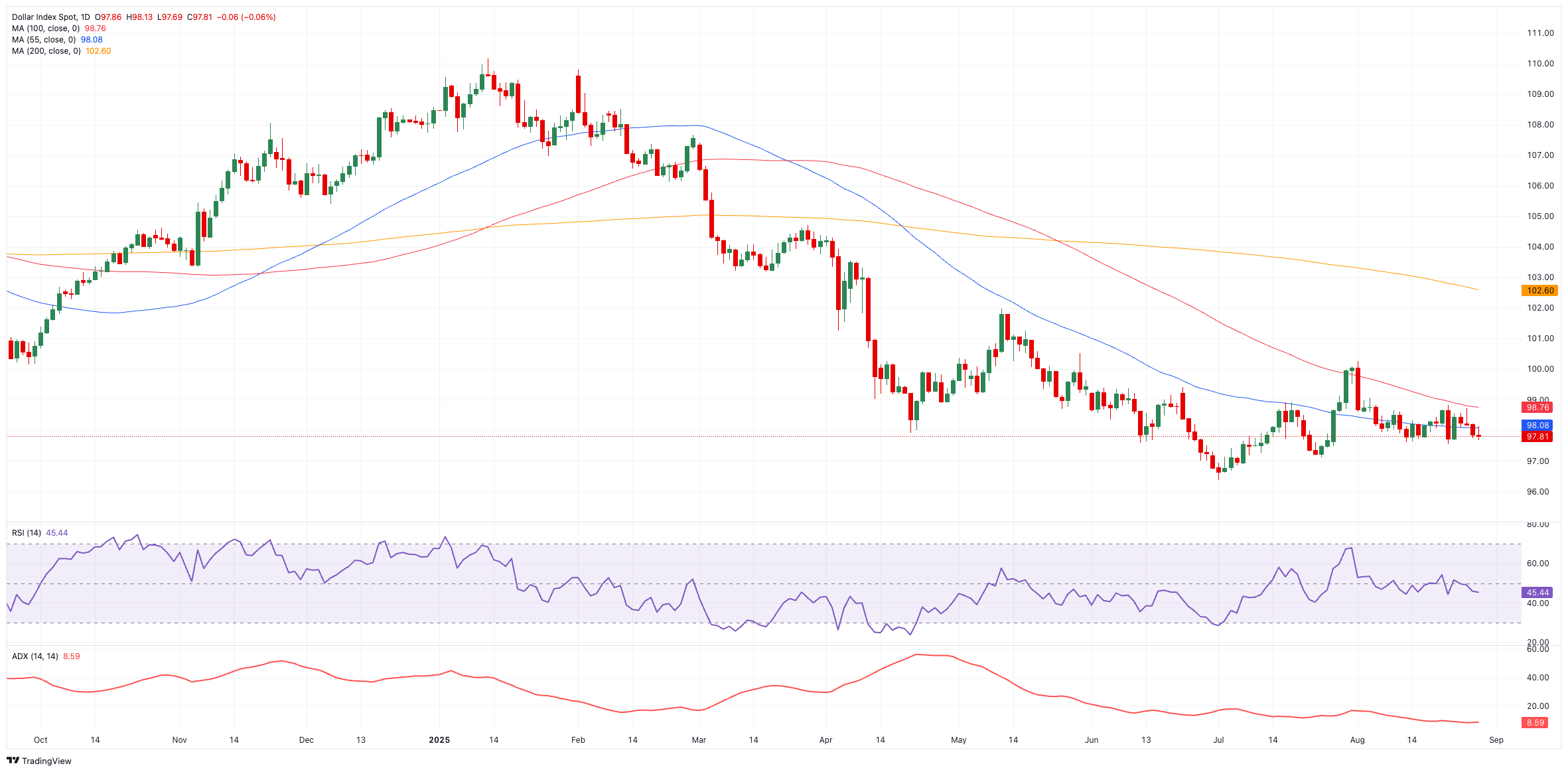
The charts don’t look friendly for the Dollar.
If the DXY slips below its multi-year low of 96.37 reached on July 1, the next stops could be 95.13 and 94.62.
On the flip side, the August high at 100.26 is the first big hurdle. A clean break there would open the way to 100.54 and then the May peak at 101.97.
For now, the index is stuck under its 200-day and 200-week SMAs, at 102.62 and 103.17, respectively, keeping the broader bias tilted down.
Momentum signals back that view: the Relative Strength Index (RSI) has cooled to about 45, showing fading bullish energy, while the Average Directional Index (ADX) is sitting near 11, a level that signals the market lacks a strong trend.
DXY daily chart
Bottom line
The US Dollar’s weakness reflects more than market flows. Trump’s tariff threats, clashes with Powell, and swelling federal debt all weigh on sentiment. Even when the currency rallies, gains rarely stick. Against the backdrop of policy uncertainty and political pressure on the Fed, most strategists still see more downside than upside for the buck.
Nonfarm Payrolls FAQs
Nonfarm Payrolls (NFP) are part of the US Bureau of Labor Statistics monthly jobs report. The Nonfarm Payrolls component specifically measures the change in the number of people employed in the US during the previous month, excluding the farming industry.
The Nonfarm Payrolls figure can influence the decisions of the Federal Reserve by providing a measure of how successfully the Fed is meeting its mandate of fostering full employment and 2% inflation. A relatively high NFP figure means more people are in employment, earning more money and therefore probably spending more. A relatively low Nonfarm Payrolls’ result, on the either hand, could mean people are struggling to find work. The Fed will typically raise interest rates to combat high inflation triggered by low unemployment, and lower them to stimulate a stagnant labor market.
Nonfarm Payrolls generally have a positive correlation with the US Dollar. This means when payrolls’ figures come out higher-than-expected the USD tends to rally and vice versa when they are lower. NFPs influence the US Dollar by virtue of their impact on inflation, monetary policy expectations and interest rates. A higher NFP usually means the Federal Reserve will be more tight in its monetary policy, supporting the USD.
Nonfarm Payrolls are generally negatively-correlated with the price of Gold. This means a higher-than-expected payrolls’ figure will have a depressing effect on the Gold price and vice versa. Higher NFP generally has a positive effect on the value of the USD, and like most major commodities Gold is priced in US Dollars. If the USD gains in value, therefore, it requires less Dollars to buy an ounce of Gold. Also, higher interest rates (typically helped higher NFPs) also lessen the attractiveness of Gold as an investment compared to staying in cash, where the money will at least earn interest.
Nonfarm Payrolls is only one component within a bigger jobs report and it can be overshadowed by the other components. At times, when NFP come out higher-than-forecast, but the Average Weekly Earnings is lower than expected, the market has ignored the potentially inflationary effect of the headline result and interpreted the fall in earnings as deflationary. The Participation Rate and the Average Weekly Hours components can also influence the market reaction, but only in seldom events like the “Great Resignation” or the Global Financial Crisis.
Author

Pablo Piovano
FXStreet
Born and bred in Argentina, Pablo has been carrying on with his passion for FX markets and trading since his first college years.














